How to Read the Year
Why does the surrender of Jerusalem make 637 a year about sacred geography and early Islamic rule?
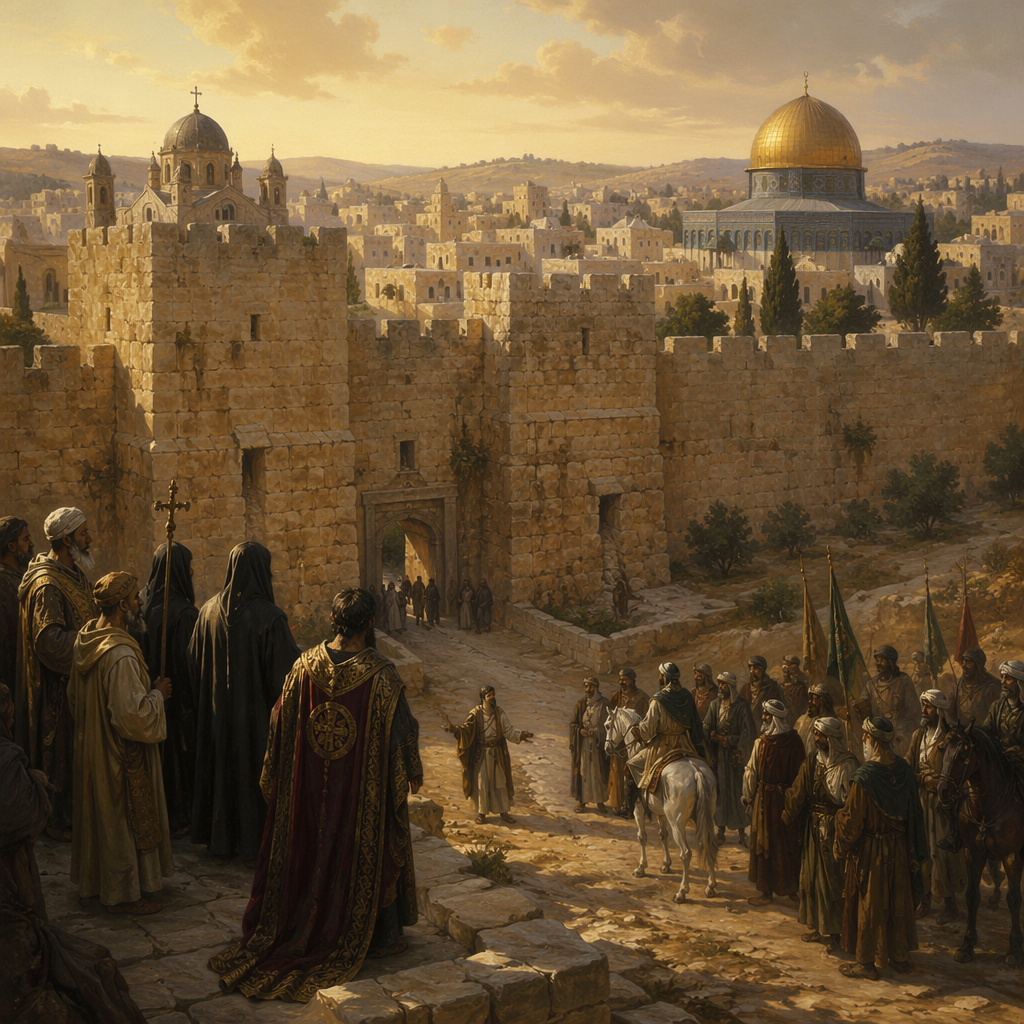
637 is anchored by the Rashidun conquest of Jerusalem, a moment when one of the eastern Mediterranean's most sacred cities entered the early Islamic political world. The date matters because it concentrates several layers at once: Byzantine-Sasanian exhaustion, Arab-Muslim military expansion, Christian sacred memory, Jewish sacred geography, and the emerging authority of the caliphate.
A careful reading avoids treating the conquest as a simple battlefield scene. Jerusalem's surrender involved negotiation, urban communities, religious institutions, imperial prestige, and the practical question of how a new ruling power would govern a city with older sacred claims. Control of walls was only one part of the story.
637 also points forward to Umayyad Jerusalem. The Dome of the Rock, Abd al-Malik, pilgrimage routes, and later Muslim, Christian, and Jewish memories all gave the city continuing political and religious weight. A year page can use 637 to show why one city kept gathering meaning after the immediate conquest.
A careful reading separates seventh-century events from later conflicts. The date belongs to late antique and early Islamic history, but later communities repeatedly reused Jerusalem's past for their own arguments. The origin needs to be understood without importing every later dispute back into the moment.
The year becomes clearer when it is placed after long imperial exhaustion. Byzantine and Sasanian war had disrupted the region before Arab-Muslim armies entered the scene, so Jerusalem's transition was not an isolated surprise. It belonged to a wider late antique rearrangement in which armies, taxation, sacred authority, urban elites, and communities had to decide how to live under changing power. That wider frame makes 637 a doorway into early Islam and into the eastern Mediterranean after the great Roman-Persian rivalry.
A reader can then follow the city's practical transition: tribute arrangements, community protection, worship, tax obligations, and administrative language mattered as much as the military handover. Sacred geography became daily governance.
637 CE in History gathers events that help readers move from a single date into wider historical patterns. A useful year entry does more than answer what happened; it shows why people keep using the year as a marker for change.
The connected events show how decisions, institutions, conflicts, ideas, and consequences crossed beyond one location or one person. The event links explain the immediate story, while the topic routes and timelines show what came before and after.
The year also helps organize broad questions. It gives readers a concise answer and a direct path into deeper event pages where causes, turning points, consequences, maps, and references are easier to inspect.
Read the date in three passes. First ask what happened inside the year itself. Then ask which older pressures made the event possible. Finally ask which later pages reuse the same vocabulary, institutions, borders, technologies, or memories. That sequence keeps the page from becoming a trivia answer.
Even when only one event is currently attached, the year still has a job: it gives students and curious visitors a stable chronological doorway into the atlas. The page makes the doorway useful by pointing to the event, the topic route, the timeline, the map, and the evidence trail that can turn a date into a broader explanation.
This year matters because it connects Rashidun Conquest of Jerusalem to a wider sequence of causes and consequences. It gives the reader a chronological anchor while still pointing outward to people, places, institutions, and later effects. A thin year page would only name the event; a useful year page explains why this date is a handle for a larger route through history. 637 matters because it gives readers a concrete entry into early Islamic expansion through a city whose meaning was already layered before the conquest and became even more layered afterward. The year connects caliphal authority, Byzantine transition, sacred geography, negotiation, urban rule, and the long memory of Jerusalem.
Reader Lenses
Look for the pressures that made change possible.
Identify who acted and what options were available.
Follow what changed after the event.
Ask why this date still appears in historical summaries.
Keep Jewish, Christian, and emerging Islamic meanings visible without flattening them into one later conflict.
Ask how negotiation, protection, tribute, community leadership, and military pressure shaped urban transition.
Follow how 637 points toward Umayyad monuments, pilgrimage, memory, and later claims about Jerusalem.
Read the conquest after Byzantine-Sasanian exhaustion, not as a disconnected military episode.
How This Year Connects
637 CE in History is anchored by Rashidun Conquest of Jerusalem. Read those pages together and the year stops being a date label; it becomes a crossroads where immediate choices met older pressures and opened later consequences.
The setting matters as much as the date. The year moves through Jerusalem and belongs to Early Islamic World. That combination helps readers avoid treating the year as isolated; geography, institutions, conflict, belief, economy, and communication all shape what a date can mean.
The year also opens into people and themes. Figures such as Umar ibn al-Khattab and Sophronius of Jerusalem appear because their choices made the year visible, while themes such as Rashidun Caliphate, Islamic World, Byzantine Empire, and Jerusalem explain why the consequences outlived the moment. A useful next step is usually an event page, then a topic route, then a timeline.
Evidence changes the way a date reads. A treaty, battle report, inscription, newspaper, census, court record, memoir, photograph, or archaeological trace does not answer the same question. Looking at source type helps separate what happened in the year from how later people remembered it.
A year page is most useful when it keeps two scales open at once. The first scale is immediate: what happened, where, and who was involved. The second scale is interpretive: why later readers use this date to organize a wider story. Holding both scales together makes the page a starting point for deeper reading rather than a dead-end answer.
The before-and-after frame matters too. A date rarely begins the forces it reveals. Earlier pressures made the linked event possible, while later pages show which effects were temporary, which became institutions, and which turned into memory. Reading the year this way helps students avoid the false impression that history changes only when the calendar flips.
Use this page as a junction. If the event feels too brief, follow the topic route for background; if the cause feels too abstract, open the event page for sequence; if the consequence feels larger than the date, move into the timeline. The value of a year page is that it lets readers change scale without losing their place.
Read 637 beside Muhammad, Umar/Rashidun routes where available, Abd al-Malik, the Dome of the Rock, Karbala, and early Islam pages. That sequence keeps conquest, administration, sacred place, and memory together.
Then compare 637 with 691, 1099, 1453, and 1517 where available. The comparison asks how cities become sacred, strategic, and political across changing empires.
The safest reading path is chronological first and comparative second: start with late antiquity and early Islam, then compare later Jerusalem moments only after the seventh-century setting is clear.
Events in This Year
- 637 CERashidun Conquest of Jerusalem
Jerusalem surrendered to the Rashidun caliphate after Byzantine control in the Levant weakened, placing one of the eastern Mediterranean's most sacred cities inside the expanding Islamic political world.
Map Layer
637 CE in History geography
Gold pins mark the approximate locations of published event pages. This is a schematic locator map, not a historical border map.
Coordinates are approximate and are used to help readers orient themselves before opening a full event page.
References
Where to Check the Facts
- Encyclopaedia Britannica: Islamic world, conversion and crystallizationReference for early Islamic expansion, Umayyad-Abbasid transition, conversion, and social change.
- The Metropolitan Museum of Art: Trade and Travel in the Islamic WorldReference for Islamic-world land and sea paths, travel, and exchange with China, the Near East, and Indian Ocean networks.
- Encyclopaedia Britannica: RashidunReference for the first four caliphs and early Islamic expansion beyond Arabia.
- Encyclopaedia Britannica: Jerusalem, HistorySpecific reference for Jerusalem's late antique history, Byzantine rule, Muslim conquest, and sacred urban setting.