How to Read the Year
Why does 1947 make decolonization and containment unfold together?
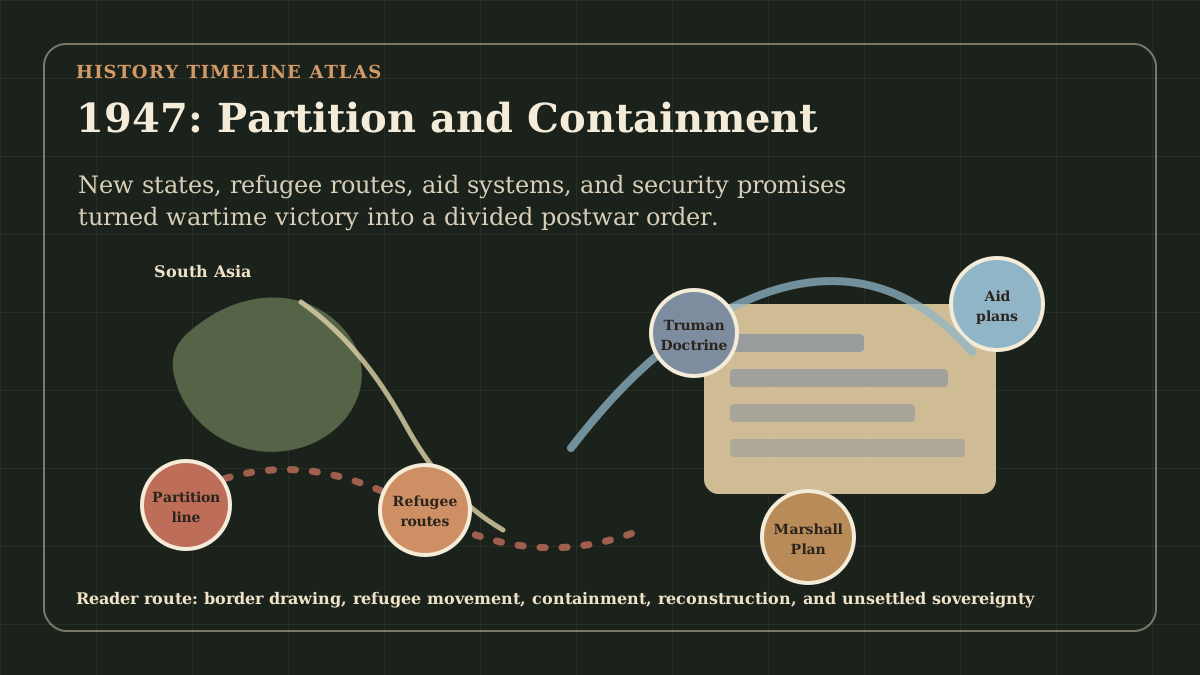
1947 joins Indian independence and partition with the Truman Doctrine and Marshall Plan. The year is not only the beginning of postwar recovery or the end of British rule in South Asia. It shows two enormous transitions at once: empire giving way to new states, and the United States defining a Cold War role through containment and reconstruction.
Partition keeps the human cost of state formation visible. Independence created India and Pakistan, but it also produced mass migration, communal violence, refugee crisis, trauma, and border disputes that outlived the formal transfer of power. Freedom and catastrophe belonged to the same historical moment.
The Truman Doctrine and Marshall Plan show postwar order being built through money, security promises, ideology, and institutional design. Greece, Turkey, Western Europe, Congress, aid programs, and fear of communist expansion all mattered. Reading these events beside partition makes 1947 a year about how new orders are made, defended, and wounded at the same time.
The year also teaches caution about clean beginnings. A flag ceremony, a presidential speech, or an aid announcement can look decisive, but refugees, administrators, soldiers, farmers, and border communities lived through consequences that took years to settle.
South Asia's transition depended on hurried administrative work as well as public celebration. Boundary commissions, census categories, police capacity, rail schedules, refugee camps, property records, princely-state negotiations, and the future of Kashmir all turned independence into a practical emergency. The new states had to become governments while people were still moving, grieving, and searching for missing relatives.
Partition also changed gendered memory. Abduction, sexual violence, family separation, recovery operations, silence, honor language, and later testimony show that state borders entered intimate life. A serious year page keeps those experiences visible because the cost of nation-making was carried not only by leaders and soldiers, but by households and bodies.
The Cold War side also had a domestic audience. Truman had to persuade Congress and voters that aid to Greece and Turkey and reconstruction in Europe were not charity alone, but a defense of a political order. Dollars, food, loans, planning offices, propaganda, and alliance thinking made containment material before NATO existed.
Reading both halves together prevents a tidy postwar map. In one region, the end of empire produced sovereignty and mass displacement; in another, reconstruction money helped stabilize states and markets. Both were state-making projects, and both show how 1947 turned wartime victory into hard institutional choices.
1947 CE in History gathers events that help readers move from a single date into wider historical patterns. A useful year entry does more than answer what happened; it shows why people keep using the year as a marker for change.
The connected events show how decisions, institutions, conflicts, ideas, and consequences crossed beyond one location or one person. The event links explain the immediate story, while the topic routes and timelines show what came before and after.
The year also helps organize broad questions. It gives readers a concise answer and a direct path into deeper event pages where causes, turning points, consequences, maps, and references are easier to inspect.
Read the date in three passes. First ask what happened inside the year itself. Then ask which older pressures made the event possible. Finally ask which later pages reuse the same vocabulary, institutions, borders, technologies, or memories. That sequence keeps the page from becoming a trivia answer.
Even when only one event is currently attached, the year still has a job: it gives students and curious visitors a stable chronological doorway into the atlas. The page makes the doorway useful by pointing to the event, the topic route, the timeline, the map, and the evidence trail that can turn a date into a broader explanation.
This year matters because it connects Indian Independence and Partition, Truman Doctrine, Marshall Plan Announced to a wider sequence of causes and consequences. It gives the reader a chronological anchor while still pointing outward to people, places, institutions, and later effects. A thin year page would only name the event; a useful year page explains why this date is a handle for a larger route through history. 1947 matters because it links decolonization, partition, refugee history, containment, reconstruction, and the early Cold War. The year helps readers see that the postwar world was not one settlement; it was several overlapping projects with different human costs.
Reader Lenses
Look for the pressures that made change possible.
Identify who acted and what options were available.
Follow what changed after the event.
Ask why this date still appears in historical summaries.
Keep migration, violence, borders, families, and memory beside the celebration of independence.
Track how U.S. policy linked aid, security, ideology, and congressional persuasion.
Ask how freedom, reconstruction, and rivalry could all expand in the same year.
How This Year Connects
1947 CE in History is anchored by Indian Independence and Partition, Truman Doctrine, and Marshall Plan Announced. Read those pages together and the year stops being a date label; it becomes a crossroads where immediate choices met older pressures and opened later consequences.
The setting matters as much as the date. The year moves through South Asia, Washington, D.C., and Cambridge, Massachusetts and belongs to Twentieth Century and Cold War. That combination helps readers avoid treating the year as isolated; geography, institutions, conflict, belief, economy, and communication all shape what a date can mean.
The year also opens into people and themes. Figures such as Mahatma Gandhi, Jawaharlal Nehru, Muhammad Ali Jinnah, Harry Truman, and George C. Marshall appear because their choices made the year visible, while themes such as India, Pakistan, Partition, Cold War, Containment, and United States explain why the consequences outlived the moment. A useful next step is usually an event page, then a topic route, then a timeline.
Evidence changes the way a date reads. A treaty, battle report, inscription, newspaper, census, court record, memoir, photograph, or archaeological trace does not answer the same question. Looking at source type helps separate what happened in the year from how later people remembered it.
A year page is most useful when it keeps two scales open at once. The first scale is immediate: what happened, where, and who was involved. The second scale is interpretive: why later readers use this date to organize a wider story. Holding both scales together makes the page a starting point for deeper reading rather than a dead-end answer.
The before-and-after frame matters too. A date rarely begins the forces it reveals. Earlier pressures made the linked event possible, while later pages show which effects were temporary, which became institutions, and which turned into memory. Reading the year this way helps students avoid the false impression that history changes only when the calendar flips.
Use this page as a junction. If the event feels too brief, follow the topic route for background; if the cause feels too abstract, open the event page for sequence; if the consequence feels larger than the date, move into the timeline. The value of a year page is that it lets readers change scale without losing their place.
Read 1947 beside Indian independence and partition, Gandhi, Nehru, Jinnah, Truman Doctrine, Marshall Plan, modern South Asia, and Cold War routes.
Then compare 1947 with 1919, 1945, 1949, 1955, 1960, and 1971. The comparison asks how settlements create states, alliances, borders, aid systems, and unresolved wounds.
Events in This Year
- August 1947Indian Independence and Partition
British India became independent as India and Pakistan, while partition produced mass migration, communal violence, and unresolved border questions.
- March 1947Truman Doctrine
President Harry Truman asked Congress to support Greece and Turkey, framing American policy around containing communist expansion.
- June 1947Marshall Plan Announced
The United States announced a European recovery program that offered aid for reconstruction and helped stabilize western European economies after World War II.
Map Layer
1947 CE in History geography
Gold pins mark the approximate locations of published event pages. This is a schematic locator map, not a historical border map.
Coordinates are approximate and are used to help readers orient themselves before opening a full event page.
References
Where to Check the Facts
- Encyclopaedia Britannica: Truman DoctrineSpecific reference for the 1947 CE anchor event, chronology, and historical setting.
- Encyclopaedia BritannicaBackground reference for chronology, names, and historical context.
- WikidataStructured reference for dates, places, alternate names, and entity links.