How to Read the Year
Why does 1680 CE in History deserve a focused year page?
The Pueblo Revolt makes 1680 a year about Native strategy, colonial violence, religion, and survival in the northern borderlands of New Spain. The date should not read as a sudden outburst. It followed mission pressure, forced labor, punishment of religious practice, drought, disease, and years of strain under Spanish colonial rule.
Pope and other Pueblo leaders coordinated action across communities that did not always share one language or one political interest. That coordination matters. It shows planning, diplomacy, secrecy, timing, and shared grievance rather than a generic rebellion.
The revolt expelled Spanish authorities from New Mexico for more than a decade. That result gives the year unusual force in colonial history: Indigenous communities did not only resist; they temporarily reversed colonial control and reopened space for their own religious and political life.
A careful reading avoids making Pueblo people appear only in reaction to Europeans. Pueblo worlds had long histories of settlement, agriculture, ceremony, trade, conflict, and adaptation before Spanish missions arrived. The revolt belongs inside that deeper Indigenous history.
The return of Spanish rule in the 1690s does not erase the meaning of 1680. The revolt changed negotiation, memory, mission practice, and Pueblo-Spanish relations. It remains a key date because it shows colonial power as contested and vulnerable.
The causes should stay concrete. Franciscan mission pressure, suppression of ceremonial practice, forced labor, tribute demands, drought, hunger, disease, and punishment of religious leaders all contributed to the crisis. None of those pressures alone explains the revolt. The point is that colonial rule entered daily life through work, worship, land, authority, and fear.
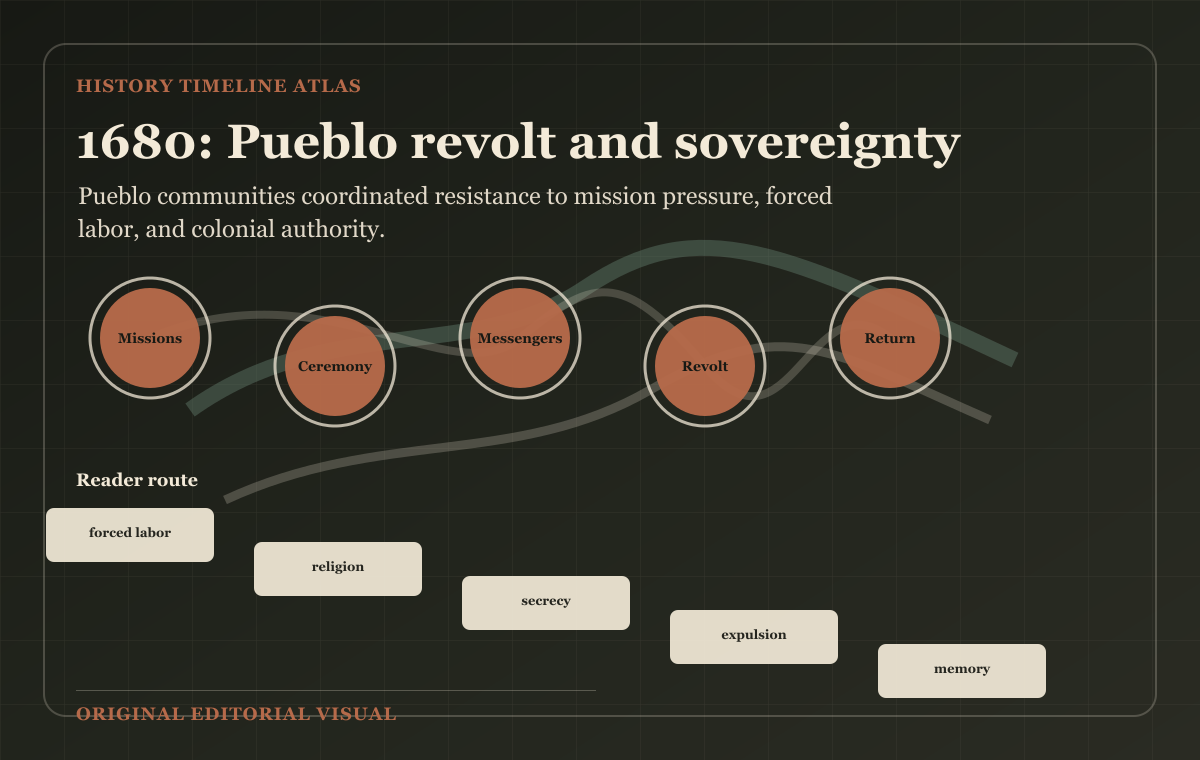
The revolt also shows political intelligence. Coordinating action across pueblos required messengers, timing, trust, secrecy, and the ability to turn local grievances into a shared campaign. That coordination is why 1680 should not be written as spontaneous rage. It was strategy under danger.
The next reading path should move from 1680 to Indigenous sovereignty, Spanish colonialism, mission systems, Pueblo history, Atlantic colonization, and later Native resistance. That path helps readers see the year as part of a broader history of empire and survival, not as an isolated Southwestern episode.
The year also changes the way readers should define power. Colonial rule had soldiers and priests, but Pueblo communities had memory, geography, ceremony, alliance, and the ability to coordinate action across distance.
That is why 1680 belongs in a global atlas: it shows empire from the viewpoint of people who studied colonial weakness and acted on it.
Source perspective also matters. Spanish records often describe rebellion through fear, loss, and official explanation, while Pueblo memory and later scholarship ask different questions about ceremony, autonomy, survival, and the meaning of expelling outsiders. Holding those angles together makes 1680 more than a colonial crisis narrative.
1680 CE in History gathers events that help readers move from a single date into wider historical patterns. A useful year entry does more than answer what happened; it shows why people keep using the year as a marker for change.
The connected events show how decisions, institutions, conflicts, ideas, and consequences crossed beyond one location or one person. The event links explain the immediate story, while the topic routes and timelines show what came before and after.
The year also helps organize broad questions. It gives readers a concise answer and a direct path into deeper event pages where causes, turning points, consequences, maps, and references are easier to inspect.
Read the date in three passes. First ask what happened inside the year itself. Then ask which older pressures made the event possible. Finally ask which later pages reuse the same vocabulary, institutions, borders, technologies, or memories. That sequence keeps the page from becoming a trivia answer.
Even when only one event is currently attached, the year still has a job: it gives students and curious visitors a stable chronological doorway into the atlas. The page makes the doorway useful by pointing to the event, the topic route, the timeline, the map, and the evidence trail that can turn a date into a broader explanation.
This year matters because it connects Pueblo Revolt to a wider sequence of causes and consequences. It gives the reader a chronological anchor while still pointing outward to people, places, institutions, and later effects. A thin year page would only name the event; a useful year page explains why this date is a handle for a larger route through history. 1680 matters because it gives readers a clear case where Indigenous communities coordinated across distance, defeated colonial authority, and forced a renegotiation of power. It belongs in the atlas as more than regional history: it changes how readers understand empire, religion, resistance, and the political intelligence of Native communities under pressure.
Reader Lenses
Look for the pressures that made change possible.
Identify who acted and what options were available.
Follow what changed after the event.
Ask why this date still appears in historical summaries.
Look for messengers, timing, secrecy, and shared grievance across distinct Pueblo communities.
Read mission pressure and ceremonial life as central political issues, not background culture.
Ask what it meant for colonial authority to be expelled rather than merely challenged.
How This Year Connects
1680 CE in History is anchored by Pueblo Revolt. Read those pages together and the year stops being a date label; it becomes a crossroads where immediate choices met older pressures and opened later consequences.
The setting matters as much as the date. The year moves through New Mexico and belongs to Colonial Americas. That combination helps readers avoid treating the year as isolated; geography, institutions, conflict, belief, economy, and communication all shape what a date can mean.
The year also opens into people and themes. Figures such as Po'pay and Pueblo communities appear because their choices made the year visible, while themes such as Pueblo, Spanish Empire, and Resistance explain why the consequences outlived the moment. A useful next step is usually an event page, then a topic route, then a timeline.
Evidence changes the way a date reads. A treaty, battle report, inscription, newspaper, census, court record, memoir, photograph, or archaeological trace does not answer the same question. Looking at source type helps separate what happened in the year from how later people remembered it.
A year page is most useful when it keeps two scales open at once. The first scale is immediate: what happened, where, and who was involved. The second scale is interpretive: why later readers use this date to organize a wider story. Holding both scales together makes the page a starting point for deeper reading rather than a dead-end answer.
The before-and-after frame matters too. A date rarely begins the forces it reveals. Earlier pressures made the linked event possible, while later pages show which effects were temporary, which became institutions, and which turned into memory. Reading the year this way helps students avoid the false impression that history changes only when the calendar flips.
Use this page as a junction. If the event feels too brief, follow the topic route for background; if the cause feels too abstract, open the event page for sequence; if the consequence feels larger than the date, move into the timeline. The value of a year page is that it lets readers change scale without losing their place.
Events in This Year
- 1680Pueblo Revolt
Pueblo communities coordinated a revolt that temporarily expelled Spanish authorities and missionaries from New Mexico.
Map Layer
1680 CE in History geography
Gold pins mark the approximate locations of published event pages. This is a schematic locator map, not a historical border map.
Coordinates are approximate and are used to help readers orient themselves before opening a full event page.
References
Where to Check the Facts
- Smithsonian National Museum of the American Indian: Native Knowledge 360Indigenous-centered educational reference for Native history, sovereignty, community knowledge, and public interpretation.
- Smithsonian NMAI: Haudenosaunee Guide for EducatorsCommunity-consulted educational reference for Haudenosaunee culture, history, continuity, and interpretation.
- Yale History: Ned Blackhawk, The Rediscovery of AmericaIndigenous historian's synthesis for centering Native peoples in broader American historical interpretation.
- Indigenous ChicagoCommunity-partnered public-history project for place-based Native history, maps, memory, and continuity.