Historical Role
Po'pay belongs at the center of the Pueblo Revolt because the story is about coordination, religious survival, and colonial pressure, not a spontaneous local disturbance. Spanish missions, forced labor, punishment of ceremonial life, drought, disease, and the violence of colonial authority created a setting in which revolt became thinkable across communities.
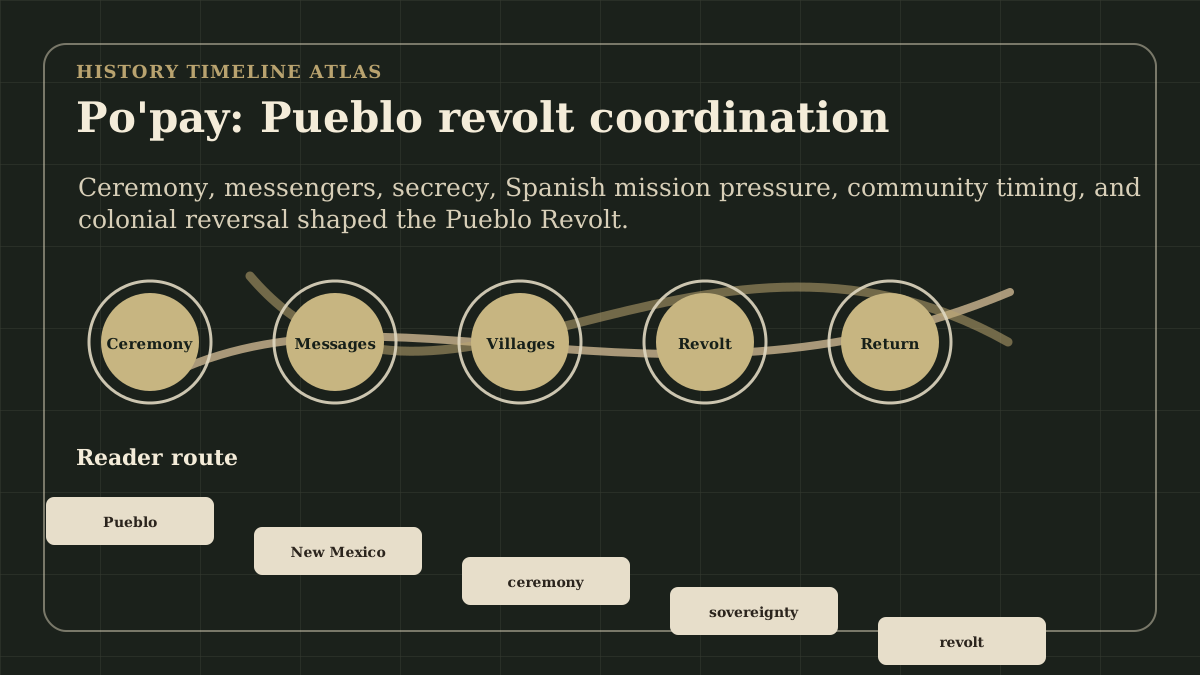
Pueblo diversity stays central. Pueblo communities did not form one simple political unit, and coordination across villages required messengers, secrecy, timing, trust, and shared grievance. Po'pay's importance lies in the ability later memory gives him as organizer: a figure around whom dispersed communities could imagine action at the same moment.
Religion was political here because mission rule reached into bodies, labor, calendars, names, ceremonies, and authority. To suppress Indigenous practice was not only to change worship; it was to reorder community life. That is why the revolt reads as both anti-colonial action and a defense of Pueblo worlds.
The 1680 result gives the biography force. Spanish authorities and missionaries were expelled from New Mexico for more than a decade, making this one of the clearest cases in North American colonial history where Indigenous resistance temporarily reversed colonial rule. The event was not symbolic only; it changed who governed, who could practice openly, and how Spanish return later had to be negotiated.
A careful page also avoids making Po'pay a lone savior. Pueblo women and men, local leaders, messengers, ritual specialists, warriors, and communities carried the revolt. Po'pay becomes historically useful when he helps readers see a network under pressure rather than replacing that network.
The reading path moves from Po'pay to the Pueblo Revolt, then to Indigenous Americas and colonialism routes. That sequence turns a short biography into a larger question: how do communities preserve authority, memory, and ritual life when empire tries to make daily survival depend on obedience?
The communication story makes the revolt legible. Knotted cords, runners, local planning, and shared timing turned dispersed villages into a coordinated political field. Readers can see resistance as infrastructure: messages, trust, secrecy, and calendars mattered as much as weapons.
Spanish return after 1692 keeps the page from ending too neatly. The revolt won a major reversal, but colonial power came back in changed form. That later negotiation shows why victory, survival, accommodation, and memory all belong in the same biography.
Po'pay's afterlife also matters in modern Indigenous memory. His figure can stand for sovereignty, ceremonial persistence, and the refusal to let colonial archives define the whole story. The page uses that memory carefully: commemoration is evidence of continuing meaning, not a substitute for the complicated seventeenth-century event.
A richer biography also holds uncertainty without weakening the story. Spanish records, Indigenous memory, archaeology, oral tradition, and later scholarship do not preserve the same details, but together they show a political world where ceremony, communication, land, and collective timing made resistance possible. That evidentiary mix is part of the history.
Po'pay helps connect individual action with wider historical change in Pueblo communities. The biography works best when it keeps the surrounding world visible: authority, conflict, belief, reform, or discovery moved through decisions made under pressure.
The related events show how roles such as Pueblo religious leader, Resistance organizer can be read through dates, places, institutions, and consequences rather than through reputation alone. The biography explains why this person matters, while the linked events explain what changed around them.
A richer reading starts with the limits around the person. Some figures acted through offices, armies, courts, laboratories, churches, parties, ships, trade networks, or protest movements; others became important because later communities turned their lives into symbols. The page therefore asks what this person could actually change, what was already moving before them, and which consequences later readers attached to the name.
Read the biography against absence as well. Many lives around Po'pay are less visible in the record: opponents, collaborators, family members, workers, soldiers, students, subjects, victims, translators, scribes, or local communities. Keeping those surrounding people in view makes the page less like a name card and more like an entry point into historical systems.
Po'pay also works as a navigation point. Open the linked event pages to see where the biography becomes chronology, then use the topic routes to test whether the same pattern appears beyond one life. That extra step matters because historical importance is rarely contained inside a single decision; it usually spreads through institutions, witnesses, opponents, imitators, and later arguments over memory.
Sources and Method
Source trail: the page uses Smithsonian Native Knowledge 360, Yale material on Indigenous North America, and the Pueblo Revolt event to avoid treating Spanish colonial records as the only frame.
Method note: the evidence for Po'pay moves through colonial accounts, Indigenous memory, archaeology, and later scholarship. The prose therefore emphasizes coordination and community pressure rather than pretending to know every private decision.
Evidence Notes
How Sensitive Claims Are Sourced
- 1
Coordination across Pueblo communities
The page treats the revolt as organized action across distinct communities. That framing matters because it shows political intelligence, communication, and religious defense rather than only reaction to Spanish abuse.
Why This Person Matters
Po'pay matters because the connected events make a larger historical pattern easier to follow. The page links biography to consequences so readers can move from a life story into the wider atlas, compare the person with contemporaries, and understand why later memory kept returning to this figure. Po'pay matters because his biography makes Indigenous coordination visible as political intelligence. The page links religious survival, Spanish mission pressure, community networks, revolt, colonial reversal, return, and modern sovereignty memory without reducing the Pueblo Revolt to a single heroic figure. It gives readers a route into Indigenous power that is strategic, ceremonial, and communal.
How did Pueblo communities turn ceremony, secrecy, timing, and shared grievance into a coordinated reversal of colonial rule?
How to Read This Life
Po'pay is easiest to understand when the biography is read beside Pueblo Revolt. Those events show the historical setting in motion: dates, places, institutions, conflict, and consequences give the life a structure that a short biography alone cannot provide.
The surrounding route crosses Colonial Americas and locations such as New Mexico. That matters because influence rarely stays inside one person. It moves through offices, armies, movements, laws, texts, speeches, institutions, and later memory.
A useful reading path starts with the role labels, then opens the event pages to see what changed, and finally compares this person with other actors facing similar pressures.
For readers who arrive on a biography first, this page is meant to become a doorway rather than a stop. Read one paragraph for the answer, then use the turning points, topic routes, and event links to test whether the person's reputation matches the wider evidence.
Read Po'pay beside the Pueblo Revolt, Spanish colonization, Indigenous sovereignty, and mission history. That route turns one biography into a wider map of colonial pressure and community survival.
Then compare him with Micaela Bastidas, Tupac Amaru II, Kamehameha I, and Queen Liliuokalani where available. The comparison asks how Indigenous and colonized communities organized power through ceremony, land, kinship, diplomacy, and revolt.
Read Po'pay through the roles of Pueblo religious leader, Resistance organizer rather than as reputation alone.
Place the biography inside Pueblo communities and the wider events linked below.
Ask which choices were personal and which were constrained by institutions or crisis.
Follow how later memory simplified, contested, or reused this person's role.
Look for messengers, timing, secrecy, and shared grievance across communities.
Read religious practice as part of political autonomy and community survival.
Ask what changed when Spanish authority was expelled rather than only resisted.
Legacy, Limits, and Memory
A useful biography keeps scale in view. Po'pay mattered because individual choices met a wider structure: institutions, enemies, allies, audiences, technologies, beliefs, and inherited conflicts. The related event pages help separate personal agency from conditions that no single person controlled.
Memory is part of the biography too. Later readers often simplify a figure into a hero, villain, founder, reformer, conqueror, prophet, scientist, or symbol. Those labels can be helpful, but they become misleading when they hide conflict, compromise, exclusion, uncertainty, or the experiences of people outside the main biography.
For the next step, compare this life with a topic route rather than stopping at the name. If the same pattern appears across several figures, the reader has found a historical structure; if this person breaks the pattern, the contrast is usually where the most interesting question begins.
Po'pay's biography does not need the shape of a European great-man story. Leadership mattered, but the evidence points toward community coordination and colonial pressure as much as individual charisma.
The page also belongs in a wider Indigenous sovereignty route. It gives readers a case where colonial power was defeated for a time, not merely endured.
Turning Points to Read Next
Pueblo Revolt
Pueblo communities coordinated a revolt that temporarily expelled Spanish authorities and missionaries from New Mexico.
Related Timeline
- 1680Pueblo Revolt
Pueblo communities coordinated a revolt that temporarily expelled Spanish authorities and missionaries from New Mexico.
References
Where to Check the Facts
- Smithsonian National Museum of the American Indian: Native Knowledge 360Indigenous-centered educational reference for Native history, sovereignty, community knowledge, and public interpretation.
- Smithsonian NMAI: Haudenosaunee Guide for EducatorsCommunity-consulted educational reference for Haudenosaunee culture, history, continuity, and interpretation.
- Yale History: Ned Blackhawk, The Rediscovery of AmericaIndigenous historian's synthesis for centering Native peoples in broader American historical interpretation.
- Indigenous ChicagoCommunity-partnered public-history project for place-based Native history, maps, memory, and continuity.
- Encyclopaedia Britannica: Pre-Columbian civilizationsReference for pre-Columbian civilizations in Mesoamerica and the Andes before European conquest.
- Official UNESCO World Heritage Centre: Cahokia Mounds State Historic SiteReference for Cahokia as a major pre-Columbian settlement north of Mexico.