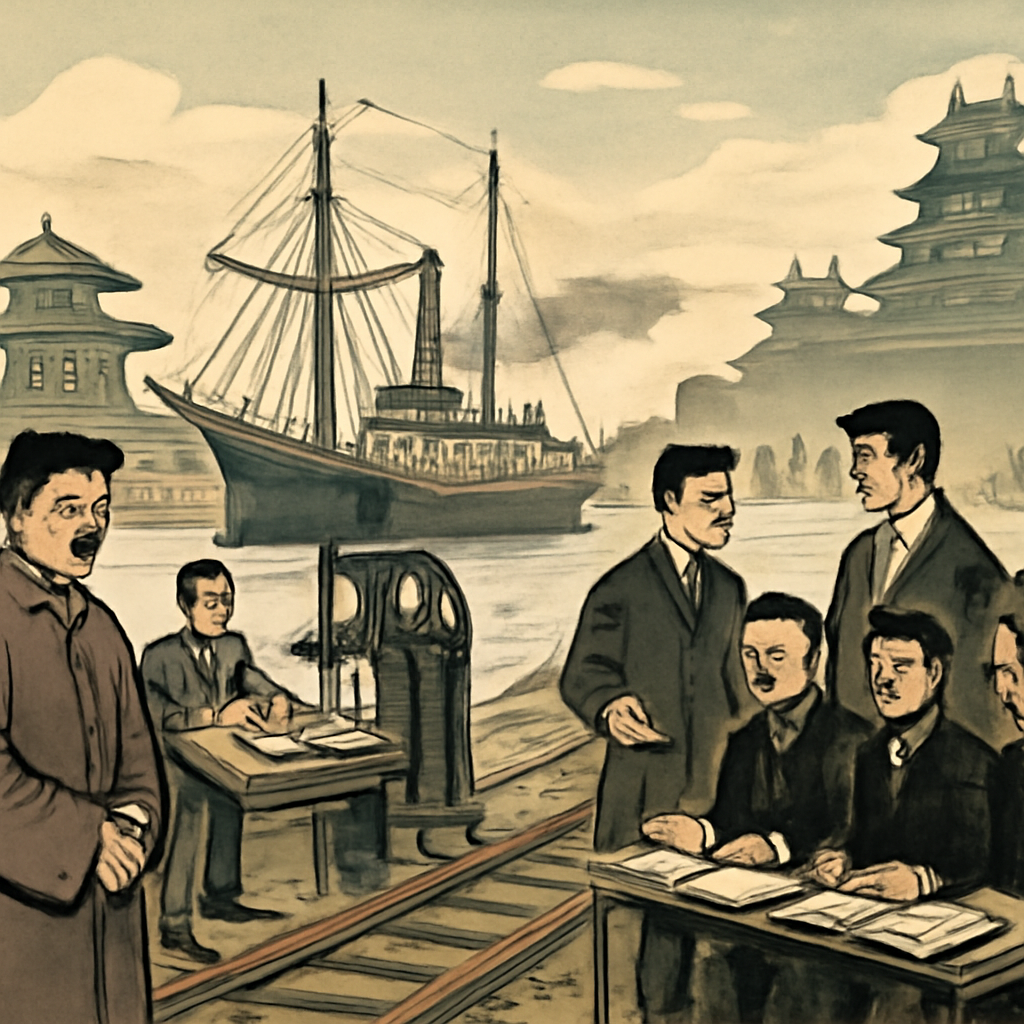
Fast Answer
Qing China and Meiji Japan both faced responding to nineteenth-century imperial pressure, military competition, treaty systems, and the demand for state reform, but Qing reform unfolded inside a vast multiethnic empire under treaty pressure and internal rebellion, while Meiji Japan used restoration politics to rebuild state institutions, military capacity, industry, and imperial ambition. The fastest answer starts with that contrast, then adds geography: Qing crisis runs through Beijing, treaty ports, Manchuria, inland rebellions, and coastal trade; Meiji transformation runs through Edo/Tokyo, domains, ports, Korea, Taiwan, and Pacific-facing state strategy. The deeper answer keeps officials, merchants, students, soldiers, peasants, treaty-port residents, reformers, women, colonized communities, and workers experienced modernization unevenly visible so the comparison does not become only a story of rulers, armies, or abstract systems.
Qing China and Meiji Japan become useful to compare when they are treated as answers to responding to nineteenth-century imperial pressure, military competition, treaty systems, and the demand for state reform. The comparison is not a scoreboard; it separates shared pressures from different institutions, geographies, vocabularies of legitimacy, and afterlives.
Reading Paths
Choose a reading path
Qing China vs Meiji Japan becomes clearer when the broad answer stays tied to sequence, place, and concrete next pages.
Follow the comparison through dated examples before returning to the grid.
Qing Conquest of China
Manchu forces entered Beijing and began Qing rule over China after Ming collapse and civil war.
First Opium War Begins
Disputes over opium smuggling, trade access, and imperial authority escalated into war between Qing China and Britain.
Treaty of Nanjing
The Treaty of Nanjing ended the First Opium War and forced Qing China into treaty-port concessions, indemnities, and Hong Kong's cession.
Meiji Restoration
The Tokugawa shogunate collapsed and imperial rule was restored in a political settlement that launched intense state-led modernization.
First Sino-Japanese War Begins
War between Qing China and Meiji Japan over influence in Korea revealed a major shift in East Asian regional power.
Comparison Grid
Qing China
Qing China faced responding to nineteenth-century imperial pressure, military competition, treaty systems, and the demand for state reform through its own institutions and inherited expectations.
Meiji Japan
Meiji Japan faced the same broad problem through a different political, social, and geographic setting.
The shared question makes the comparison possible; the local setting prevents it from becoming flat.Qing China
Qing China becomes clearer when the map is read through routes, capitals, borders, and zones of contact.
Meiji Japan
Meiji Japan changes the map frame by emphasizing different corridors, centers, or frontiers.
Qing crisis runs through Beijing, treaty ports, Manchuria, inland rebellions, and coastal trade; Meiji transformation runs through Edo/Tokyo, domains, ports, Korea, Taiwan, and Pacific-facing state strategyQing China
Qing China shaped people who rarely appear as the main title of the event.
Meiji Japan
Meiji Japan also depended on ordinary labor, coercion, negotiation, and memory.
officials, merchants, students, soldiers, peasants, treaty-port residents, reformers, women, colonized communities, and workers experienced modernization unevenlyQing China
Qing China left institutions and symbols that later people reused.
Meiji Japan
Meiji Japan produced its own afterlife through law, memory, identity, or opposition.
Qing memory often centers humiliation, reform failure, revolution, and imperial collapse; Meiji memory often centers modernization, constitutional reform, empire, and the costs of militarized successWhy the Comparison Matters
Qing China and Meiji Japan are often named together because both look large on a map or central in a textbook sequence. That is only the entrance. The better comparison asks what problem each case tried to solve, which tools were available, and which costs were pushed onto people with less power. responding to nineteenth-century imperial pressure, military competition, treaty systems, and the demand for state reform gives the two cases a shared frame without pretending they were the same.
Qing reform unfolded inside a vast multiethnic empire under treaty pressure and internal rebellion, while Meiji Japan used restoration politics to rebuild state institutions, military capacity, industry, and imperial ambition. That difference changes the whole interpretation. A date, battle, law, treaty, or reform may look similar at first glance, but it worked through different institutions and expectations. The comparison becomes richer when readers track offices, ports, courts, religious authorities, armies, labor systems, taxes, and local communities rather than only matching one famous leader against another.
The comparison also protects the atlas from a narrow regional habit. It lets a familiar search query open into a wider world-historical method: keep one question constant, then let the evidence remain local. The result is more useful than a list of similarities and differences because it explains why the similarities appeared and why the differences mattered.
Causes, Pressures, and Turning Points
foreign pressure mattered, but internal fiscal capacity, elite politics, military organization, social reform, and regional rivalry determined how each state responded. Causes here are layered. Some pressures were slow: fiscal strain, social hierarchy, trade routes, land hunger, legal tradition, religious authority, or inherited political memory. Others became visible as triggers: a battle, a treaty, a revolt, a reform, a crisis of succession, or a diplomatic failure.
For Qing China, the turning points reveal which institutions could absorb pressure and which could not. For Meiji Japan, the same question produces a different pattern because the political field, source record, and map were different. The strongest comparison keeps background pressure, immediate trigger, decision, and consequence in separate layers.
This separation matters for search intent as well as historical accuracy. A reader asking for causes usually needs more than a single origin story. The comparison shows how different causes can lead to apparently similar outcomes, and how similar pressures can produce different consequences when institutions, geography, and public memory diverge.
Geography and Institutions
Qing crisis runs through Beijing, treaty ports, Manchuria, inland rebellions, and coastal trade; Meiji transformation runs through Edo/Tokyo, domains, ports, Korea, Taiwan, and Pacific-facing state strategy. Geography is not scenery in this comparison. It decides which routes mattered, where armies or officials could move, which ports or capitals collected information, and which borderlands became pressure zones. A map changes the answer because it makes distance, environment, and connection visible.
Institutions turn that geography into durable behavior. Courts, charters, councils, fleets, land systems, tribute, parliaments, assemblies, religious offices, companies, schools, and armies all created habits that outlasted individual decisions. Qing China and Meiji Japan differed most when those institutions translated ambition into ordinary practice.
The comparison therefore moves between scale and texture. Scale explains why the cases mattered across regions; texture explains how people experienced them locally. A capital city, a plantation, a frontier settlement, a treaty port, a courtroom, a village, and a battlefield each reveal a different part of the same historical structure.
People, Labor, and Affected Groups
officials, merchants, students, soldiers, peasants, treaty-port residents, reformers, women, colonized communities, and workers experienced modernization unevenly. This is the layer that prevents the comparison from becoming too clean. Power operated through workers, soldiers, enslaved people, migrants, merchants, officials, women in households and courts, religious communities, students, colonized subjects, and local elites who had to live with decisions made elsewhere.
The human scale also changes causation. People did not only suffer systems; they adapted, resisted, interpreted, collaborated, fled, petitioned, organized, and remembered. Their actions often forced institutions to change. A comparison that includes affected groups can explain both top-down command and bottom-up pressure.
That wider lens is especially important when later memory turns complex histories into simplified symbols. Some groups become visible in monuments and schoolbooks; others survive in court records, petitions, oral traditions, material culture, or the silences of archives. The comparison invites readers to ask who is easy to see and who requires more careful reconstruction.
Consequences and Memory
Qing memory often centers humiliation, reform failure, revolution, and imperial collapse; Meiji memory often centers modernization, constitutional reform, empire, and the costs of militarized success. Consequences did not stop when the main event sequence ended. Institutions, borders, categories of citizenship, racial systems, religious identities, economic habits, and political vocabulary often survived in altered forms. Memory then selected certain lessons and pushed others aside.
The afterlife of Qing China may appear in law, identity, statecraft, monuments, political language, or public arguments. The afterlife of Meiji Japan may appear through different channels. The point is not to flatten both into the same legacy, but to ask which institutions and memories continued to organize later choices.
A useful comparison ends with unresolved questions. Which consequences were immediate, which were medium-term, and which became durable? Which groups gained language for new claims? Which injuries remained unaddressed? Which later movements reused the memory for purposes the original actors could not have predicted?
How to Read the Evidence Trail
The linked events give the comparison a route. Start with the earliest event to see the background pressure, then follow the turning points in chronological order. Each event page adds a map, actors, causes, consequences, sources, and reading questions that keep the comparison grounded in evidence rather than analogy alone.
The timeline links keep chronology visible. They show whether the comparison concerns a short crisis, a long institutional transformation, or a memory that changed meaning across generations. The topic links widen the frame so the reader can move from a single comparison into empire, rights, trade, religion, science, decolonization, or global exchange.
The strongest reading method is recursive. Read the fast answer, inspect the comparison grid, follow one event, return to the map, and then ask whether the original contrast still holds. Good comparisons survive that test because they become more precise as evidence accumulates.
The final habit is humility about sources. Court chronicles, official treaties, newspapers, museum collections, oral memory, legal documents, diplomatic records, inscriptions, and later histories do not preserve the same voices. A comparison is strongest when it admits what the evidence shows clearly and where the record remains uneven.
A second pass through the route can use one factor at a time. Read only the geography first, then read only institutions, then read affected groups, then read memory. The comparison becomes easier to hold because each pass asks one focused question instead of demanding that the whole argument arrive at once.
The comparison also points outward. Related topic hubs explain the broader vocabulary, timeline pages keep the sequence visible, and event pages slow down the causal chain. That structure lets the reader move from a quick answer into deeper study without creating duplicate pages for every similar search phrase.
When the cases seem too far apart, return to the shared problem. When they seem too similar, return to the map. That two-step habit keeps the comparison flexible: the shared question creates coherence, and the local evidence restores difference.
The comparison starts with scale. Qing China was a vast multiethnic empire with Manchu ruling institutions, Chinese bureaucratic traditions, Inner Asian frontiers, treaty-port pressures, rebellions, and a huge agrarian population. Meiji Japan was smaller, more compact, and politically remade through restoration, domain abolition, conscription, schooling, tax reform, and centralized state-building. Foreign pressure mattered in both cases, but the state containers were not alike.
Treaty ports make the pressure visible. In Qing China, coastal defeats and unequal treaties opened ports, fixed tariff limits, expanded foreign privileges, and exposed weaknesses in military and diplomatic capacity. In Japan, port opening also created crisis, but the political outcome moved through anti-shogunate mobilization, imperial restoration, and a reforming state that tried to control the terms of adaptation before external powers could define them completely.
Internal violence changes the comparison. Qing reform unfolded after and during devastating rebellions such as the Taiping crisis, regional militarization, fiscal strain, and court factionalism. Meiji transformation also faced resistance, including former samurai unrest and local hardship, but the new regime consolidated institutions with unusual speed. A comparison that names only Western pressure misses how domestic conflict decided which reforms could be carried out.
Modernization was not a neutral checklist. Railways, arsenals, schools, uniforms, factories, constitutions, banks, police, print culture, and armies all changed social life. In Qing China, reform efforts met the problem of preserving imperial order while adapting military, educational, and industrial systems. In Meiji Japan, reform strengthened the state but also fed empire-building, colonial rule in Taiwan and Korea, labor discipline, and militarized nationalism.
The human stakes run below the cabinet level. Merchants in treaty ports, students studying abroad, officials reading foreign texts, soldiers under new drill systems, women facing changing education and family law, peasants paying land taxes, workers in new industries, and colonized communities in Japan's expanding empire all carried the costs of reform. Reform was not only a state decision; it reorganized daily obligations.
The Sino-Japanese War is the turning point that makes the comparison unavoidable. Japan's victory in 1895 did not prove a timeless national superiority. It showed that Meiji institutions, military reform, finance, leadership, and strategic choices had produced new regional power. For Qing China, defeat intensified reform urgency, elite debate, and the crisis of imperial legitimacy that fed the road toward 1911.
Memory has made the comparison politically charged. Chinese narratives often connect the Qing crisis to national humiliation, reform failure, revolution, and later recovery. Japanese narratives often celebrate Meiji modernization while debating empire, militarism, Korea, Taiwan, labor, and war memory. The page keeps success and cost together because modernization can expand sovereignty while narrowing it for others.
The evidence route moves through Opium War, Treaty of Nanjing, Meiji Restoration, Sino-Japanese War, Xinhai Revolution, and May Fourth. That order lets readers watch reform pressure move from port and treaty to school, army, party, street protest, and national memory. It also gives the page a reason to link technology and discovery to diplomacy and revolution.
The most useful reader question is not why one state succeeded and the other failed. It is which institutions could turn crisis into capacity, and at what human price. Qing and Meiji histories both show adaptation under pressure, but one adaptation preserved imperial coherence less successfully while the other built power that soon imposed pressure on neighbors.
The comparison also gains depth when it follows knowledge itself. Translation bureaus, military manuals, foreign advisers, students abroad, newspapers, shipyards, arsenals, schools, and diplomatic missions carried information across borders. Reform depended on deciding which knowledge counted as useful, who could teach it, which institutions could absorb it, and which older social arrangements it threatened.
Regional consequences keep the page from becoming a domestic reform story. Korea, Taiwan, Manchuria, treaty ports, and Pacific routes all mattered because East Asian modernization quickly became a question of power over neighbors. Meiji success altered the regional balance, while Qing weakness exposed how imperial pressure could turn into territorial loss, reform panic, and revolutionary language.
A final caution concerns vocabulary. Modernization, westernization, self-strengthening, restoration, revolution, empire, and nationalism are not interchangeable. Each term carries an argument about who controlled change. The reader gets a better answer by asking which institution used the term, which group benefited, and which communities were made to adapt.
The comparison closes with consequences. Qing crisis helped feed republican and nationalist movements in China; Meiji capacity helped Japan become an imperial power. Reform was therefore not just response to pressure. It redistributed pressure across East Asia.
A final check is to name one institution, one place, one affected group, and one memory for each side. If any slot stays empty, the comparison still has a blind spot worth following through the linked pages.
Reader Lenses
responding to nineteenth-century imperial pressure, military competition, treaty systems, and the demand for state reform
Qing reform unfolded inside a vast multiethnic empire under treaty pressure and internal rebellion, while Meiji Japan used restoration politics to rebuild state institutions, military capacity, industry, and imperial ambition
Qing crisis runs through Beijing, treaty ports, Manchuria, inland rebellions, and coastal trade; Meiji transformation runs through Edo/Tokyo, domains, ports, Korea, Taiwan, and Pacific-facing state strategy
officials, merchants, students, soldiers, peasants, treaty-port residents, reformers, women, colonized communities, and workers experienced modernization unevenly
Qing memory often centers humiliation, reform failure, revolution, and imperial collapse; Meiji memory often centers modernization, constitutional reform, empire, and the costs of militarized success
Map Layer
Qing China vs Meiji Japan geography
Gold pins mark the approximate locations of published event pages. This is a schematic locator map, not a historical border map.
Coordinates are approximate and are used to help readers orient themselves before opening a full event page.
Linked Events
Read the Evidence Trail
Qing Conquest of China
Manchu forces entered Beijing and began Qing rule over China after Ming collapse and civil war.
First Opium War Begins
Disputes over opium smuggling, trade access, and imperial authority escalated into war between Qing China and Britain.
Treaty of Nanjing
The Treaty of Nanjing ended the First Opium War and forced Qing China into treaty-port concessions, indemnities, and Hong Kong's cession.
Meiji Restoration
The Tokugawa shogunate collapsed and imperial rule was restored in a political settlement that launched intense state-led modernization.
First Sino-Japanese War Begins
War between Qing China and Meiji Japan over influence in Korea revealed a major shift in East Asian regional power.
Xinhai Revolution
The Xinhai Revolution overthrew the Qing dynasty and opened the way for the Republic of China after centuries of imperial rule.
May Fourth Movement
Chinese students and intellectuals protested the Versailles settlement and broader political weakness, linking nationalism to cultural and political critique.
References
Where to Check the Facts
- Encyclopaedia Britannica: Qing dynastyReference for Qing imperial history and crisis.
- Encyclopaedia Britannica: Meiji RestorationReference for Meiji state reform and modernization.
- Encyclopaedia Britannica: Sino-Japanese WarReference for Qing-Japan conflict and regional power shift.