At a Glance
The shape of the event
- Date
- 1919
- Place
- Beijing
- Type
- Student and Cultural Movement
Chinese students and intellectuals protested the Versailles settlement and broader political weakness, linking nationalism to cultural and political critique.
1919; place the event in Beijing before comparing causes or consequences.
The event connects World War I's settlement to modern Chinese political and intellectual history.
Chinese students / New Culture intellectuals are the first names or groups to compare before widening the story.
The movement energized new political organizations, cultural reform, and anti-imperial nationalism.
The movement energized new political organizations, cultural reform, and anti-imperial nationalism.
The event connects World War I's settlement to modern Chinese political and intellectual history.
Follow the threads of 1919 to see how a diplomatic decision ricocheted through culture and politics.
Background
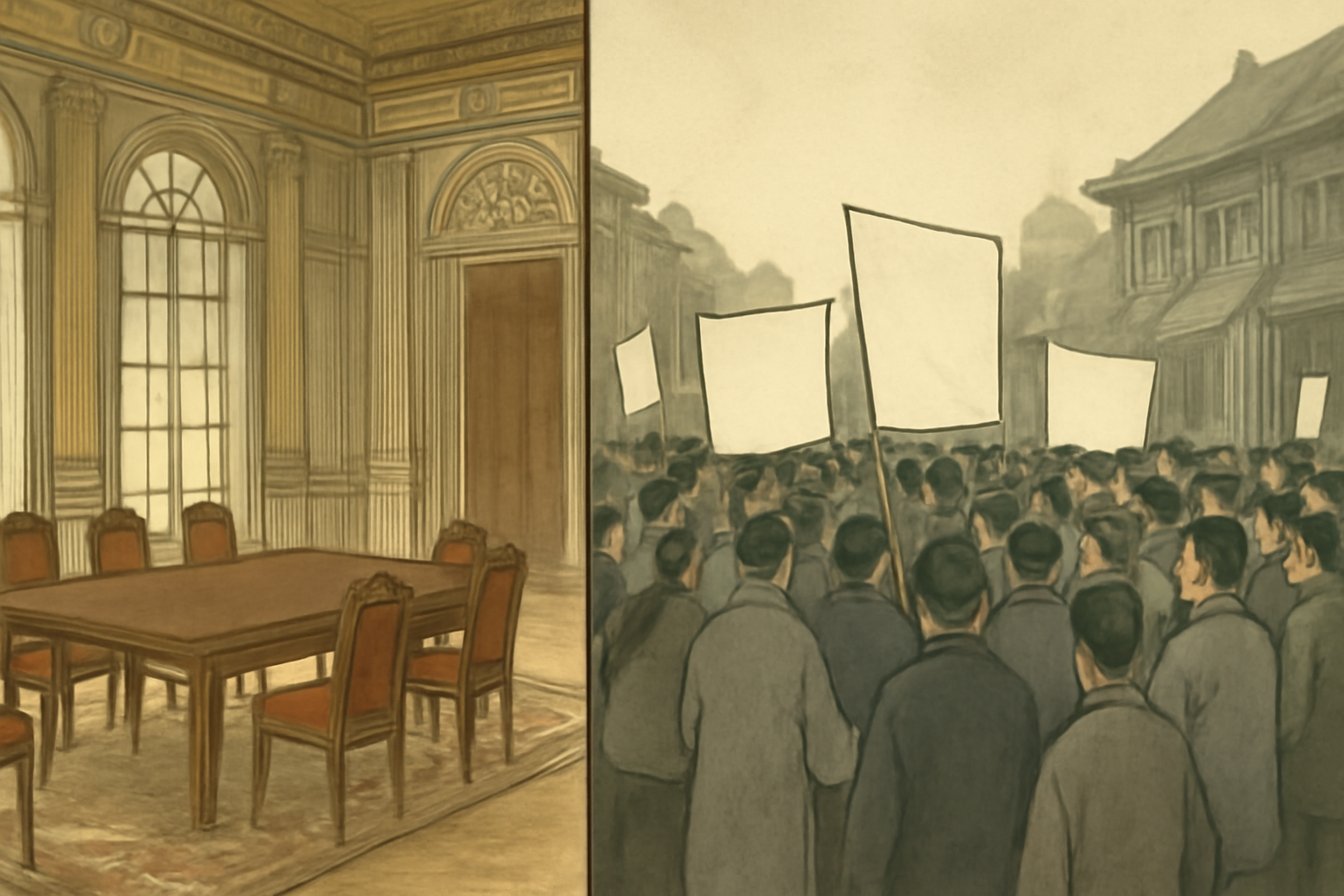
The years around 1919 left China exposed to competing pressures. A global conflict had redrawn boundaries and reputations elsewhere; in Beijing, students and thinkers watched a diplomatic settlement they regarded as unfair and as emblematic of broader political weakness. For many New Culture intellectuals, cultural reform was inseparable from national survival: language, education, and literary forms were not merely aesthetic concerns but tools for remaking public life. At the same time, Chinese political institutions struggled to project authority or to protect national interests in international fora. These overlapping strains—international decisions perceived as injustices, domestic fragility, and a generational debate about culture—created an environment in which protest could move beyond single grievances.
The movement emerged from this pressure cooker: grievances about foreign policy found expression through young activists and cultural critics who were already questioning how to modernize and who should lead that transformation. No single cause explains the eruption; rather, a cluster of political, diplomatic, and intellectual tensions converged in a charged Beijing. A stronger May Fourth page has to connect street protest with a larger intellectual and imperial crisis. Students in Beijing reacted to the Versailles settlement and the Shandong question, but their anger drew on years of New Culture debate over language, science, democracy, classical learning, gender, youth, and national weakness. The movement also moved beyond students.
Workers, merchants, printers, teachers, journalists, women activists, returned students, and urban readers helped turn a campus protest into a wider public challenge. Boycotts, strikes, speeches, vernacular writing, and newspapers made politics travel through daily life. May Fourth belongs in a global postwar frame. The same peace settlement that promised self-determination also preserved imperial privileges. Chinese protesters saw a gap between Wilsonian language and great-power practice, and that gap gave anti-imperial nationalism a sharper language.
The Turning Point
What changed in 1919 was how these tensions were reconfigured as collective action. Chinese students in Beijing publicly protested the Versailles settlement and, crucially, framed their complaint not only as a diplomatic affront but as evidence of broader political failure. New Culture intellectuals lent the denunciation language and argument, linking nationalism to critiques of tradition, education, and public life. The choices mattered: students chose the streets and public demonstration as a venue for political expression; intellectuals chose to translate outrage into critique of cultural forms and language. Together they shifted the debate from private discontent to national conversation.
This was not merely a spontaneous outburst but a moment when activists decided to bind foreign-policy grievance to cultural reform and political renewal. By doing so, they opened new political possibilities—energizing civic networks, accelerating debate about modernity, and making popular protest an instrument of national critique in ways that reached beyond the immediate targets of diplomatic negotiation. The turning point was the fusion of international humiliation with domestic criticism. Anger over Shandong became a way to attack weak diplomacy, warlord politics, old cultural authority, and institutions that seemed unable to defend China. Another turning point was media expansion.
Vernacular writing, journals, student networks, and urban print culture allowed May Fourth arguments to circulate far beyond one demonstration, turning protest into a durable intellectual field.
Consequences
In the near term, the May Fourth movement intensified public scrutiny of both foreign policy and domestic capacity. The protests energized the formation and growth of new political organizations and networks that drew on the momentum of students and intellectuals. Culturally, the movement amplified calls for reform—about language, education, and the role of ideas in public life—so that debates once confined to salons and journals moved into streets, classrooms, and workplaces. Over the long term, the event became a hinge connecting the settlement that followed World War I to the trajectory of modern Chinese politics and thought. It helped legitimize protest as a mechanism of political influence and reinforced anti-imperial sentiments that reshaped national priorities.
Interpretations of what the movement achieved, however, vary depending on the evidence scholars center: official records, community memory, law, diplomacy, archaeology, labor struggles, and later public commemoration each highlight different outcomes. That divergence is itself a consequence—an ongoing contest over what the May Fourth movement meant and for whom it mattered. The immediate consequence was pressure on Chinese officials and a wave of public mobilization around national sovereignty. The longer consequence was a transformed political culture in which nationalism, feminism, science, democracy, Marxism, liberalism, and cultural reform competed for China's future. May Fourth also helps readers understand why twentieth-century Chinese politics cannot be reduced to one party's later story.
The movement opened arguments that Nationalists, Communists, liberals, educators, writers, and activists would all inherit and reinterpret.
Interpretation Notes
Interpretations of May Fourth Movement depend on whose evidence is centered: rulers and official records, affected communities, oral memory, archaeology, law, diplomacy, labor, and later public memory do not always tell the same story.
Why Keep Reading
Follow the threads of 1919 to see how a diplomatic decision ricocheted through culture and politics. Reading on reveals how student protest and intellectual debate fed organizational growth, how cultural arguments about language and education fed political agendas, and how competing sources—official archives, personal memories, and public monuments—tell different stories about influence and legacy. If you want to trace how a moment of outrage turned into new institutions and enduring debates about national identity, the next pages map the routes from Beijing’s streets to later political and cultural transformations. Read May Fourth after World War I and Versailles, then continue to Chinese revolution, anti-imperialism, language reform, and Cold War East Asia.
That path keeps Chinese agency visible inside global postwar disorder.
Reading Path
Follow the story without losing the thread
Before This
- Easter RisingApril 1916
- Assassination of Archduke Franz FerdinandJune 28, 1914
- Xinhai Revolution1911
After This
- Long March Begins1934
- Indonesia Proclaims IndependenceAugust 17, 1945
- Founding of the People's Republic of ChinaOctober 1, 1949
Same Period
- Qin Unification of China221 BCE
- First Opium War Begins1839 CE
- Revolutions of 18481848 CE
Wider Timeline
Mind Map
How to think about May Fourth Movement
Versailles settlement
Seen by students as a diplomatic affront that sparked outrage in Beijing
Map Layer
Where this event sits geographically
Gold pins mark the approximate locations of published event pages. This is a schematic locator map, not a historical border map.
Coordinates are approximate and are used to help readers orient themselves before opening a full event page.
References
Where to Check the Facts
- Cambridge University Press: The Cambridge History of ChinaSpecialist scholarly synthesis for Chinese dynastic, imperial, revolutionary, and Mao-era historical interpretation.
- Cambridge University Press: The Cambridge History of JapanSpecialist scholarly synthesis for Japanese state formation, Meiji transformation, imperial expansion, and modern political change.
- Harvard University Press: A New History of KoreaKorean-history scholarship reference for long Korean chronology, institutions, cultural history, colonial pressure, and modern change.
- Oxford Research Encyclopedia of Asian History: Meiji RevolutionPeer-reviewed reference for Meiji transformation as revolution, state centralization, social change, and contested modernization.
- Encyclopaedia Britannica: Ming dynastyReference for Ming restoration, government, maritime activity, and culture.
- Encyclopaedia Britannica: Qing dynastyReference for Qing conquest, imperial expansion, crisis, and reform.
- Official UNESCO World Heritage Centre: Historic Monuments of Ancient KyotoInstitutional reference for Kyoto's long capital history, court culture, temples, and urban memory.
- Official archive: Columbia Asia for Educators: Treaty of Nanjing excerptsPrimary-source teaching excerpt for the Treaty of Nanjing, treaty-port coercion, indemnity, and legal-commercial pressure after the Opium War.
- National Archives of Japan: Constitution of Japan and Meiji constitutional holdingsJapanese archival reference for Meiji constitutional state-building, imperial rescripts, and the legal language of modern reform.
- National Diet Library: Modern Japan in Archives - Japan's Annexation of KoreaJapanese archive reference for the 1910 annexation of Korea and the documentary trail behind Japanese colonial rule.
- National Institute of Korean History: Annals of the Choson DynastyKorean institutional reference for Joseon court records, dynastic governance, and Korean historical specificity inside the East Asia path.
- U.S. Office of the Historian: English translation of the 1910 Korea annexation treatyDiplomatic-document reference for treaty language around Japan's annexation of Korea and international reporting of colonial transition.
- Official archive: UK National Archives: May Fourth Movement 1919Primary-source archive material for May Fourth diplomacy, national equality language, and post-World War I Chinese protest context.
- Official archive: Hong Kong Basic Law official English textOfficial legal text for the Hong Kong handover framework, rights language, political structure, and sovereignty after 1997.