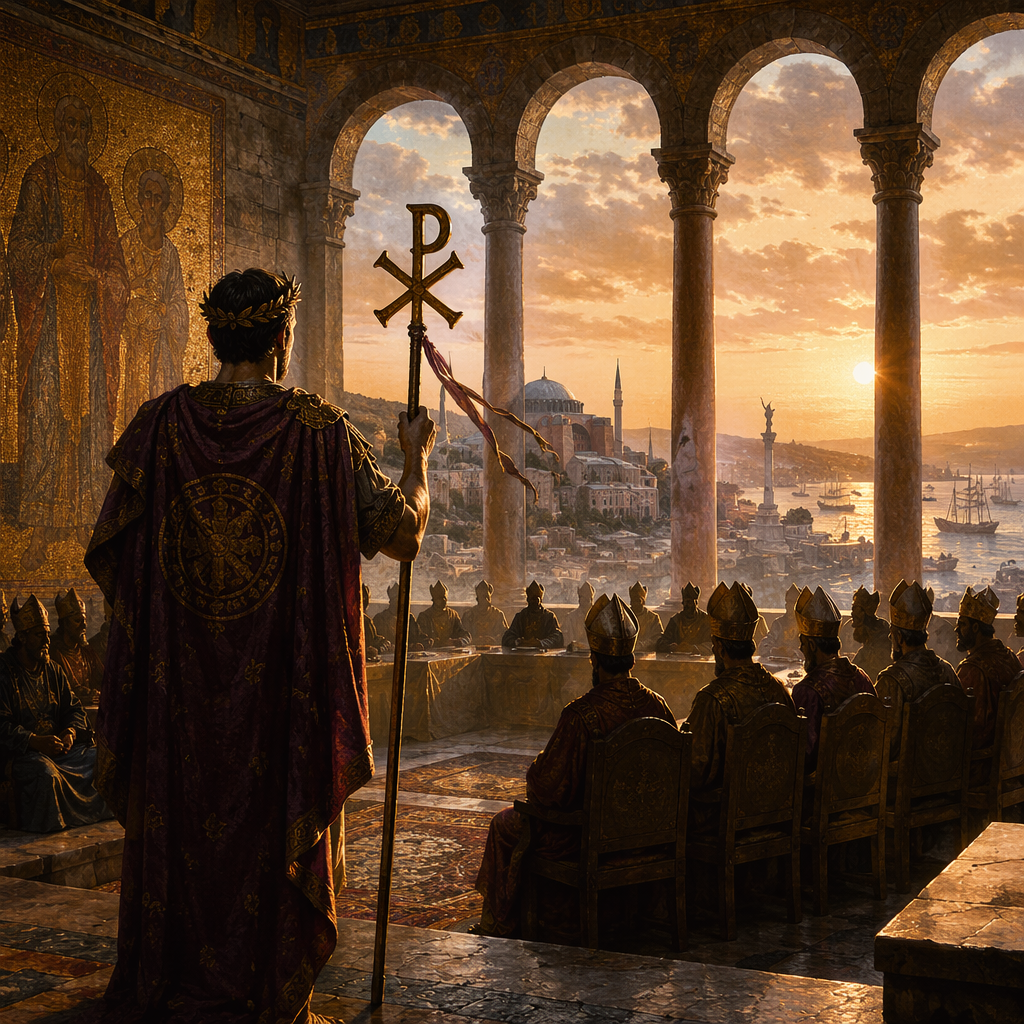
How to Read the Year
Why did the Edict of Milan change the public position of Christianity in the Roman world?
313 CE is anchored by the agreement associated with Constantine and Licinius that granted legal toleration to Christians and ordered the return of confiscated property. The year matters because it moved Christianity into a new public position after periods of persecution, but it did not instantly make the Roman Empire Christian in a simple or uniform way.
The shift is easiest to understand through legal status. A Christian community that had faced imperial suspicion could now own property, gather more openly, rebuild institutions, and appeal to imperial favor. That did not end pagan worship, theological dispute, local hostility, or political calculation. It changed the rules under which religious communities could act.
Constantine's role gives the date its drama, but the wider imperial setting matters just as much. Civil war, legitimacy, military loyalty, urban communities, bishops, local officials, and public order all shaped why an emperor cared about religious policy. Toleration was a political act as well as a religious turning point.
The year becomes richer when read beside 325 and the Council of Nicaea. 313 opened space for Christianity; 325 showed that Christian disputes could become imperial concerns. Together they help readers see a gradual change in the relationship between church and state rather than a single overnight conversion of empire.
For late antique history, 313 also raises a question about memory. Christians later remembered Constantine as a pivotal ruler, while critics have debated whether imperial favor changed the church's moral and political character. That debate is part of the year because public legitimacy always changes what a movement can become.
The background of persecution keeps the change from sounding abstract. Under Diocletian and other imperial authorities, Christian communities had faced church destruction, confiscated books and property, imprisonment, and pressure to sacrifice. Toleration mattered because it altered daily risk for bishops, congregations, households, and local officials who had to decide what public religion now meant.
The return of property made policy material. Buildings, meeting places, records, donations, cemeteries, and legal claims helped Christian communities rebuild institutional life. Imperial favor did not settle doctrine, but it changed access to resources and made bishops more visible as public negotiators.
313 also needs chronological care. It was not the same as Theodosius making Nicene Christianity the favored imperial orthodoxy later in the fourth century. The date belongs to toleration and restitution; its importance is that it opened a new relationship between imperial law and Christian public life.
313 CE in History gathers events that help readers move from a single date into wider historical patterns. A useful year entry does more than answer what happened; it shows why people keep using the year as a marker for change.
The connected events show how decisions, institutions, conflicts, ideas, and consequences crossed beyond one location or one person. The event links explain the immediate story, while the topic routes and timelines show what came before and after.
The year also helps organize broad questions. It gives readers a concise answer and a direct path into deeper event pages where causes, turning points, consequences, maps, and references are easier to inspect.
Read the date in three passes. First ask what happened inside the year itself. Then ask which older pressures made the event possible. Finally ask which later pages reuse the same vocabulary, institutions, borders, technologies, or memories. That sequence keeps the page from becoming a trivia answer.
Even when only one event is currently attached, the year still has a job: it gives students and curious visitors a stable chronological doorway into the atlas. The page makes the doorway useful by pointing to the event, the topic route, the timeline, the map, and the evidence trail that can turn a date into a broader explanation.
This year matters because it connects Edict of Milan to a wider sequence of causes and consequences. It gives the reader a chronological anchor while still pointing outward to people, places, institutions, and later effects. A thin year page would only name the event; a useful year page explains why this date is a handle for a larger route through history. 313 matters because it marks a legal and political transformation in the Roman Empire's treatment of Christianity. It helps readers connect persecution, toleration, property, imperial legitimacy, bishops, public worship, and later church-state debates without collapsing them into a single conversion story.
Reader Lenses
Look for the pressures that made change possible.
Identify who acted and what options were available.
Follow what changed after the event.
Ask why this date still appears in historical summaries.
Track how toleration and returned property changed what Christian communities could do.
Ask why emperors linked religious policy to unity, legitimacy, and public order.
Read 313 with 325 to see a process, not an instant Christian empire.
How This Year Connects
313 CE in History is anchored by Edict of Milan. Read those pages together and the year stops being a date label; it becomes a crossroads where immediate choices met older pressures and opened later consequences.
The setting matters as much as the date. The year moves through Milan and belongs to Late Antiquity. That combination helps readers avoid treating the year as isolated; geography, institutions, conflict, belief, economy, and communication all shape what a date can mean.
The year also opens into people and themes. Figures such as Constantine the Great and Licinius appear because their choices made the year visible, while themes such as Christianity, Roman Empire, and Religious Toleration explain why the consequences outlived the moment. A useful next step is usually an event page, then a topic route, then a timeline.
Evidence changes the way a date reads. A treaty, battle report, inscription, newspaper, census, court record, memoir, photograph, or archaeological trace does not answer the same question. Looking at source type helps separate what happened in the year from how later people remembered it.
A year page is most useful when it keeps two scales open at once. The first scale is immediate: what happened, where, and who was involved. The second scale is interpretive: why later readers use this date to organize a wider story. Holding both scales together makes the page a starting point for deeper reading rather than a dead-end answer.
The before-and-after frame matters too. A date rarely begins the forces it reveals. Earlier pressures made the linked event possible, while later pages show which effects were temporary, which became institutions, and which turned into memory. Reading the year this way helps students avoid the false impression that history changes only when the calendar flips.
Use this page as a junction. If the event feels too brief, follow the topic route for background; if the cause feels too abstract, open the event page for sequence; if the consequence feels larger than the date, move into the timeline. The value of a year page is that it lets readers change scale without losing their place.
Read 313 beside Constantine, the Council of Nicaea, and the Christianization of the Roman Empire. That route shows toleration becoming institutional influence and then public theological conflict.
Then move toward medieval church-state routes and religious reform pages. The later disputes make more sense when readers see how imperial favor first changed Christianity's public position.
Events in This Year
- 313 CEEdict of Milan
The Edict of Milan recognized religious toleration for Christians within the Roman Empire, changing the relationship between imperial power and Christianity.
Map Layer
313 CE in History geography
Gold pins mark the approximate locations of published event pages. This is a schematic locator map, not a historical border map.
Coordinates are approximate and are used to help readers orient themselves before opening a full event page.
References
Where to Check the Facts
- Encyclopaedia Britannica: Edict of MilanSpecific reference for the 313 CE anchor event, chronology, and historical setting.
- Encyclopaedia BritannicaBackground reference for chronology, names, and historical context.
- WikidataStructured reference for dates, places, alternate names, and entity links.