How to Read the Year
Why does 1939 CE in History deserve a focused year page?
The invasion of Poland makes 1939 a year about the collapse of European peace and the start of World War II in Europe. The date should not be read as a surprise bolt from nowhere. It followed Nazi expansion, appeasement, remilitarization, the destruction of Czechoslovakia, German-Soviet diplomacy, and the failure of deterrence.
The military sequence matters. German forces combined air power, armor, infantry, communications, and speed, while Poland faced invasion from the west and then from the Soviet east. The human result included bombing, occupation, displacement, executions, and the beginning of a brutal wartime order.
1939 is also a diplomatic year. Britain and France declared war after Germany attacked Poland, but they could not save Poland from occupation. The gap between declarations and effective relief shows why alliance promises can be politically important and militarily insufficient.
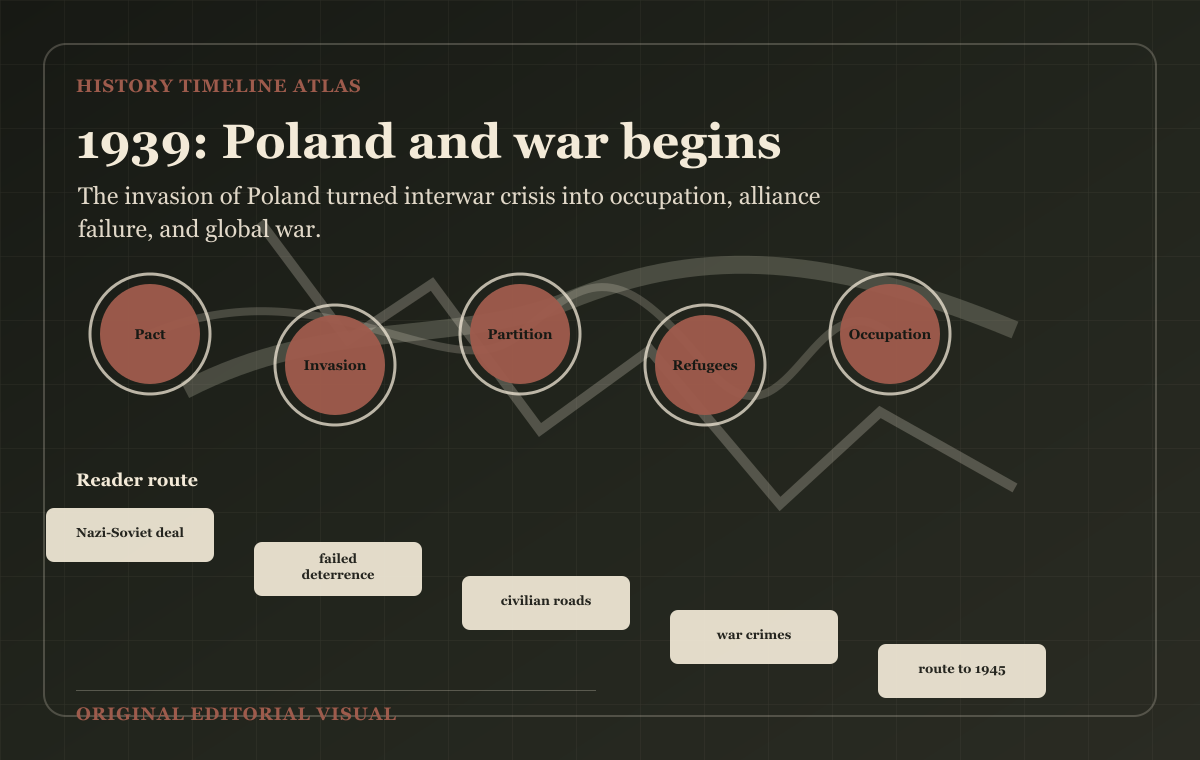
The year opens several routes at once: World War II, the Holocaust, occupation regimes, Soviet-German partition, refugee history, resistance, and postwar border changes. A useful page gives readers those routes rather than stopping at the phrase 'war begins.'
The Nazi-Soviet Pact belongs near the front of the page because it changed what Germany and the Soviet Union could risk. Its public nonaggression language masked secret protocols that divided parts of Eastern Europe into spheres of influence. For Poland and the Baltic region, diplomacy among dictators was not a distant maneuver; it became invasion, partition, deportation, occupation, and the loss of political independence.
1939 also teaches readers how war beginnings become moral and legal questions. Aggression, declarations, propaganda, refugee flows, treatment of prisoners, and occupation policy all shaped later ideas about responsibility. A page about the year should therefore connect the first shots to later war-crimes reckoning, not because judgment was already complete, but because the methods of the war were visible from the start.
The year should widen beyond Western European capitals. Polish soldiers, Jewish families, Ukrainian and Belarusian communities in eastern Poland, Baltic observers, German civilians hearing propaganda, and Soviet officials following secret agreements all entered the war through different doors. That human geography matters because the start of World War II was not experienced as one synchronized headline. It arrived as invasion, occupation, fear, calculation, and uncertainty.
A strong reading path moves from 1939 to 1940, 1941, the Holocaust, occupation and resistance, the Eastern Front, and 1945. That route helps readers understand why the invasion of Poland is a beginning but not the whole explanation. The year opened a system of war whose consequences hardened through later decisions, technologies, ideologies, and institutions.
It also keeps civilians in the first frame. War began for many people as sirens, roads filled with refugees, destroyed towns, arrests, forced labor, and uncertain borders. That social view prevents the page from becoming only a military summary of invasion plans.
1939 CE in History gathers events that help readers move from a single date into wider historical patterns. A useful year entry does more than answer what happened; it shows why people keep using the year as a marker for change.
The connected events show how decisions, institutions, conflicts, ideas, and consequences crossed beyond one location or one person. The event links explain the immediate story, while the topic routes and timelines show what came before and after.
The year also helps organize broad questions. It gives readers a concise answer and a direct path into deeper event pages where causes, turning points, consequences, maps, and references are easier to inspect.
Read the date in three passes. First ask what happened inside the year itself. Then ask which older pressures made the event possible. Finally ask which later pages reuse the same vocabulary, institutions, borders, technologies, or memories. That sequence keeps the page from becoming a trivia answer.
Even when only one event is currently attached, the year still has a job: it gives students and curious visitors a stable chronological doorway into the atlas. The page makes the doorway useful by pointing to the event, the topic route, the timeline, the map, and the evidence trail that can turn a date into a broader explanation.
This year matters because it connects Invasion of Poland to a wider sequence of causes and consequences. It gives the reader a chronological anchor while still pointing outward to people, places, institutions, and later effects. A thin year page would only name the event; a useful year page explains why this date is a handle for a larger route through history. 1939 matters because it turns interwar crisis into global war. The year links ideology, diplomacy, military innovation, alliance failure, occupation, and civilian suffering. It also teaches that war beginnings are processes: by September 1939, earlier choices had already narrowed the space for peace, while later consequences would reach far beyond Poland.
Reader Lenses
Look for the pressures that made change possible.
Identify who acted and what options were available.
Follow what changed after the event.
Ask why this date still appears in historical summaries.
Read the invasion as the outcome of earlier expansion, appeasement, and failed deterrence.
Follow what happened to civilians after the battlefield phase moved on.
Ask why declarations of war did not translate into immediate rescue for Poland.
How This Year Connects
1939 CE in History is anchored by Invasion of Poland. Read those pages together and the year stops being a date label; it becomes a crossroads where immediate choices met older pressures and opened later consequences.
The setting matters as much as the date. The year moves through Poland and belongs to Twentieth Century. That combination helps readers avoid treating the year as isolated; geography, institutions, conflict, belief, economy, and communication all shape what a date can mean.
The year also opens into people and themes. Figures such as Adolf Hitler appear because their choices made the year visible, while themes such as World War II, Nazi Germany, and Poland explain why the consequences outlived the moment. A useful next step is usually an event page, then a topic route, then a timeline.
Evidence changes the way a date reads. A treaty, battle report, inscription, newspaper, census, court record, memoir, photograph, or archaeological trace does not answer the same question. Looking at source type helps separate what happened in the year from how later people remembered it.
A year page is most useful when it keeps two scales open at once. The first scale is immediate: what happened, where, and who was involved. The second scale is interpretive: why later readers use this date to organize a wider story. Holding both scales together makes the page a starting point for deeper reading rather than a dead-end answer.
The before-and-after frame matters too. A date rarely begins the forces it reveals. Earlier pressures made the linked event possible, while later pages show which effects were temporary, which became institutions, and which turned into memory. Reading the year this way helps students avoid the false impression that history changes only when the calendar flips.
Use this page as a junction. If the event feels too brief, follow the topic route for background; if the cause feels too abstract, open the event page for sequence; if the consequence feels larger than the date, move into the timeline. The value of a year page is that it lets readers change scale without losing their place.
Events in This Year
- September 1, 1939Invasion of Poland
Germany invaded Poland, using speed, air power, and coordinated ground forces to begin the European phase of World War II.
Map Layer
1939 CE in History geography
Gold pins mark the approximate locations of published event pages. This is a schematic locator map, not a historical border map.
Coordinates are approximate and are used to help readers orient themselves before opening a full event page.
References
Where to Check the Facts
- Encyclopaedia Britannica: World War IISpecific reference for the 1939 CE anchor event, chronology, and historical setting.
- Encyclopaedia BritannicaBackground reference for chronology, names, and historical context.
- WikidataStructured reference for dates, places, alternate names, and entity links.