Historical Role
A strong Pachacuti biography begins in the Andes, where altitude, road systems, labor obligations, ritual landscapes, and local lordships shaped political possibility. Inca expansion was not only the ambition of one ruler; it was a way of organizing people, land, storage, movement, and memory across difficult terrain.
His reign is associated with the transformation of Cusco and the expansion of Inca power. That expansion depended on armies, diplomacy, resettlement, tribute labor, provincial administration, sacred authority, and the ability to connect valleys and highlands through roads and storehouses.
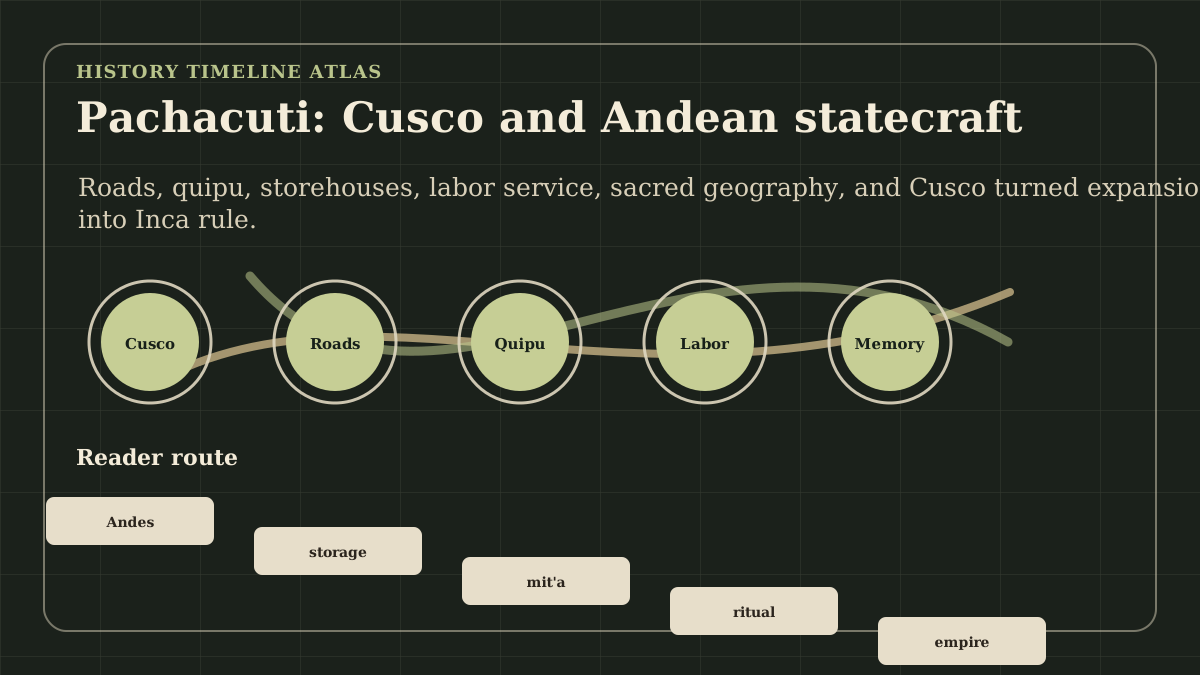
The biography becomes more concrete when readers imagine infrastructure. Roads, bridges, runners, quipu recordkeeping, terraces, warehouses, and ceremonial centers helped turn conquest into durable rule. These systems mattered because the empire stretched across environments where movement and food storage were political problems.
Pachacuti also belongs to memory and myth. Later Inca tradition and Spanish colonial accounts preserved his image through stories shaped by conquest, translation, and political need. The biography marks that evidence problem rather than pretending his life is recorded like a modern archive.
Reading Pachacuti beside Tenochtitlan, the Spanish conquest, and other pre-Columbian routes helps readers avoid treating the Americas as a preface to Europe. The Inca state was already a complex imperial system before Spanish arrival changed the political world.
The capital itself gives the biography texture. Cusco was not only a residence for a ruler; it was a ritual and administrative center where lineage, sacred geography, labor, storage, and conquest memory could be organized. If readers picture roads leading toward Cusco and storehouses reaching out from it, Pachacuti becomes less like a name and more like a builder of imperial space.
The mit'a labor system is a key reader lens because it connects state power to household obligation. Inca rule did not rely on money or alphabetic paperwork in the same way many Eurasian empires did. It organized work, movement, storage, building, and service through reciprocal claims, hierarchy, and recordkeeping that made labor itself a governing resource.
Resettlement and provincial management make expansion harder than a map of conquest suggests. Local leaders could be incorporated, moved, watched, rewarded, or made responsible for supplying labor and goods. Roads and storehouses mattered because they let the state convert distant landscapes into obligations that could be counted, moved, and remembered.
A careful biography also treats Spanish-era accounts as both indispensable and difficult. Much of what readers know about Pachacuti was preserved after conquest, through translators, colonial politics, Andean memory, and European categories. That source problem does not erase Inca history; it asks the page to show how archaeology, oral tradition, colonial writing, and comparative statecraft have to be read together.
The reader route should move from Pachacuti into the event page, then sideways into Cahokia, Tenochtitlan, and Indigenous Americas routes. That comparison changes the frame from isolated civilizations to different ways of building cities, food systems, ritual power, roads, and political memory before European conquest.
Readers asking for a Pachacuti timeline or biography need the short answer and the wider frame: this is a ruler associated with expansion, but the historically interesting issue is how Andean infrastructure made expansion governable.
Environmental diversity is part of that frame. Highland terraces, valley routes, storage facilities, camelid transport, maize fields, textiles, and labor obligations connected ecological zones that could not be governed through one simple model. Pachacuti's importance grows when readers see empire as coordination across altitude, climate, food, ritual, and road systems.
Pachacuti helps connect individual action with wider historical change in Inca Empire. The biography works best when it keeps the surrounding world visible: authority, conflict, belief, reform, or discovery moved through decisions made under pressure.
The related events show how roles such as Inca ruler, Imperial builder can be read through dates, places, institutions, and consequences rather than through reputation alone. The biography explains why this person matters, while the linked events explain what changed around them.
A richer reading starts with the limits around the person. Some figures acted through offices, armies, courts, laboratories, churches, parties, ships, trade networks, or protest movements; others became important because later communities turned their lives into symbols. The page therefore asks what this person could actually change, what was already moving before them, and which consequences later readers attached to the name.
Read the biography against absence as well. Many lives around Pachacuti are less visible in the record: opponents, collaborators, family members, workers, soldiers, students, subjects, victims, translators, scribes, or local communities. Keeping those surrounding people in view makes the page less like a name card and more like an entry point into historical systems.
Pachacuti also works as a navigation point. Open the linked event pages to see where the biography becomes chronology, then use the topic routes to test whether the same pattern appears beyond one life. That extra step matters because historical importance is rarely contained inside a single decision; it usually spreads through institutions, witnesses, opponents, imitators, and later arguments over memory.
Sources and Method
Source trail: the page uses Britannica's Inca reference, the linked Inca expansion event, UNESCO Andean heritage material, and the Indigenous Americas route. It keeps Inca expansion visible before European conquest enters the frame.
Evidence Notes
How Sensitive Claims Are Sourced
- 1
Infrastructure as imperial power
The biography explains roads, quipu, storage, labor, and ritual geography as tools of rule. Pachacuti matters because expansion had to be organized across Andean environments, not simply won in battle.
Why This Person Matters
Pachacuti matters because the connected events make a larger historical pattern easier to follow. The page links biography to consequences so readers can move from a life story into the wider atlas, compare the person with contemporaries, and understand why later memory kept returning to this figure. Pachacuti matters because he helps readers understand the Inca Empire as a system of terrain, labor, roads, ritual, storage, memory, and administration. His page is strongest when it makes Andean statecraft visible before European conquest enters the story and when it lets readers compare empire without assuming all empires used the same tools.
What becomes clearer when this person's life is read through connected events instead of isolated biography, and where do the consequences outgrow the person?
How to Read This Life
Pachacuti is easiest to understand when the biography is read beside Inca Expansion under Pachacuti. Those events show the historical setting in motion: dates, places, institutions, conflict, and consequences give the life a structure that a short biography alone cannot provide.
The surrounding route crosses Inca Empire and locations such as Cusco. That matters because influence rarely stays inside one person. It moves through offices, armies, movements, laws, texts, speeches, institutions, and later memory.
A useful reading path starts with the role labels, then opens the event pages to see what changed, and finally compares this person with other actors facing similar pressures.
For readers who arrive on a biography first, this page is meant to become a doorway rather than a stop. Read one paragraph for the answer, then use the turning points, topic routes, and event links to test whether the person's reputation matches the wider evidence.
Read Pachacuti through the roles of Inca ruler, Imperial builder rather than as reputation alone.
Place the biography inside Inca Empire and the wider events linked below.
Ask which choices were personal and which were constrained by institutions or crisis.
Follow how later memory simplified, contested, or reused this person's role.
Ask how mountains, valleys, roads, and storage shaped imperial strategy.
Follow tribute labor, resettlement, building, and food storage as political tools.
Read oral tradition, archaeology, and colonial accounts as different kinds of source.
Legacy, Limits, and Memory
A useful biography keeps scale in view. Pachacuti mattered because individual choices met a wider structure: institutions, enemies, allies, audiences, technologies, beliefs, and inherited conflicts. The related event pages help separate personal agency from conditions that no single person controlled.
Memory is part of the biography too. Later readers often simplify a figure into a hero, villain, founder, reformer, conqueror, prophet, scientist, or symbol. Those labels can be helpful, but they become misleading when they hide conflict, compromise, exclusion, uncertainty, or the experiences of people outside the main biography.
For the next step, compare this life with a topic route rather than stopping at the name. If the same pattern appears across several figures, the reader has found a historical structure; if this person breaks the pattern, the contrast is usually where the most interesting question begins.
The evidence trail for Pachacuti is different from a modern political biography. Oral tradition, colonial writing, archaeology, and later memory have to be read together with caution.
The best comparison is with Qin Shi Huang and Augustus. All three connect conquest to administration, but the Inca case shows how infrastructure and labor organization could hold an empire without alphabetic bureaucracy.
Turning Points to Read Next
Inca Expansion under Pachacuti
Pachacuti and his successors transformed the Inca polity around Cusco into a rapidly expanding Andean empire.
Related Timeline
- c. 1438Inca Expansion under Pachacuti
Pachacuti and his successors transformed the Inca polity around Cusco into a rapidly expanding Andean empire.
References
Where to Check the Facts
- Encyclopaedia Britannica: IncaReference for Inca state formation, expansion, and Spanish conquest.
- Official UNESCO World Heritage Centre: Lines and Geoglyphs of Nasca and PalpaReference for the Nazca geoglyph landscape and its archaeological significance.