Fast Answer
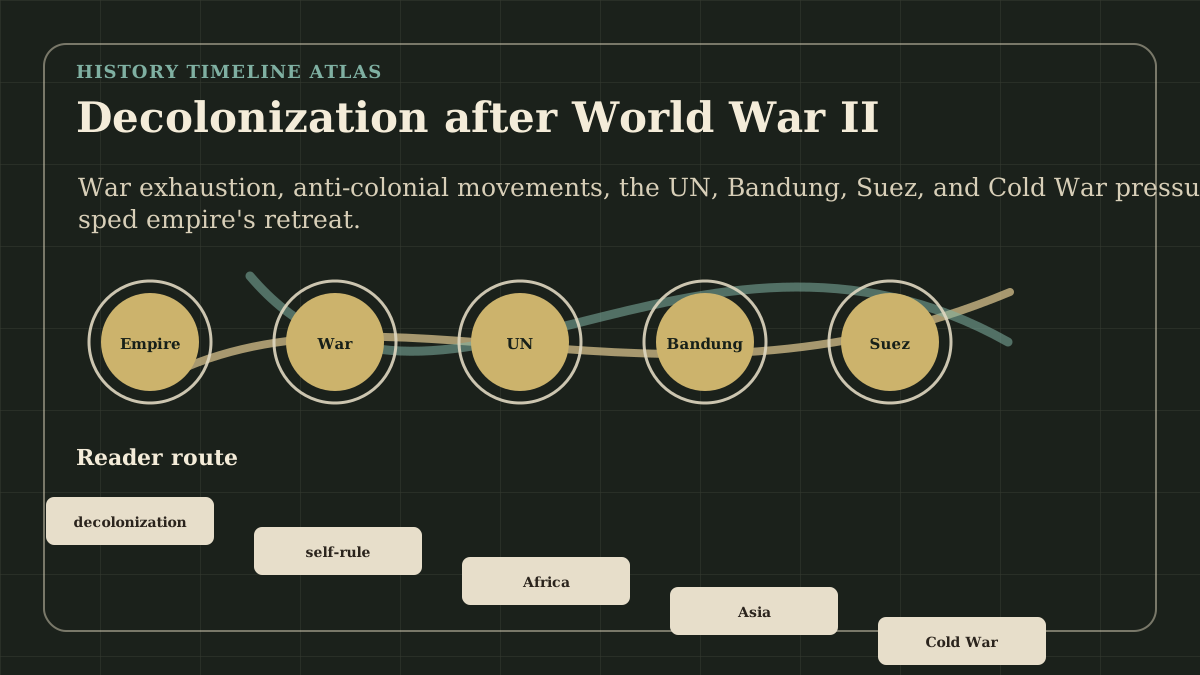
World War II weakened European empires, armed and mobilized colonial subjects, damaged imperial legitimacy, expanded self-determination language, and opened a world where anti-colonial movements in South Asia, Southeast Asia, Africa, and the Caribbean could use both mass politics and international pressure. Key sequence: the war ended in 1945, India and Pakistan became independent in 1947, Bandung met in 1955, Ghana became independent in 1957, and African and Asian decolonization widened through the 1960s and 1970s. The map matters because decolonization unfolded through South Asian partitions, Southeast Asian wars, African independence movements, Middle Eastern crises, Caribbean politics, and UN forums. The human stakes are concrete: colonized soldiers, workers, students, women organizers, rural communities, political prisoners, migrants, veterans, and families facing counterinsurgency violence turned imperial weakness into political opportunity.
Why Did Decolonization Accelerate After World War II cannot be answered by a definition alone. The answer has to name the people, places, institutions, corridors, and conflicts that made the process visible.
Reading Paths
Choose a reading path
Why Did Decolonization Accelerate After World War II? becomes clearer when the broad answer stays tied to sequence, place, and concrete next pages.
Start with a concrete event, then return to the fast answer with evidence in view.
End of World War II
World War II ended with the defeat of Nazi Germany and Imperial Japan, closing a global conflict while opening urgent questions of occupation and reconstruction.
United Nations Founded
The United Nations came into force after World War II as states tried to build a stronger framework for peace, security, and cooperation.
Indian Independence and Partition
British India became independent as India and Pakistan, while partition produced mass migration, communal violence, and unresolved border questions.
Bandung Conference
Asian and African leaders met at Bandung to discuss anti-colonial solidarity, racial equality, economic cooperation, sovereignty, and alternatives to Cold War bloc politics.
Ghana Independence
Ghana became independent from British colonial rule, with Kwame Nkrumah framing the new state as part of a broader African liberation project.
How to Think About It
World War II weakened European empires, armed and mobilized colonial subjects, damaged imperial legitimacy, expanded self-determination language, and opened a world where anti-colonial movements in South Asia, Southeast Asia, Africa, and the Caribbean could use both mass politics and international pressure
the war ended in 1945, India and Pakistan became independent in 1947, Bandung met in 1955, Ghana became independent in 1957, and African and Asian decolonization widened through the 1960s and 1970s
decolonization unfolded through South Asian partitions, Southeast Asian wars, African independence movements, Middle Eastern crises, Caribbean politics, and UN forums
colonized soldiers, workers, students, women organizers, rural communities, political prisoners, migrants, veterans, and families facing counterinsurgency violence turned imperial weakness into political opportunity
Debate centers on the balance between imperial exhaustion, anti-colonial pressure, Cold War strategy, economic change, and local revolutionary organization
Fast Explanation
World War II weakened European empires, armed and mobilized colonial subjects, damaged imperial legitimacy, expanded self-determination language, and opened a world where anti-colonial movements in South Asia, Southeast Asia, Africa, and the Caribbean could use both mass politics and international pressure. The answer becomes persuasive only when it is tied to named places, institutions, and choices rather than repeated as a slogan.
the war ended in 1945, India and Pakistan became independent in 1947, Bandung met in 1955, Ghana became independent in 1957, and African and Asian decolonization widened through the 1960s and 1970s. That order matters because it shows when pressure built, when people still had choices, and when later outcomes narrowed those choices.
Dates, places, institutions, names, and affected groups carry the explanation. colonized soldiers, workers, students, women organizers, rural communities, political prisoners, migrants, veterans, and families facing counterinsurgency violence turned imperial weakness into political opportunity.
A reader can test the answer by following one named case first, then asking whether the same pattern appears elsewhere. The best examples usually show a pressure becoming visible in law, labor, violence, diplomacy, technology, or public memory.
The useful question is never only what happened. Ask who had leverage, who had to react, what place made action possible, what institution preserved the change, and what later memory simplified. That habit turns a broad answer into a historical argument instead of a glossary entry.
Causes and Conditions
The causes sit in layers. Long-term conditions created pressure: resources, labor systems, beliefs, state capacity, borders, technology, public language, and inherited inequality. Immediate triggers then made the pressure visible through a crisis, law, protest, battle, treaty, discovery, or institutional failure.
The common misconception is that European empires simply granted independence after becoming enlightened. That misconception survives because it is simple, but it hides the sequence. A better answer separates background conditions from triggers and then follows the decisions that made one outcome more likely than another.
The strongest causal explanation also includes people who did not control formal institutions. Workers, enslaved people, colonized communities, soldiers, women, migrants, students, religious communities, scientists, officials, and local leaders often changed the path by resisting, adapting, organizing, translating, or refusing.
The same cause can also work differently across regions. A port, empire, plantation, school, borderland, laboratory, or city council could translate the larger pressure into a local choice with its own risks and limits.
Geography and Movement
decolonization unfolded through South Asian partitions, Southeast Asian wars, African independence movements, Middle Eastern crises, Caribbean politics, and UN forums. The map determines what could move, how fast, and at what cost. Ports, rivers, mountain passes, railroads, plantations, capitals, treaty ports, islands, borderlands, and disease corridors all change the shape of the explanation.
Geography also changes whose experience becomes visible. A capital may preserve speeches and laws, while a port reveals labor, disease, migration, customs records, and commercial pressure. A battlefield shows command decisions; a village or settlement may show taxes, land loss, hunger, religious change, or family separation.
Once the places are visible, the reader can ask why the story unfolded there and not somewhere else. The geography is part of the cause, not scenery behind the cause.
Affected Groups and Unequal Power
colonized soldiers, workers, students, women organizers, rural communities, political prisoners, migrants, veterans, and families facing counterinsurgency violence turned imperial weakness into political opportunity. The people most affected were not always the people most visible in official sources. A careful explanation keeps both formal decision-makers and less powerful communities in the same frame.
Unequal power changes the evidence. Officials leave records that explain policy; communities under pressure may appear through petitions, court cases, archaeology, oral memory, music, protest, missionary records, business records, or hostile descriptions written by others. Reading those sources requires attention to voice and silence.
This human layer also makes the topic more readable. Readers keep going when the stakes are concrete: land, food, family, wages, law, schooling, worship, voting, safety, sovereignty, mobility, or memory. The explanation becomes richer when those stakes are named directly.
Debate and Misconception
Debate centers on the balance between imperial exhaustion, anti-colonial pressure, Cold War strategy, economic change, and local revolutionary organization. Debate does not weaken the explanation. It shows where historians, communities, and public memory disagree about cause, responsibility, significance, or moral language.
The common mistake is to make the topic too clean. Some histories are remembered as progress, but they also include coercion. Others are remembered as catastrophe, but they also include survival, adaptation, and new political claims. A useful explainer keeps those tensions on the surface.
Another mistake is to treat later categories as if actors at the time already shared them. Words such as empire, nation, rights, race, science, globalization, reform, sovereignty, and civilization changed meaning. The page works when it explains vocabulary as part of the history.
Consequences and Why It Still Matters
Decolonization matters because it remade the map, created new states, changed international law, and left unresolved questions about borders, development, debt, memory, and violence. The consequences belong in more than one time frame. Immediate effects changed institutions and decisions; medium-term effects changed alliances, economies, education, borders, movements, or laws; long-term effects shaped memory and later political language.
Each connected event adds a case where the topic becomes visible. Order matters, because wars, reforms, revolutions, treaties, migrations, technologies, and social movements stop looking isolated when their sequence is clear.
The strongest follow-up is to test the fast answer against one concrete case, then return to the larger question with sharper evidence.
How to Use This Reading Path
The reading path works best in three passes. First, read the fast answer to get the basic claim. Second, follow the event links in chronological order. Third, return to the question and ask which event changed the claim most. That rhythm turns a broad topic into a sequence of evidence rather than a loose definition.
The linked timelines add another layer. They reveal whether the topic was a short crisis, a long transformation, or a recurring pattern that changed meaning in different periods. A single event can explain a trigger, but a timeline explains why the trigger had consequences beyond the moment.
The topic hubs widen the frame without scattering the reader. A question about why did decolonization accelerate after world war ii? may lead into trade, empire, rights, religion, science, disease, nationalism, or decolonization. The hub links show those neighboring paths while keeping the original search intent anchored to one canonical answer.
Source awareness belongs inside the reading path. Official documents often preserve decisions; museum and archive collections preserve material evidence; encyclopedias stabilize chronology; community memory preserves experiences that formal records may flatten. Reading across source types makes the explanation less brittle.
The war weakened empire in practical ways before it weakened empire in moral language. European states lost money, ships, soldiers, infrastructure, and administrative confidence. Colonies supplied labor, food, troops, taxes, and bases, which made imperial dependence visible. After 1945, the old claim that empire represented stable protection sounded less convincing to people who had carried wartime burdens.
Colonial veterans changed the political field. Men who had served in armies, labor corps, transport units, and wartime industries returned with new skills, expectations, networks, and grievances. Service did not automatically create independence movements, but it gave many people a sharper language for asking why sacrifice for empire did not produce citizenship, wages, land, or self-rule.
Anti-colonial organizing was already present before 1945. The war accelerated movements that had older roots in newspapers, unions, schools, religious associations, peasant grievances, student groups, exile networks, and earlier revolts. That continuity matters because independence was not a gift handed down after Europe became tired. It was claimed by people who had been building political capacity for years.
International language gave local movements a wider stage. The United Nations, self-determination vocabulary, human-rights claims, and Afro-Asian diplomacy did not free colonies by themselves, but they changed legitimacy. Imperial powers increasingly had to explain coercion in a world where formal empire looked backward and where newly independent states could support one another in public forums.
Cold War pressure cut both ways. The United States and Soviet Union often criticized old empires when doing so served strategy, but both also supported allies, armed clients, tolerated repression, or treated liberation movements through ideological suspicion. Anti-colonial leaders could use superpower rivalry, but they also risked becoming trapped inside it.
Violence varied by place. India and Pakistan reveal partition, migration, and border violence alongside transfer of power. Indonesia and Vietnam show war against returning imperial forces. Algeria and Kenya show counterinsurgency, detention, torture, settler politics, and rural disruption. Ghana shows a different path through party organization and negotiation. The acceleration after 1945 did not mean one peaceful pattern.
Economics made independence both urgent and difficult. Wartime extraction, commodity dependence, land inequality, infrastructure built for export, debt, and limited industrial capacity shaped what new states inherited. Political sovereignty could arrive faster than economic autonomy. That gap explains why decolonization belongs with development history as well as diplomatic history.
Borders were one of the hardest afterlives. Many new states inherited colonial boundaries that cut across older communities or joined groups with unequal access to power. Some leaders defended inherited borders to avoid endless conflict; others faced secession, civil war, refugee crises, and military coups. The map was remade, but the inherited map still constrained choices.
Women organizers, rural communities, workers, teachers, clerks, students, and political prisoners need to stay visible. Independence ceremonies often highlight male nationalist leaders and flags, but movements depended on household labor, food supply, clandestine organizing, protest, education, communication, and survival under repression. The social history makes decolonization feel less like a conference table and more like a struggle over daily life.
A useful reading path moves from 1945 to the UN, then to India, Bandung, Ghana, Congo, and Angola. That order shows acceleration without pretending inevitability. Each case asks a different question: transfer, partition, diplomacy, party organization, crisis, armed struggle, and the long effort to turn sovereignty into durable institutions.
The story also needs a post-independence frame. New flags and seats at the United Nations did not automatically settle language policy, minority rights, military power, land distribution, schooling, public health, or export dependency. Some states built durable institutions; others faced coups, secession, authoritarianism, or outside intervention. Decolonization accelerated after 1945, but its consequences unfolded over generations.
For students, the most reliable answer is a chain: war weakened empire, anti-colonial organization supplied pressure, international language changed legitimacy, Cold War competition widened opportunity and danger, and local movements decided the shape of each struggle. Removing any link makes the answer too simple.
A final check is to name one imperial weakness, one organized anti-colonial force, one international forum, one local conflict, and one post-independence problem. If the answer can do all five, it has moved beyond a thin claim that empires simply collapsed.
Counterexamples are useful too. When one linked event does not fit the quick answer, it may reveal a regional difference, a missing institution, a weaker source trail, or a later memory that changed the topic's meaning.
The most useful note-taking method is to separate four columns: pressure, trigger, institution, and consequence. Pressure explains why change became possible. Trigger explains why it became visible. Institution explains how change became durable. Consequence explains why later people remembered it.
The final reading question is not whether the topic was important in general. It is which concrete people, places, and institutions made it important. Once those are visible, the explanation can support essays, classroom study, search snippets, and deeper browsing without losing historical texture.
A second path is comparative. Place two linked events beside each other and ask what changed: the actors, the geography, the technology, the legal language, the scale of violence, or the memory afterward. Comparison keeps the explainer from becoming a one-directional summary.
A third path is source-led. Start with the strongest institutional source, then ask which voices it privileges. Move to a museum, archive, or event page to recover material evidence and local experience. The answer becomes stronger when it treats evidence as part of the story instead of a footnote.
A fourth path is vocabulary-led. Terms such as empire, rights, reform, globalization, nation, revolution, science, and religion carry different meanings in different periods. Track how the term changes from the earliest linked event to the latest one, and the broad question becomes a historical sequence.
The reading path also supports a practical study habit: after reading, summarize the answer in one sentence, then add one example that proves it and one example that complicates it. If both examples fit, the explanation has enough depth to be useful beyond a search snippet.
The last pass is human. Name who gained, who paid, who moved, who was forced, who argued, who recorded the event, and who later remembered it differently. Broad explanations become memorable when they end with people rather than abstractions.
That human pass also reveals limits. Some sources make officials easy to quote while leaving workers, families, captives, migrants, or local witnesses harder to hear. The reading path keeps those limits visible so the answer remains curious rather than overconfident, and it gives the next click a real historical purpose grounded in evidence, geography, lived stakes, public memory, institutions, consequences, contingency, conflict over power, and changing historical vocabulary. It also helps readers notice when an apparently simple answer is really a dispute over records, authority, survival, and interpretation.
Map Layer
Why Did Decolonization Accelerate After World War II? map examples
Gold pins mark the approximate locations of published event pages. This is a schematic locator map, not a historical border map.
Coordinates are approximate and are used to help readers orient themselves before opening a full event page.
Examples
Events That Make the Pattern Visible
End of World War II
World War II ended with the defeat of Nazi Germany and Imperial Japan, closing a global conflict while opening urgent questions of occupation and reconstruction.
United Nations Founded
The United Nations came into force after World War II as states tried to build a stronger framework for peace, security, and cooperation.
Indian Independence and Partition
British India became independent as India and Pakistan, while partition produced mass migration, communal violence, and unresolved border questions.
Bandung Conference
Asian and African leaders met at Bandung to discuss anti-colonial solidarity, racial equality, economic cooperation, sovereignty, and alternatives to Cold War bloc politics.
Ghana Independence
Ghana became independent from British colonial rule, with Kwame Nkrumah framing the new state as part of a broader African liberation project.
Congo Independence and Crisis
Congo's independence from Belgium quickly became a crisis involving army mutiny, Katanga secession, Cold War pressure, UN intervention, and Lumumba's removal.
Angola Gains Independence
Angola became independent from Portugal after the Carnation Revolution, but liberation movements and Cold War patrons quickly pushed the country into civil war.
References
Where to Check the Facts
- Official United Nations: DecolonizationOfficial reference for decolonization and self-determination within the UN system.
- Official OHCHR: Declaration on the Granting of Independence to Colonial Countries and PeoplesOfficial reference for the UN declaration that framed decolonization as self-determination.
- Encyclopaedia Britannica: Bandung ConferenceReference for Bandung and Afro-Asian politics.
- Encyclopaedia Britannica: Suez CrisisReference for the 1956 crisis and imperial retreat.