Fast Answer
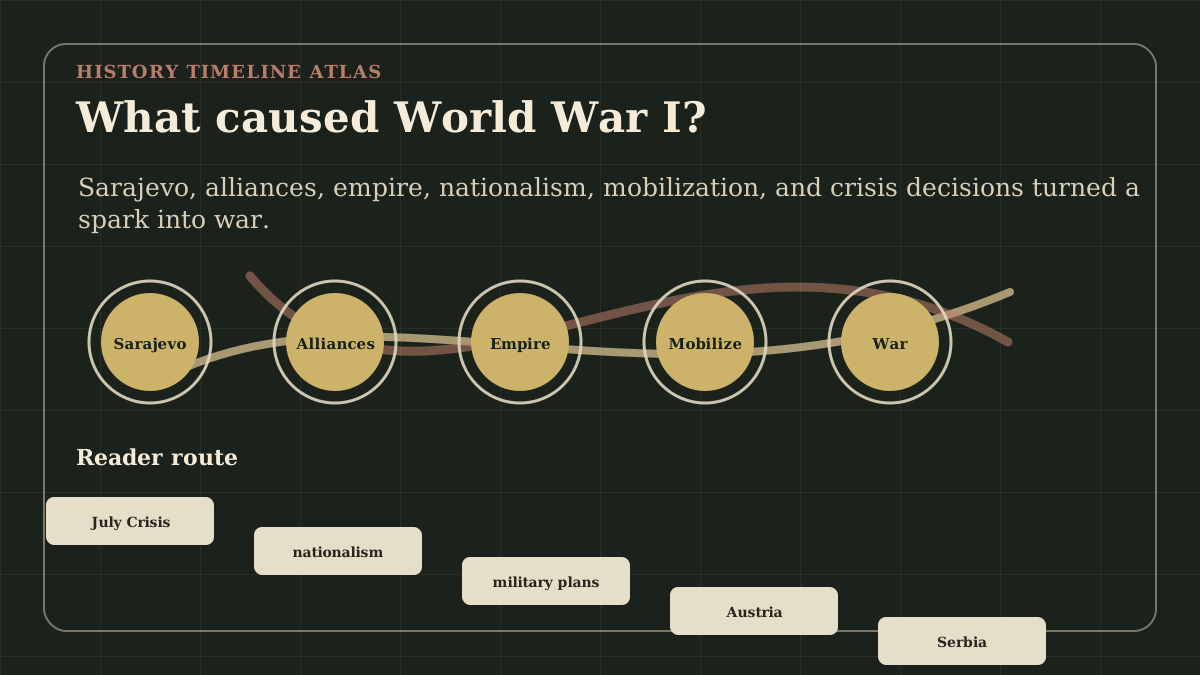
Sarajevo explains the trigger; the July Crisis timeline explains how the trigger became war. Austria-Hungary, Serbia, Russia, Germany, France, Britain, alliance promises, imperial competition, nationalist politics, military planning, and mobilization schedules all shaped the escalation, so responsibility has to be weighed in layers rather than pinned on one cause.
World War I was caused by the interaction of alliance commitments, imperial rivalry, nationalism, militarized planning, domestic politics, and a July 1914 decision chain that turned the assassination at Sarajevo into a continental and then global war.
Reading Paths
Choose a reading path
What Caused World War I? July Crisis Timeline and Consequences becomes clearer when the broad answer stays tied to sequence, place, and concrete next pages.
Start with a concrete event, then return to the fast answer with evidence in view.
Assassination of Archduke Franz Ferdinand
Gavrilo Princip assassinated Archduke Franz Ferdinand in Sarajevo, setting off a diplomatic crisis among Europe's alliance systems.
First Battle of the Marne
French and British forces stopped the German advance near the Marne, preventing a quick German victory and helping turn the Western Front into a long war of attrition.
Gallipoli Campaign
Allied forces attempted to force the Dardanelles and open a path to Russia, but the Gallipoli campaign became a costly failure against Ottoman defenses.
Zimmermann Telegram
Germany proposed a potential alliance with Mexico if the United States entered World War I, and British interception helped inflame American opinion.
Treaty of Versailles
The Treaty of Versailles ended formal war between Germany and the Allied powers while assigning responsibility, reparations, and territorial changes.
How to Think About It
Alliances, empires, arms competition, and military plans created danger before 1914.
The Sarajevo assassination opened the July Crisis but did not mechanically make war inevitable.
Governments made choices under fear, prestige pressure, bad information, and mobilization timetables.
Imperial systems turned a European crisis into a war involving colonies, oceans, and wider world politics.
The Fast Answer Needs Layers
The most useful answer to 'what caused World War I?' is layered. Start with the long background: European great powers were connected by alliances, competing empires, military planning, public nationalism, and anxiety about decline. Add the regional setting: the Balkans were unstable because Ottoman retreat, Serbian nationalism, Austro-Hungarian fear, Russian interest, and great-power prestige overlapped. Then add the trigger: the assassination of Archduke Franz Ferdinand in Sarajevo on June 28, 1914.
That trigger did not mechanically produce war. It opened a crisis in which Austria-Hungary, Germany, Russia, France, Britain, Serbia, and others made choices under fear, pride, incomplete information, and military pressure. The July Crisis matters because it shows causation in motion. Governments issued ultimatums, promised support, mobilized armies, interpreted signals, and feared that delay would make them weaker.
A strong page therefore avoids two bad answers. One says the assassination caused everything. The other says the war was inevitable because Europe was already tense. The better explanation says Europe was dangerous, but the war still required decisions. Structures created risk; actors converted risk into war.
Long-Term Pressures
Alliance systems made crisis harder to isolate. The Triple Alliance and Triple Entente were not automatic machines, but they encouraged governments to imagine local danger as part of a wider strategic balance. When Austria-Hungary confronted Serbia, Russia worried about Balkan influence and Slavic politics. Germany worried about encirclement. France watched Germany. Britain watched the balance of power and Belgian neutrality. Each government saw its own moves as defensive.
Imperial rivalry added another pressure. European states competed for prestige, resources, naval power, and influence beyond Europe. Crises in Morocco, competition in Africa and Asia, and fears about economic and military standing made leaders sensitive to humiliation. Empire did not cause Sarajevo, but it made international politics more suspicious and status-conscious.
Militarism and planning also mattered. War plans often assumed that speed would be decisive. Mobilization timetables could narrow diplomatic time because leaders feared being caught unprepared. This does not mean generals alone caused the war. It means political choices were made inside systems that rewarded rapid commitment and punished hesitation.
The Sarajevo Trigger
The assassination gave Austria-Hungary a chance to confront Serbia, but it also created a problem. A limited punitive action might have stayed regional if other powers had accepted it. Instead, Austria-Hungary wanted to reassert authority, Germany offered support, Serbia resisted parts of the ultimatum, Russia moved toward support for Serbia, and the crisis widened.
The trigger mattered because it joined symbolic outrage to strategic fear. Austria-Hungary feared internal weakness and Serbian nationalism. Germany feared the future balance of power. Russia feared loss of influence. France feared abandonment and German power. Britain feared a hostile power dominating the continent and later responded to Germany's violation of Belgian neutrality.
The assassination was therefore the spark, but not the whole fire. A spark can die if there is no fuel. In 1914 the fuel was a system of rivalries, fears, plans, and political commitments that made compromise look like danger.
Why the War Became Global
The war became global because the powers involved were imperial powers. Colonies supplied soldiers, workers, money, raw materials, ports, and battlefields. Fighting touched Africa, the Middle East, Asia, oceans, and colonial societies. The Western Front may dominate memory, but a world-war explanation must include empire from the beginning.
The Ottoman Empire's entry widened the conflict further. The Gallipoli campaign, the Middle Eastern fronts, and later settlement questions tied the war to imperial collapse and new borders. Sea power and blockade linked the war to food, trade, finance, and civilian endurance. The Zimmermann Telegram and submarine warfare helped draw the United States into the conflict in 1917.
This global scale changes the causes question. World War I was not simply caused by European leaders and then exported. European power already depended on global empires, and those empires made the consequences larger than the original crisis.
Common Misconceptions
One misconception is that alliances forced everyone to fight automatically. Alliances mattered, but governments still interpreted obligations and chose how to act. Another misconception is that nationalism alone explains the war. Nationalism mattered in Serbia, Austria-Hungary, Russia, France, Germany, and elsewhere, but nationalism became explosive because it interacted with empire, monarchy, military planning, and great-power credibility.
A third misconception is that everyone wanted a long war. Many leaders expected a shorter war, or at least believed delay would be worse than action. That misjudgment is part of the cause. States had built capacity for industrial war without fully understanding what industrial attrition would mean for soldiers, workers, families, budgets, and politics.
A fourth misconception is that responsibility disappears because causes were complex. Complexity does not erase responsibility. It clarifies it. Austria-Hungary, Germany, Russia, France, Britain, Serbia, and other actors made choices, but those choices had different weights, constraints, and consequences. The explanation makes that uneven agency visible.
What to Read Next
Begin with the assassination of Archduke Franz Ferdinand, then follow the First Battle of the Marne to see how a crisis became a failed short-war plan. Move to Verdun and the Somme to understand attrition. Open the Zimmermann Telegram to see how intelligence, submarine warfare, and diplomacy widened the conflict. End with the Treaty of Versailles to see why the causes question does not stop in 1914.
The best reading path keeps cause and consequence together. If alliances helped widen the war, postwar alliances and institutions tried to prevent a repeat. If imperial rivalry helped create the conflict, colonial soldiers and anti-colonial claims shaped what came after. If mobilization plans narrowed choices, trench stalemate revealed the cost of those plans.
That path also answers a real reader problem: causes and effects are easier to understand together. Causes explain why war began. Effects explain why the war remained important: empire collapse, revolution, new borders, mass grief, debt, political radicalization, and a fragile settlement that later generations struggled to repair.
A useful classroom structure is four boxes. Put long-term pressures in the first box: alliances, imperial rivalry, nationalism, militarism, and domestic politics. Put the immediate trigger in the second box: Sarajevo and the Austro-Serbian crisis. Put decision points in the third box: ultimatums, blank checks, mobilization, declarations of war, and diplomatic failure. Put effects in the fourth box: trench warfare, U.S. entry, revolution, armistice, Versailles, and postwar instability.
This structure keeps causes from becoming a memorized acronym. Acronyms can help beginners remember terms, but they often flatten the story. Militarism, alliances, imperialism, and nationalism did not float above events. They worked through people, documents, timetables, newspapers, railway plans, cabinet meetings, military assumptions, and public expectations about honor and security.
The page also needs affected groups. Serbian nationalists, Austro-Hungarian officials, Russian ministers, German generals, French planners, British diplomats, colonial soldiers, Armenian civilians, factory workers, nurses, farmers, and families waiting for casualty lists did not experience the causes in the same way. Causes look different from a palace, a barracks, a newspaper office, a village, and a colonial recruiting station.
Finally, ask what would have had to change to avoid war. A different Austro-Hungarian response, a different German pledge, slower mobilization, stronger mediation, Serbian concessions, Russian restraint, British clarity, or more flexible military planning might have changed the path. Counterfactuals cannot become fantasy, but they help readers see that inevitability is too easy. The war was structurally likely by 1914, but it still had to be made through concrete decisions.
The same method helps readers evaluate blame. Germany's blank check to Austria-Hungary mattered. Austria-Hungary's decision to punish Serbia mattered. Russia's mobilization mattered. France's alliance commitments mattered. Britain's position mattered. Serbia's nationalist politics mattered. The point is not to spread responsibility evenly; it is to weigh different choices inside different constraints.
Geography stays visible as well. Sarajevo, Vienna, Berlin, St. Petersburg, Paris, London, Belgrade, the Marne, Gallipoli, and the Atlantic were connected by railways, telegrams, treaty obligations, shipping lanes, imperial interests, and military assumptions. The causes of World War I look clearer when the reader sees a network of places rather than a row of abstract terms.
The final reason to keep reading is that World War I changed the meaning of modern politics. It helped produce revolutions, new states, wounded veterans' politics, commemorative cultures, debt disputes, border conflicts, and arguments about collective security. A causes page that stops in August 1914 leaves out why the question still matters.
For younger readers, the causes question can feel like a search for one guilty party. For deeper readers, it becomes a way to study how modern states make danger. Leaders acted through institutions they did not fully control. Newspapers amplified fear. Military staff treated timetables as reality. Diplomats spoke in careful phrases while armies prepared for irreversible steps. Publics heard about honor, defense, revenge, and survival, often without seeing how quickly options were narrowing.
The causes also look different when empire is placed at the center. Indian soldiers, African carriers, Middle Eastern communities, Pacific islands, and colonial economies were not afterthoughts. They were part of the power system that allowed European states to fight at world scale. A complete answer therefore links Sarajevo to empire, not because empire pulled the trigger, but because empire made the blast travel farther and changed who paid the costs in labor, taxes, food, displacement, wounds, mourning, political expectation, anti-colonial argument, border disputes, family histories, public monuments, school lessons, national anniversaries, public grief, and shared memory.
How to Build a Strong Causes Answer
A strong answer begins with the July Crisis as a sequence, not a label. Sarajevo came first, but the decisive movement ran through Vienna's punishment of Serbia, Berlin's support for Austria-Hungary, Belgrade's partial acceptance and resistance, St. Petersburg's concern for Serbia and Balkan influence, Paris's alliance calculations, London debates over balance and Belgium, and the military clocks that made delay feel dangerous. The sequence shows why a murder became a diplomatic breakdown.
The second step is to separate structure from agency. Alliances, arms races, imperial rivalry, nationalism, and war plans made Europe dangerous before 1914. They did not sign the ultimatums by themselves. Ministers, monarchs, generals, diplomats, editors, and party leaders interpreted the danger and acted inside it. That distinction lets readers say the war was highly likely without pretending no one made choices.
The Balkan setting needs its own place in the answer. Serbia, Bosnia, Austria-Hungary, Russia, Ottoman retreat, Slavic nationalism, and imperial anxiety formed a regional problem before it became a continental one. Treating the Balkans only as the stage for a great-power accident erases local actors and makes the crisis look as if it arrived from nowhere. A better explanation keeps local nationalism and imperial fear in the same frame.
Mobilization is another layer that students often underread. Mobilization was not just moving soldiers; it meant rail schedules, supply systems, public signals, legal procedures, and political commitments that other governments read as threats. Once mobilization began, leaders feared losing the advantage if they paused. That does not make war automatic, but it explains why diplomacy became thinner as armies became more visible.
Domestic politics also mattered. Leaders worried about prestige, public opinion, parliamentary pressure, nationalist newspapers, military influence, court factions, and the fear that backing down would damage legitimacy. These pressures did not make every public a warmonger. They made compromise politically expensive in states already anxious about decline, encirclement, revolution, or humiliation.
The causes question should also include what different people could see. A cabinet minister saw telegrams, alliances, and military advice. A soldier saw mobilization orders. A factory worker saw prices and wages. A colonial recruit saw imperial command. A family saw censorship, rumors, uniforms, and casualty anxiety. The same cause looks different depending on where someone stood in the system.
A useful paragraph on responsibility weighs choices without flattening them. Austria-Hungary chose a hard line toward Serbia. Germany chose to encourage that line. Russia chose mobilization under pressure. France supported its alliance. Britain moved from uncertainty toward war after Belgium. Serbia contained nationalist networks it could not fully control. The point is not equal blame. The point is unequal agency inside a shared crisis.
The answer becomes most readable when it ends by explaining why 1914 still matters. World War I shows how modern states can turn security fears into irreversible escalation. It shows how empire can make a European crisis global. It shows how military planning can outrun diplomacy. It shows how a war expected to be limited or short can remake borders, revolutions, citizenship, grief, memory, and later international order.
For essays, use a simple spine: background pressures created danger, Sarajevo created a crisis, July decisions widened the crisis, mobilization compressed time, empire globalized the war, and the consequences made the causes question impossible to treat as trivia. That spine keeps the answer broad enough for Google search intent and precise enough for a reader who wants more than a memorized acronym.
It also helps to mark the difference between cause and condition. A condition makes war easier to imagine; a cause helps explain why war actually began. Nationalist language was a condition across much of Europe, but the Austro-Serbian confrontation made nationalism politically explosive in a specific setting. Alliance expectations were a condition, but decisions during July 1914 turned expectation into diplomatic commitment and military action.
The evidence trail can be read in source families. Diplomatic documents show official reasoning and strategic fear. Newspapers show public rhetoric, rumor, and pressure. Military plans show assumptions about speed and victory. Memoirs show later self-defense and memory. Colonial records show how European war demands reached far beyond Europe. No single source family explains the war alone; each reveals a different layer of causation.
The answer also changes when the Ottoman Empire is included early rather than late. Ottoman weakness, Balkan wars, Russian interests, Mediterranean sea lanes, Middle Eastern strategy, and postwar settlement questions tie World War I to the end of several imperial orders. This does not replace Sarajevo, but it widens the frame from a European alliance crisis to a world of empires under strain.
Finally, the causes of World War I are useful because they teach caution about simple inevitability. A crisis can look predetermined after it happens because the surviving timeline hides the alternatives that failed. Mediation, delayed mobilization, narrower punishment of Serbia, different German advice, clearer British signaling, or different Russian timing all remained conceivable for some actors. Studying those lost possibilities reveals how quickly modern systems can convert choices into constraints.
Map Layer
What Caused World War I? July Crisis Timeline and Consequences map examples
Gold pins mark the approximate locations of published event pages. This is a schematic locator map, not a historical border map.
Coordinates are approximate and are used to help readers orient themselves before opening a full event page.
Examples
Events That Make the Pattern Visible
Assassination of Archduke Franz Ferdinand
Gavrilo Princip assassinated Archduke Franz Ferdinand in Sarajevo, setting off a diplomatic crisis among Europe's alliance systems.
First Battle of the Marne
French and British forces stopped the German advance near the Marne, preventing a quick German victory and helping turn the Western Front into a long war of attrition.
Gallipoli Campaign
Allied forces attempted to force the Dardanelles and open a path to Russia, but the Gallipoli campaign became a costly failure against Ottoman defenses.
Zimmermann Telegram
Germany proposed a potential alliance with Mexico if the United States entered World War I, and British interception helped inflame American opinion.
Treaty of Versailles
The Treaty of Versailles ended formal war between Germany and the Allied powers while assigning responsibility, reparations, and territorial changes.
References
Where to Check the Facts
- Encyclopaedia Britannica: World War IReference for World War I causes, belligerents, chronology, and consequences.
- Imperial War Museums: First World WarMuseum reference for the war's global scale, military experience, and public memory.
- National WWI Museum and Memorial: About World War IInstitutional reference for causes, chronology, and global impact of World War I.