At a Glance
The shape of the event
- Date
- 1739
- Place
- South Carolina
- Type
- Enslaved Resistance
Enslaved Africans in South Carolina launched the Stono Rebellion, one of the largest slave uprisings in British North America.
1739; place the event in South Carolina before comparing causes or consequences.
The event keeps resistance and repression inside the story of Atlantic slavery.
Enslaved rebels / South Carolina planters are the first names or groups to compare before widening the story.
Colonial authorities violently suppressed the revolt and tightened slave codes.
Colonial authorities violently suppressed the revolt and tightened slave codes.
The event keeps resistance and repression inside the story of Atlantic slavery.
Follow the threads Stono unravels: how did tightened codes reshape life on Carolina plantations, and how did enslaved people adapt to those new restrictions?
Background
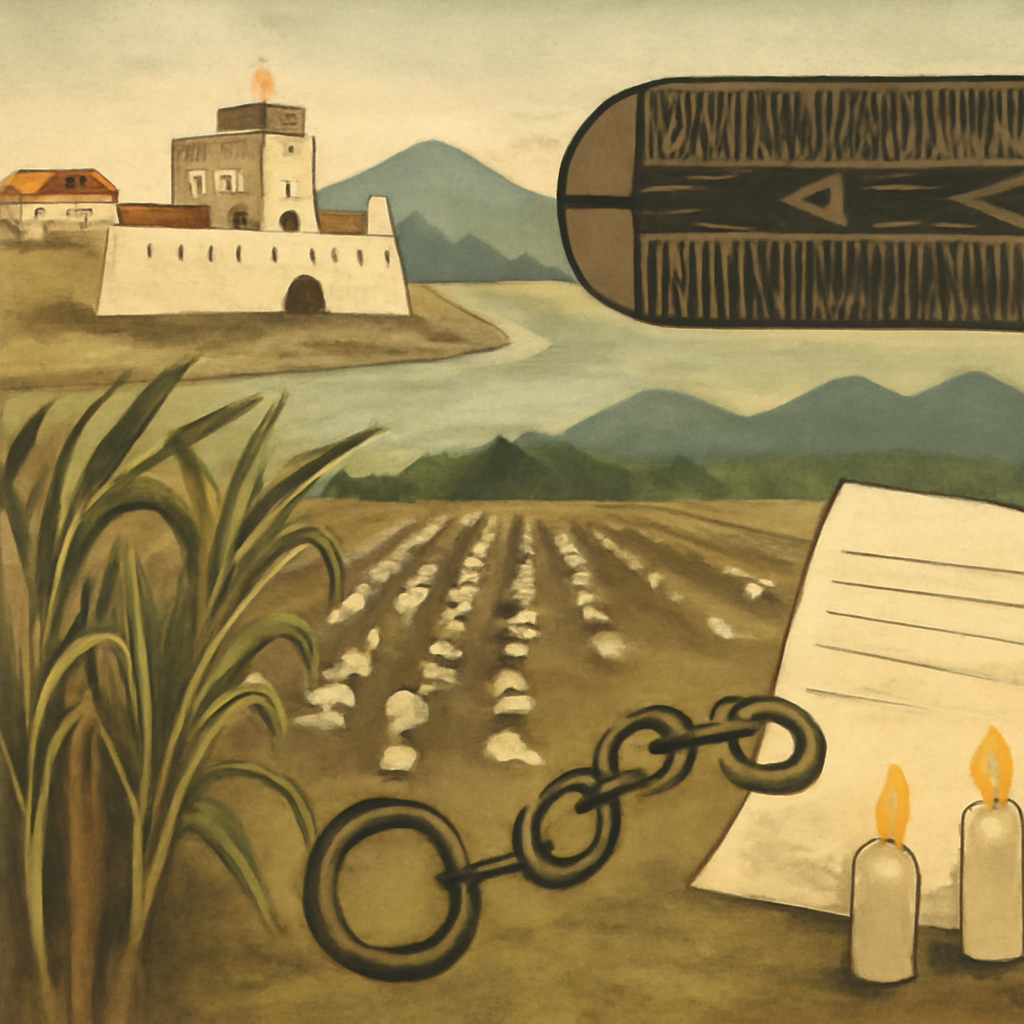
By 1739 South Carolina was a colony built on the labor and coercion of enslaved Africans. Planter wealth, local politics, and everyday life depended on a legal and social order that sought to control bodies, labor, movement and knowledge. Enslaved people lived within that system, subjected to work regimes, punishments, and laws designed to limit autonomy; yet resistance in many forms—daily foot-slogging refusal, running away, legal petitions, cultural survival—was a constant part of life. Colonial authorities and planters also lived with a persistent fear of violent insurrection, and they responded by drafting and enforcing codes intended to prevent collective action.
At the same time, those who labored in bondage carried memories, networks, and hopes that connected them to one another and to wider Atlantic worlds. No single cause explains an uprising like Stono: economic pressure, personal anguish, communal memory, and opportunity all intersected. Understanding this backdrop helps explain why some chose to act when they did and why the colony reacted as it did. The Stono Rebellion unfolded in colonial South Carolina, where plantation slavery, African cultural memory, Catholic Spanish Florida, militia law, and brutal labor discipline shaped daily life.
Many enslaved people in the colony had African military or communal experience, and some knew that Spanish Florida had offered freedom to fugitives who reached its territory and accepted Catholic baptism. Stono was therefore not random violence. It emerged from a landscape of forced labor, surveillance, rumor, opportunity, and a real geography of escape.
The Turning Point
The Stono moment changed the tenor of conflict in the colony by turning everyday resistance into an organized, visible challenge. Enslaved rebels—whose names and full stories do not all survive in the official record—undertook armed action that directly confronted planters and the colonial order. That act of collective choice forced immediate decisions by South Carolina planters and their magistrates: they mobilized militia, enacted rapid measures to reassert control, and used overwhelming force to end the uprising. Those choices made two things clear at once. First, enslaved people could and would move from covert forms of resistance to open rebellion when they judged it necessary or possible.
Second, colonial authorities would respond with decisive repression and legal tightening to deter future challenges. The unfolding reveals a clash of agency and authority—people risking everything to contest their condition, and a colonial regime determined to reimpose a strict social hierarchy. The event thus crystallized tensions that otherwise simmered beneath plantation life and turned them into immediate policy and military responses. The rebellion began when a group of enslaved people gathered near the Stono River, seized weapons, and moved southward while calling others to join. The march made resistance visible and alarming to white colonists because it challenged the assumption that enslaved people were isolated and controllable. Armed planters and militia responded quickly.
The turning point was the clash between a collective bid for freedom and a colonial society organized to prevent exactly that possibility. The event's violence must be read alongside the violence of the system it confronted.
Consequences
In the short term, colonial authorities suppressed the revolt by force and then moved to codify their response: laws and local regulations were tightened to restrict movement, assembly, and the capacity of enslaved people to organize. Planters and officials sought to make rebellion more difficult through stricter oversight and harsher penalties, reshaping daily realities on plantations and in towns. In the longer view, Stono became part of a pattern in Atlantic slavery in which acts of resistance and systems of repression were in continual dialogue. Its legacy is not a single line of cause and effect but a stratified one: the uprising informed legal practice, influenced planter attitudes toward security and labor, and entered into the contested archives of memory.
How people remember and record Stono depends on the sources consulted—official court records and newspapers emphasize order and punishment; community memory, oral traditions, and later scholarship highlight resistance, motives, and human suffering. Archaeology, law, diplomacy, and labor history each add pieces to a story that resists a single, authoritative account. That complexity is itself part of the event’s consequence: Stono compels historians and readers to weigh varied kinds of evidence and to live with unresolved tensions between resistance and repression. The consequences included harsh repression and the 1740 Negro Act, which tightened control over movement, assembly, education, and economic activity by enslaved people. The rebellion also forced colonists to confront how fragile their labor regime was.
Stono's memory matters because it shows enslaved people as strategic actors who understood law, geography, and imperial rivalry. It also shows how slave societies answered resistance with more regulation. The event is a compact but powerful window into Atlantic slavery's fear and coercion.
Interpretation Notes
Interpretations of Stono Rebellion depend on whose evidence is centered: rulers and official records, affected communities, oral memory, archaeology, law, diplomacy, labor, and later public memory do not always tell the same story.
Why Keep Reading
Follow the threads Stono unravels: how did tightened codes reshape life on Carolina plantations, and how did enslaved people adapt to those new restrictions? Tracing subsequent laws, local court cases, fugitive narratives, and material remains shows how the colony tried to lock down society and how those attempts repeatedly met with evasion and contestation. Readers who continue will see Stono not as an isolated outbreak but as a hinge in a longer story of legal change, everyday resistance, and memory-making across the British Atlantic. Each record—official report, oral account, artifact—moves us closer to understanding the choices people made under bondage and the limits of colonial power. Read next into Atlantic slavery, maroon communities, British and U. S.
slave-trade bans, and the Haitian Revolution. Stono helps connect local rebellion to the wider Atlantic politics of escape and control.
Reading Path
Follow the story without losing the thread
Before This
- Pueblo Revolt1680
After This
- Somerset Case1772
- Zong Massacre1781
- Haitian Revolution Begins1791 CE
Same Period
- Zong Massacre1781
- Haitian Revolution Begins1791 CE
- American Civil War BeginsApril 12, 1861
Wider Timeline
Mind Map
How to think about Stono Rebellion
Plantation dependence
South Carolina’s economy relied on the labor of enslaved people and strict systems of control.
Map Layer
Where this event sits geographically
Gold pins mark the approximate locations of published event pages. This is a schematic locator map, not a historical border map.
Coordinates are approximate and are used to help readers orient themselves before opening a full event page.
References
Where to Check the Facts
- Encyclopaedia Britannica: Transatlantic slave tradeReference for the forced migration system, Atlantic paths, and slavery's global consequences.
- Gilder Lehrman Institute: Olaudah Equiano, 1789Primary-source teaching reference for Equiano's abolitionist narrative and remembered Middle Passage experience.
- Official database: Slave VoyagesReference database for transatlantic slave trade paths, voyages, forced migration, and estimates.