At a Glance
The shape of the event
- Date
- 1392
- Place
- Korean Peninsula
- Type
- Dynastic Foundation
The Joseon dynasty replaced Goryeo and built a long-lasting Korean state shaped by Confucian institutions and elite culture.
1392; place the event in Korean Peninsula before comparing causes or consequences.
The event deepens East Asian coverage with Korea's own dynastic transformation.
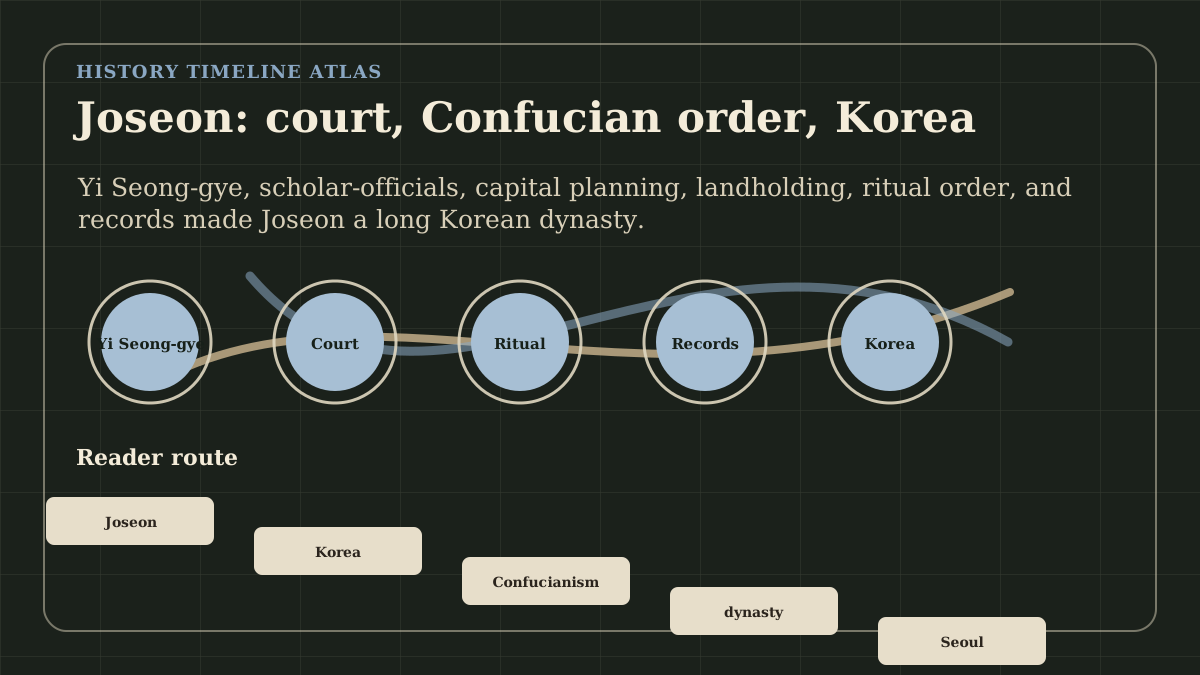
Yi Seong-gye / Korean scholar-officials are the first names or groups to compare before widening the story.
Joseon rule became central to Korean political, social, and cultural history.
Joseon rule became central to Korean political, social, and cultural history.
The event deepens East Asian coverage with Korea's own dynastic transformation.
Follow the next entries to trace how ideas and institutions seeded in 1392 were tested across decades: the spread of Confucian schools, the reshaping of law and local administration, changing diplomatic ties with neig...
Background
By the late 14th century the Korean Peninsula carried layered pressures: dynastic strains within Goryeo, competing military and civil elites, and the ongoing flow of ideas and diplomatic contact across East Asia. Networks of scholar-officials—men trained in literary learning and administrative practice—had gained influence by arguing for different priorities in governance. Yi Seong-gye, a military leader who emerged within these contested circles, found an opportunity to reset the political order. The new ruling group drew on Confucian thought not just as private belief but as a framework for institutions: education, meritocratic selection, law, and ritual. That intellectual turn mattered because it reshaped criteria for legitimacy and the composition of the ruling elite.
Yet it would be misleading to attribute the change to a single cause. Local communities, labor arrangements, legal customs, oral memories, archaeology, and diplomatic ties also shaped what was possible. Some records emphasize royal proclamations; other kinds of evidence—what people built, how they worked, what they remembered—point to different experiences of the same years. The founding of Joseon must be seen against all of these overlapping pressures rather than as the product of a single narrative. Joseon's foundation is strongest when the page treats the dynasty as a Korean political transformation, not just another East Asian label.
Yi Seong-gye's rise replaced Goryeo after military crisis, elite division, and questions about how the state should relate to land, bureaucracy, Buddhism, Confucian learning, and Ming China. Confucianism mattered as institution, not only philosophy. Scholar-official recruitment, court ritual, family order, education, historical writing, law, and the moral language of rulership all helped Joseon define legitimate government. A dynasty could last because it trained people to argue inside its rules as well as obey them. The evidence route matters.
Court records, annals, material culture, palace spaces, literati writing, and later national memory each show different Joseon worlds: central officials, local elites, women in household systems, Buddhist communities, commoners, enslaved people, and border populations did not all experience the dynasty the same way.
The Turning Point
The core change in 1392 was a transfer of political authority accompanied by a program to reorder government along Confucian lines. Yi Seong-gye took the decisive political initiative; scholar-officials supplied the administrative blueprints and ideological language that justified a new dynasty. Together they closed one chapter of Goryeo institutions and opened another: offices were rethought, ritual calendars and official priorities were revised, and the moral weight of Confucian learning was elevated as the basis for governance. These were concrete choices—who sits at the capital, which examinations matter, how laws are framed, how diplomacy is conducted—that made the break more than symbolic. At the same time, those choices did not play out uniformly across the peninsula.
Local authorities, labor systems, and popular practices shaped how reforms were implemented, and many communities retained older customs even as new policies were promulgated from the center. The turning point, then, was not a single event but a set of deliberate institutional decisions by rulers and literati, experienced unevenly by farmers, artisans, provincial elites, and border communities. The turning point was the conversion of a military-political takeover into a new dynastic order. Founding a dynasty meant more than replacing a ruler. It required a capital, royal genealogy, official titles, calendars, diplomatic recognition, court history, and a claim that the new order was morally superior to the one it replaced. Hanyang, later Seoul, gave the transformation a city.
Capital planning turned political legitimacy into gates, palaces, offices, ritual spaces, streets, and archives. The page becomes easier to read when the dynasty is seen as a built environment as well as a chronology.
Consequences
In the near term, the founding of Joseon re-centered political legitimacy on a Confucian model and consolidated a core of scholar-official authority. That realignment changed recruitment for office, official priorities, and the vocabulary of statecraft. Over longer spans of time, the dynasty that emerged became central to how Korean political, social, and cultural history is remembered and studied: its institutions shaped educational and bureaucratic habits, its archives provide a record for later generations, and its elite culture left enduring marks on literature and ritual. Yet outcomes were complex. Some communities benefited from clearer bureaucratic channels; others experienced new demands—taxes, corvée labor, or more exacting ritual obligations—that altered daily life.
Interpretations of the founding vary because different sources foreground different experiences: court records emphasize legal reorganization and diplomacy, while archaeology and oral memory reveal continuities and disruptions in material life. Recognizing these multiple registers helps explain why historians still debate the balance between deliberate institutional design and ordinary social continuities when they assess Joseon’s beginnings. Joseon became one of world history's unusually long dynastic orders. Its institutions shaped Korean law, social hierarchy, education, diplomacy, gender norms, printing, records, and elite culture for centuries. The dynasty gave later Korean history a deep institutional memory. The long afterlife also complicates praise.
Joseon statecraft produced durable administration and rich cultural forms, but it also relied on hierarchy, exclusion, slavery, gender restriction, factional conflict, and border pressure. A full page should let readers admire institutional creativity without flattening social cost.
Interpretation Notes
Interpretations of Joseon Dynasty Founded depend on whose evidence is centered: rulers and official records, affected communities, oral memory, archaeology, law, diplomacy, labor, and later public memory do not always tell the same story.
Why Keep Reading
Follow the next entries to trace how ideas and institutions seeded in 1392 were tested across decades: the spread of Confucian schools, the reshaping of law and local administration, changing diplomatic ties with neighboring states, and the lived responses of provincial communities. Each subsequent event—policy reforms, legal codes, notable reigns—casts a different light on the original choices made at the dynasty’s founding. If you want to see how an intellectual program became everyday governance, and how material life pushed back on official designs, the timelines that follow will show that process in sequence and detail. Read Joseon beside Goryeo, Ming China, the Imjin War, Qing expansion, treaty-port pressure, annexation, and modern Korean division.
The route shows Korea as an active historical center whose institutions shaped East Asia rather than a backdrop to neighbors.
Reading Path
Follow the story without losing the thread
Before This
After This
- Imjin War Begins1592
- First Opium War Begins1839 CE
- Meiji Restoration1868 CE
Same Period
- Qin Unification of China221 BCE
- First Opium War Begins1839 CE
- Meiji Restoration1868 CE
Wider Timeline
Mind Map
How to think about Joseon Dynasty Founded
Institutional reform
Elevation of Confucian frameworks for law, education, and ritual as state policy
Map Layer
Where this event sits geographically
Gold pins mark the approximate locations of published event pages. This is a schematic locator map, not a historical border map.
Coordinates are approximate and are used to help readers orient themselves before opening a full event page.
References
Where to Check the Facts
- National Institute of Korean History: Annals of the Choson DynastyKorean institutional reference for Joseon court records, dynastic governance, scholar-official culture, and Korean historical specificity.
- Harvard University Press: A New History of KoreaKorean-history scholarship reference for Joseon state formation, Confucian institutions, elite culture, and long dynastic chronology.
- Metropolitan Museum of Art: Arts of KoreaMuseum reference for Korean cultural history, court culture, material culture, and dynastic-period interpretation.