At a Glance
The shape of the event
- Date
- 1757 CE
- Place
- Plassey
- Type
- Battle and company rule
The British East India Company defeated the nawab of Bengal at Plassey, turning commercial power into a much deeper political and military foothold in India.
1757 CE; place the event in Plassey before comparing causes or consequences.
The battle became a turning point in the creation of British colonial power in South Asia and a key example of empire built through company rule rather than only state conquest.
Robert Clive / Siraj ud-Daulah are the first names or groups to compare before widening the story.
The Company gained decisive influence in Bengal and moved toward direct revenue and political control.
The Company gained decisive influence in Bengal and moved toward direct revenue and political control.
The battle became a turning point in the creation of British colonial power in South Asia and a key example of empire built through company rule rather than only state conquest.
If Plassey intrigues you, the next steps are to follow how the Company turned battlefield advantage into administrative power and how Bengal’s revenue systems were reorganised.
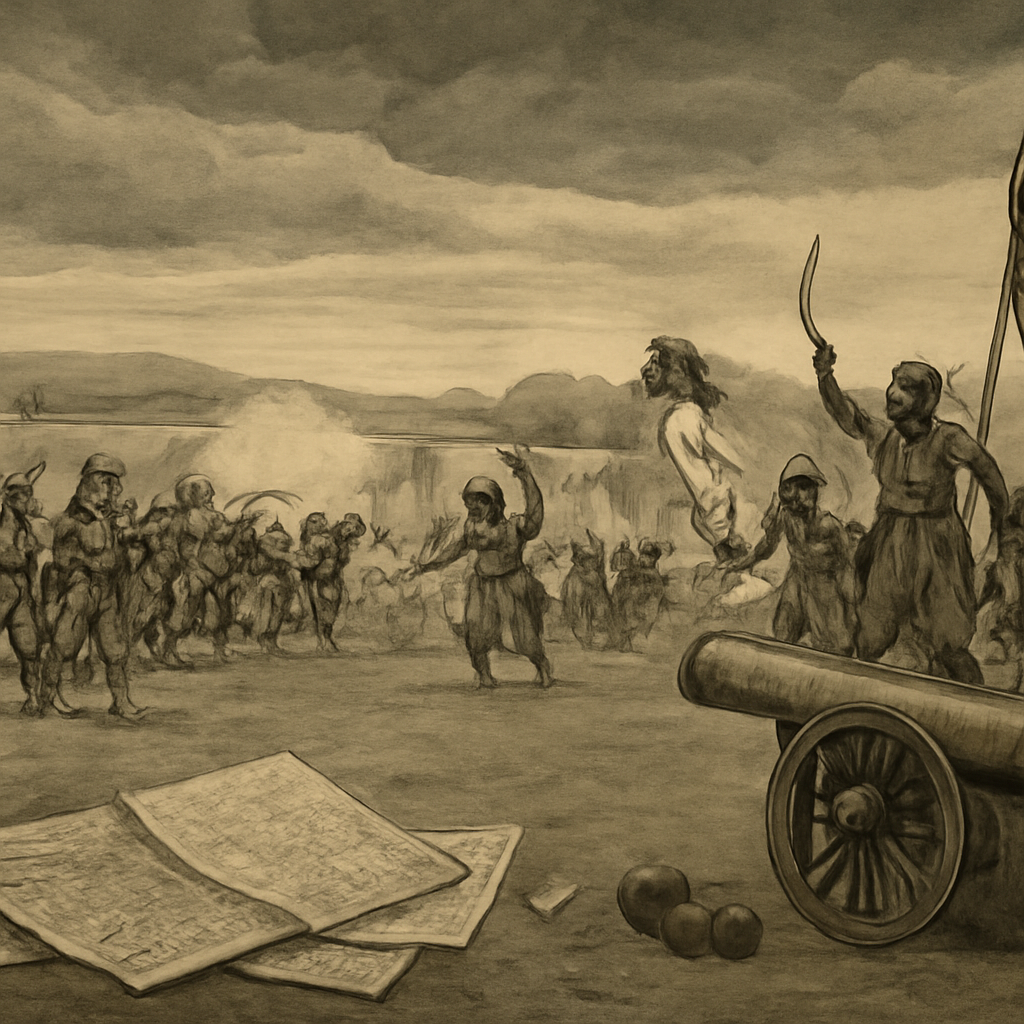
Background
By the mid-18th century Bengal was one of the richest provinces in South Asia, central to regional trade and fiscal resources. The British East India Company had long operated there as a trading concern; it collected profits, negotiated privileges and maintained armed forces to protect its interests. At the same time, Bengal’s own politics were unsettled: the nawab’s authority rested on shifting alliances, court factions and the loyalty of military commanders. Company servants combined commercial motives with personal ambition; finances and private profit sat beside formal corporate policy. European rivals, local powerbrokers and fiscal imperatives pressed on the fragile arrangements that had governed trade and taxation.
That layered context matters because Plassey did not create Company power from nothing; it capitalised on existing commercial penetration, on divisions within Bengal’s elite, and on the Company’s capacity to convert armed force into political leverage. No single cause explains the outcome — military force, political intrigue and the Company’s need for revenue and control all intersected. Plassey was not just a battlefield victory by the East India Company. It grew from Bengal's wealth, court faction, European commercial rivalry, private trade, fortification disputes, credit networks, and mistrust between Siraj ud-Daulah and company officials. The Company was a corporation with soldiers, shareholders, diplomats, and revenue ambitions. That combination made the battle a hinge between commerce and rule.
The Turning Point
The decisive shift at Plassey was not only a battlefield result but a conversion of roles: merchant traders acting as a political-military power. During the engagement the East India Company, under Robert Clive’s leadership, defeated the forces of Siraj ud-Daulah, the sitting nawab of Bengal. That victory created immediate leverage. For the Company, winning on the field became a means to press demands that previously had been negotiated through commerce and diplomacy. For the nawab, defeat meant the erosion of sovereign authority in practical terms — the capacity to collect revenue, command troops and secure loyalties was compromised.
The choices made in the aftermath mattered as much as those on the day itself: the Company chose to translate military advantage into sustained influence over Bengal’s administration and finances, while Bengal’s ruling structures were left weakened and exposed to further corporate intervention. In short, Plassey altered the relationship between commerce and sovereignty in Bengal, making political control attainable through a company that already pursued profit and protection. The decisive turn came through alliance and betrayal as much as combat. Robert Clive's forces were smaller, but negotiations with Mir Jafar and other Bengali elites changed the political equation before the battlefield was settled. Plassey showed that company power could operate through local divisions, financial promises, and military force together.
The event's drama lies in how little fighting was needed once legitimacy and loyalty had shifted.
Consequences
In the near term the Company seized decisive influence in Bengal. That influence opened pathways toward direct control over revenue collection and political appointments, shifting the balance between private commercial interest and regional governance. The longer-term consequence was structural: Plassey stands as an early example of empire built through company rule rather than only by metropolitan armies and state administration. Over subsequent decades the East India Company expanded its capacity to administer territory, raise revenues and exercise military power in ways that resembled sovereignty. Those processes reshaped governance in Bengal — altering who made fiscal decisions, who profited from trade and who answered to which authorities — and they informed practices the Company would use elsewhere in South Asia.
At the same time, the battle’s significance is complex: it accelerated change but did not by itself settle every question of rule or resistance. Political maneuvering, fiscal pressures and local agency continued to shape outcomes long after the muskets fell silent, and historians must keep Bengal politics and Company finance visible when tracing the path from Plassey to later colonial structures. The consequences were enormous. Company influence over Bengal expanded, revenue access transformed corporate power, and British political authority in India entered a new phase. Bengal's resources helped finance further expansion, while corruption and extraction produced controversy in Britain and suffering in India.
Plassey therefore marks a shift from trading privilege toward territorial power, even though that shift developed unevenly after 1757. For Bengal, the consequences were not abstract: court politics, revenue collection, military employment, and merchant credit all shifted under company pressure.
Interpretation Notes
Plassey can be oversimplified as the beginning of British India; the page keeps Bengal politics, company finance, and later revenue control visible.
Why Keep Reading
If Plassey intrigues you, the next steps are to follow how the Company turned battlefield advantage into administrative power and how Bengal’s revenue systems were reorganised. Look for accounts of how Company servants negotiated authority with local elites, how finance underpinned military expansion, and how legal and fiscal changes altered everyday governance. Tracing those threads reveals the mechanics by which a commercial corporation became a ruling power and shows the uneven, contested nature of early colonial rule — a story that connects a single 1757 encounter to decades of political transformation across South Asia. Follow Plassey into the Bengal revenue system, the 1770 famine, Company rule, Indian rebellion in 1857, and British imperial governance.
The route shows how a company became a state-like power. The same route also makes corporate sovereignty visible: contracts, credit, armies, and revenue rights could turn commercial privilege into political command.
Reading Path
Follow the story without losing the thread
Before This
After This
Same Period
- Columbus's First Atlantic Voyage1492 CE
- Fall of the Aztec Empire1521 CE
- First Opium War Begins1839 CE
Wider Timeline
Mind Map
How to think about Battle of Plassey
Commercial pressure
Bengal’s wealth and trade made control of revenue and privileges a central aim for the East India Company.
Map Layer
Where this event sits geographically
Gold pins mark the approximate locations of published event pages. This is a schematic locator map, not a historical border map.
Coordinates are approximate and are used to help readers orient themselves before opening a full event page.
References
Where to Check the Facts
- The National Archives: India 1857Archive education reference using documents for the causes and interpretation of the 1857 rebellion.
- British Library: India Office Records and Private PapersInstitutional archive reference for East India Company and British India records.
- Encyclopaedia Britannica: Battle of PlasseyReference for the battle, East India Company victory, Bengal context, and colonial consequences.
- Encyclopaedia Britannica: Indian Rebellion of 1857Reference for the 1857 revolt, sepoy context, British rule, and transfer toward direct imperial government.
- Library of Congress: U.S. History Primary Source TimelinePrimary-source timeline reference for Atlantic settlement, colonial expansion, reform, and later U.S. history paths.