How to Read the Year
Why did Guinea's 1958 vote make decolonization look like a public choice rather than a uniform handover?
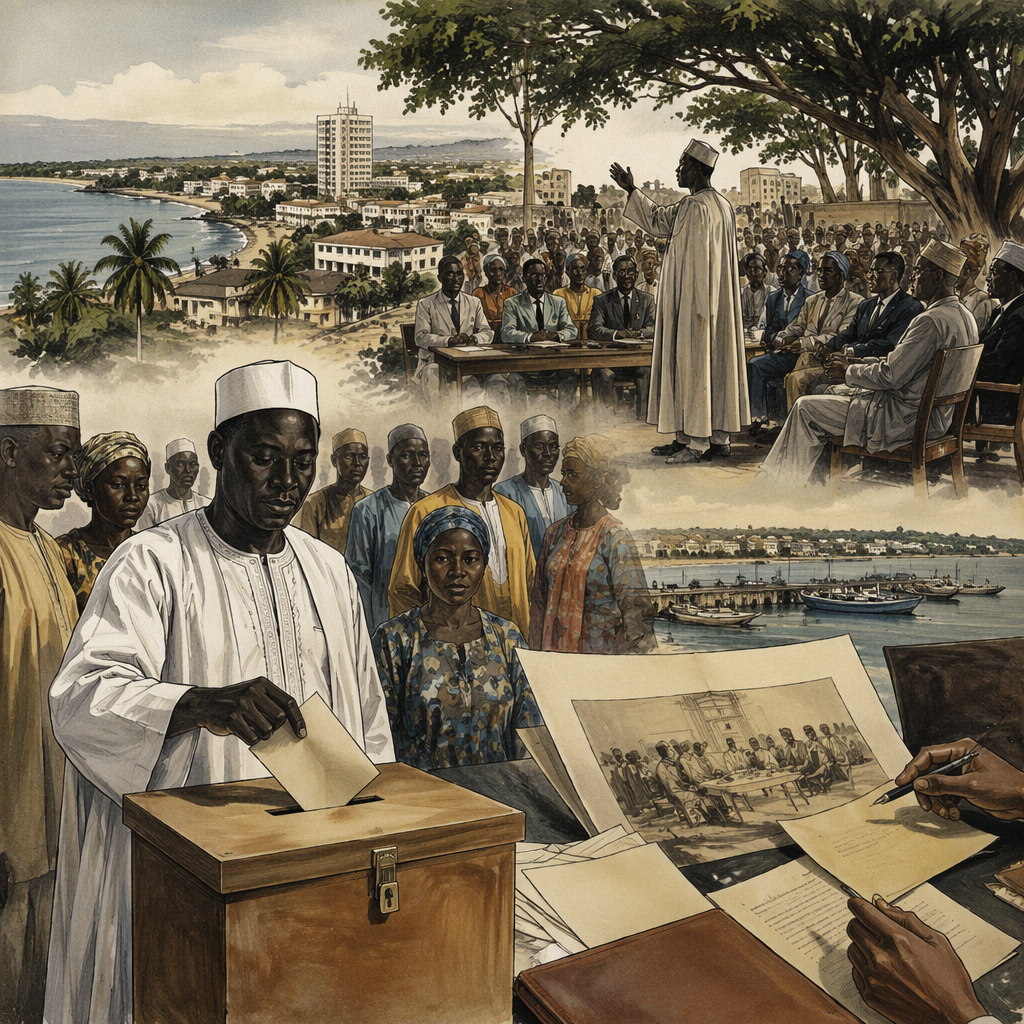
1958 is anchored by Guinea's vote against membership in the French Community. The date matters because it turns Francophone African decolonization into a visible political decision: voters and leaders in Guinea chose immediate independence even though French officials made clear that rejection could bring economic and administrative consequences.
The year belongs to a wider crisis of French empire. Algeria was at war, France was remaking its constitution under Charles de Gaulle, and colonial territories were being asked to accept a new relationship that preserved French influence while promising reform. Guinea's no vote exposed the tension between autonomy offered from above and sovereignty demanded from below.
Ahmed Sekou Toure and the Democratic Party of Guinea gave the vote a political voice, but the story also belongs to ordinary voters, union networks, teachers, clerks, youth organizers, chiefs, farmers, and urban workers. Decolonization was not only a negotiation among officials. It involved public meetings, party discipline, economic fear, and arguments over dignity.
The aftermath gives the year its edge. Guinea gained independence quickly, but France's withdrawal of personnel, resources, and support made sovereignty costly. The new state had to build administration, seek foreign partners, manage party power, and turn symbolic independence into schools, budgets, roads, health services, and international recognition.
1958 should be read beside Ghana, Algeria, Congo, Bandung, and later African unity pages. The comparison shows that decolonization did not follow one script. Some states negotiated gradual transfer, some fought wars, some entered federations, and Guinea made a dramatic referendum choice that shaped Francophone African memory.
The date also helps readers understand the Global South route. A ballot in Conakry was connected to Cold War aid, pan-African rhetoric, French strategy, UN diplomacy, and the question of whether political independence could survive economic vulnerability. That makes 1958 more than a national anniversary. It asks who pays the first costs of sovereignty.
The French Community proposal gives the year a precise institutional frame. It offered a redesigned imperial relationship rather than immediate equality among sovereign states. Guinea's rejection mattered because it exposed the gap between reforming empire and leaving empire, a difference that many readers miss when decolonization is summarized too quickly.
1958 CE in History gathers events that help readers move from a single date into wider historical patterns. A useful year entry does more than answer what happened; it shows why people keep using the year as a marker for change.
The connected events show how decisions, institutions, conflicts, ideas, and consequences crossed beyond one location or one person. The event links explain the immediate story, while the topic routes and timelines show what came before and after.
The year also helps organize broad questions. It gives readers a concise answer and a direct path into deeper event pages where causes, turning points, consequences, maps, and references are easier to inspect.
Read the date in three passes. First ask what happened inside the year itself. Then ask which older pressures made the event possible. Finally ask which later pages reuse the same vocabulary, institutions, borders, technologies, or memories. That sequence keeps the page from becoming a trivia answer.
Even when only one event is currently attached, the year still has a job: it gives students and curious visitors a stable chronological doorway into the atlas. The page makes the doorway useful by pointing to the event, the topic route, the timeline, the map, and the evidence trail that can turn a date into a broader explanation.
This year matters because it connects Guinea Votes No to the French Community to a wider sequence of causes and consequences. It gives the reader a chronological anchor while still pointing outward to people, places, institutions, and later effects. A thin year page would only name the event; a useful year page explains why this date is a handle for a larger route through history. 1958 matters because Guinea's no vote made sovereignty visible as a choice with costs. It helps readers understand decolonization as public politics: ballots, speeches, party organization, imperial pressure, economic retaliation, and international alignment all shaped what independence meant. The year is a strong doorway into Francophone Africa and the wider Global South.
Reader Lenses
Look for the pressures that made change possible.
Identify who acted and what options were available.
Follow what changed after the event.
Ask why this date still appears in historical summaries.
Treat the vote as public political action shaped by party organizing, speeches, fear, and dignity.
Ask what immediate independence required once French personnel, aid, and administrative support withdrew.
Place Guinea beside other French African territories that made different choices in 1958.
How This Year Connects
1958 CE in History is anchored by Guinea Votes No to the French Community. Read those pages together and the year stops being a date label; it becomes a crossroads where immediate choices met older pressures and opened later consequences.
The setting matters as much as the date. The year moves through Conakry and belongs to Decolonization. That combination helps readers avoid treating the year as isolated; geography, institutions, conflict, belief, economy, and communication all shape what a date can mean.
The year also opens into people and themes. Figures such as Ahmed Sekou Toure and Guinean voters appear because their choices made the year visible, while themes such as Guinea, French Community, Francophone West Africa, and Sovereignty explain why the consequences outlived the moment. A useful next step is usually an event page, then a topic route, then a timeline.
Evidence changes the way a date reads. A treaty, battle report, inscription, newspaper, census, court record, memoir, photograph, or archaeological trace does not answer the same question. Looking at source type helps separate what happened in the year from how later people remembered it.
A year page is most useful when it keeps two scales open at once. The first scale is immediate: what happened, where, and who was involved. The second scale is interpretive: why later readers use this date to organize a wider story. Holding both scales together makes the page a starting point for deeper reading rather than a dead-end answer.
The before-and-after frame matters too. A date rarely begins the forces it reveals. Earlier pressures made the linked event possible, while later pages show which effects were temporary, which became institutions, and which turned into memory. Reading the year this way helps students avoid the false impression that history changes only when the calendar flips.
Use this page as a junction. If the event feels too brief, follow the topic route for background; if the cause feels too abstract, open the event page for sequence; if the consequence feels larger than the date, move into the timeline. The value of a year page is that it lets readers change scale without losing their place.
Read 1958 beside Guinea's referendum, Ghana independence, Bandung, Algeria, Congo, OAU, and decolonization timelines. That path shows several routes out of empire rather than one decolonization template.
Then compare 1958 with 1947, 1955, 1960, 1963, and 1975. The comparison asks how elections, wars, conferences, and institutions each made sovereignty public.
Events in This Year
- September 28, 1958Guinea Votes No to the French Community
Guinea rejected continued membership in the French Community and chose immediate independence, making Francophone West African decolonization visible as a public vote rather than a uniform handover.
Map Layer
1958 CE in History geography
Gold pins mark the approximate locations of published event pages. This is a schematic locator map, not a historical border map.
Coordinates are approximate and are used to help readers orient themselves before opening a full event page.
References
Where to Check the Facts
- Encyclopaedia Britannica: GuineaReference for Guinea's 1958 independence and political context.