How to Read the Year
Why does 1896 make anti-colonial history visible in both Africa and Southeast Asia?
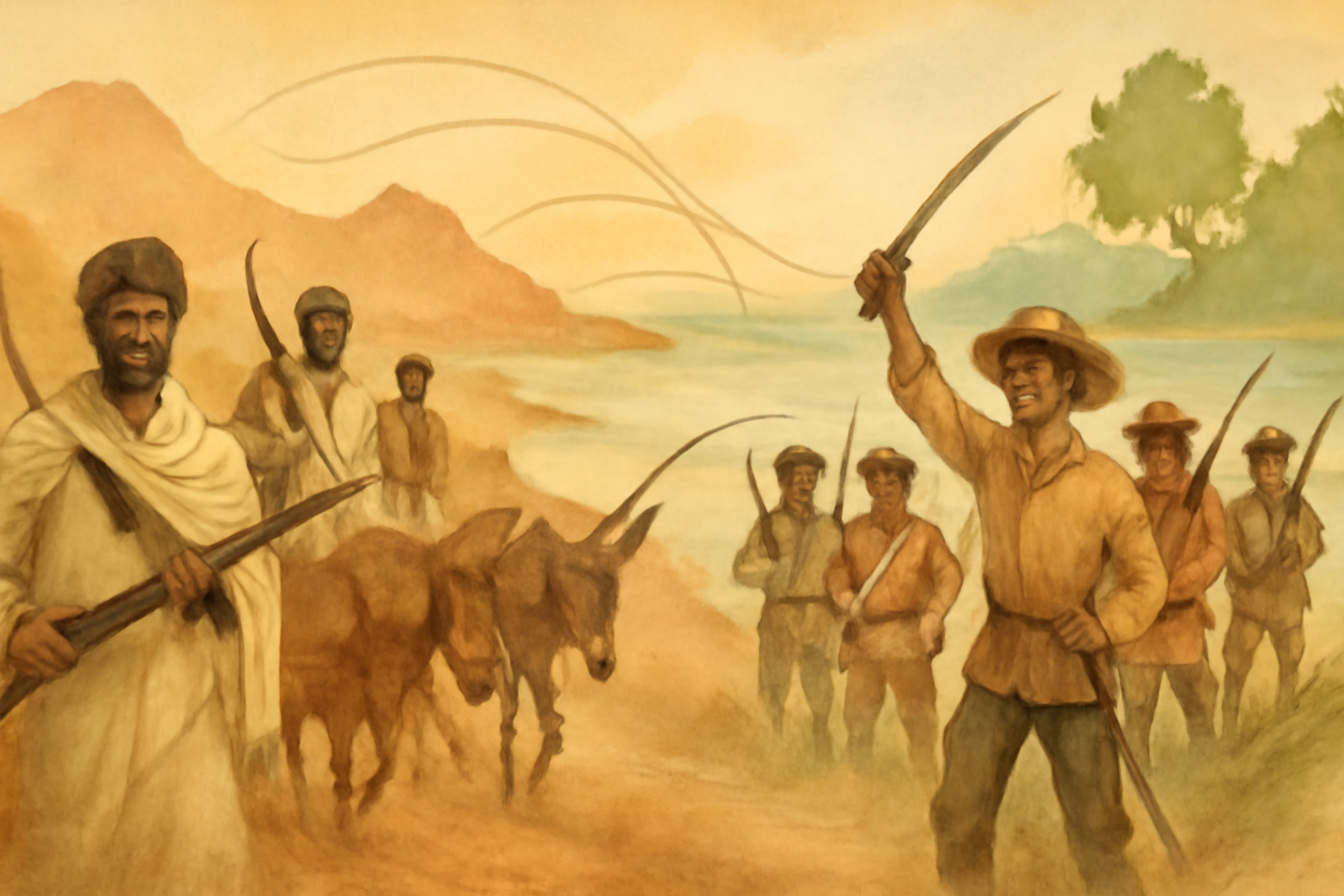
1896 is anchored by the Battle of Adwa and the Philippine Revolution, two events that make the year much larger than a single national anniversary. In Ethiopia, Menelik II's forces defeated Italy and preserved sovereignty at a moment when European empires were partitioning much of Africa. In the Philippines, revolutionary organizing challenged Spanish colonial rule and opened a longer struggle over republic-making, empire, and U.S. intervention.
The year matters because it shows anti-colonial history taking different forms at the same time. Adwa was a battlefield victory built from diplomacy, arms, mobilization, geography, and imperial miscalculation. The Philippine Revolution was a movement of networks, writings, societies, local uprisings, leaders, and competing visions of nationhood. One event preserved an existing African state's sovereignty; the other pushed a colony toward revolution and uncertain independence.
1896 also warns against simple victory language. Adwa became a global symbol of African resistance, but Ethiopian state-building had its own internal hierarchies and contested memories. The Philippine Revolution challenged Spanish rule, but the collapse of one empire soon opened confrontation with another. A rich year page keeps achievement and unfinished struggle together.
The best reading path moves from Menelik II and Adwa to the Scramble for Africa, then from Jose Rizal, Emilio Aguinaldo, and the Philippine Revolution to Pacific empire and Southeast Asian decolonization. The comparison helps readers see that anti-colonial politics could move through armies, pamphlets, secret societies, diplomacy, local grievances, and world attention.
For Google search intent, 1896 in history should answer what happened while giving readers a reason to continue. The answer is not a list; it is a pattern. Across distant regions, imperial confidence met organized resistance, and later movements remembered the year as evidence that colonial power was not inevitable.
The memory layer connects the two cases. Adwa and the Philippine Revolution entered songs, commemorations, school narratives, exile writing, and nationalist argument, proving that resistance continued through memory as well as through armies.
1896 CE in History gathers events that help readers move from a single date into wider historical patterns. A useful year entry does more than answer what happened; it shows why people keep using the year as a marker for change.
The connected events show how decisions, institutions, conflicts, ideas, and consequences crossed beyond one location or one person. The event links explain the immediate story, while the topic routes and timelines show what came before and after.
The year also helps organize broad questions. It gives readers a concise answer and a direct path into deeper event pages where causes, turning points, consequences, maps, and references are easier to inspect.
Read the date in three passes. First ask what happened inside the year itself. Then ask which older pressures made the event possible. Finally ask which later pages reuse the same vocabulary, institutions, borders, technologies, or memories. That sequence keeps the page from becoming a trivia answer.
Even when only one event is currently attached, the year still has a job: it gives students and curious visitors a stable chronological doorway into the atlas. The page makes the doorway useful by pointing to the event, the topic route, the timeline, the map, and the evidence trail that can turn a date into a broader explanation.
This year matters because it connects Battle of Adwa, Philippine Revolution to a wider sequence of causes and consequences. It gives the reader a chronological anchor while still pointing outward to people, places, institutions, and later effects. A thin year page would only name the event; a useful year page explains why this date is a handle for a larger route through history. 1896 matters because it makes resistance to empire visible across more than one region. Adwa and the Philippine Revolution show that anti-colonial history was not a single script: sovereignty could be defended by a state, claimed by revolutionaries, remembered through martyrdom, and complicated by new imperial pressures. The year helps the atlas connect Africa, Southeast Asia, nationalism, empire, and global memory.
Reader Lenses
Look for the pressures that made change possible.
Identify who acted and what options were available.
Follow what changed after the event.
Ask why this date still appears in historical summaries.
Compare Ethiopia defending state sovereignty with Filipinos challenging colonial rule and imagining a republic.
Ask why Adwa and the Philippine Revolution became symbols that later anti-colonial movements could reuse.
Track how one imperial defeat or colonial crisis could still leave new pressures, negotiations, and conflicts.
How This Year Connects
1896 CE in History is anchored by Battle of Adwa and Philippine Revolution. Read those pages together and the year stops being a date label; it becomes a crossroads where immediate choices met older pressures and opened later consequences.
The setting matters as much as the date. The year moves through Adwa and Philippines and belongs to African Anti-Colonial Resistance and Revolutionary and Colonial World. That combination helps readers avoid treating the year as isolated; geography, institutions, conflict, belief, economy, and communication all shape what a date can mean.
The year also opens into people and themes. Figures such as Menelik II, Empress Taytu Betul, Jose Rizal, Emilio Aguinaldo, and Andres Bonifacio appear because their choices made the year visible, while themes such as Africa, Ethiopia, Imperialism, Anti-Colonial Resistance, Philippine Revolution, and Spanish Empire explain why the consequences outlived the moment. A useful next step is usually an event page, then a topic route, then a timeline.
Evidence changes the way a date reads. A treaty, battle report, inscription, newspaper, census, court record, memoir, photograph, or archaeological trace does not answer the same question. Looking at source type helps separate what happened in the year from how later people remembered it.
A year page is most useful when it keeps two scales open at once. The first scale is immediate: what happened, where, and who was involved. The second scale is interpretive: why later readers use this date to organize a wider story. Holding both scales together makes the page a starting point for deeper reading rather than a dead-end answer.
The before-and-after frame matters too. A date rarely begins the forces it reveals. Earlier pressures made the linked event possible, while later pages show which effects were temporary, which became institutions, and which turned into memory. Reading the year this way helps students avoid the false impression that history changes only when the calendar flips.
Use this page as a junction. If the event feels too brief, follow the topic route for background; if the cause feels too abstract, open the event page for sequence; if the consequence feels larger than the date, move into the timeline. The value of a year page is that it lets readers change scale without losing their place.
Read 1896 beside the Battle of Adwa, Menelik II, the Philippine Revolution, Jose Rizal, Emilio Aguinaldo, Scramble for Africa, and Southeast Asian decolonization routes.
Then compare 1896 with 1857, 1905, 1947, 1957, and 1975. The comparison asks how anti-colonial resistance moved through rebellion, state armies, parties, referendums, and liberation wars.
Events in This Year
- March 1, 1896Battle of Adwa
Ethiopian forces defeated Italy at Adwa, preserving Ethiopian sovereignty during the age of European imperial partition.
- 1896-1898 CEPhilippine Revolution
The Philippine Revolution challenged Spanish colonial rule through nationalist organization, armed revolt, reformist memory, and competing visions of independence.
Map Layer
1896 CE in History geography
Gold pins mark the approximate locations of published event pages. This is a schematic locator map, not a historical border map.
Coordinates are approximate and are used to help readers orient themselves before opening a full event page.
References
Where to Check the Facts
- Encyclopaedia Britannica: Battle of AdwaSpecific reference for the 1896 CE anchor event, chronology, and historical setting.
- Encyclopaedia BritannicaBackground reference for chronology, names, and historical context.
- WikidataStructured reference for dates, places, alternate names, and entity links.