How to Read the Year
Why did the overthrow of the Hawaiian Kingdom become a lasting sovereignty question?
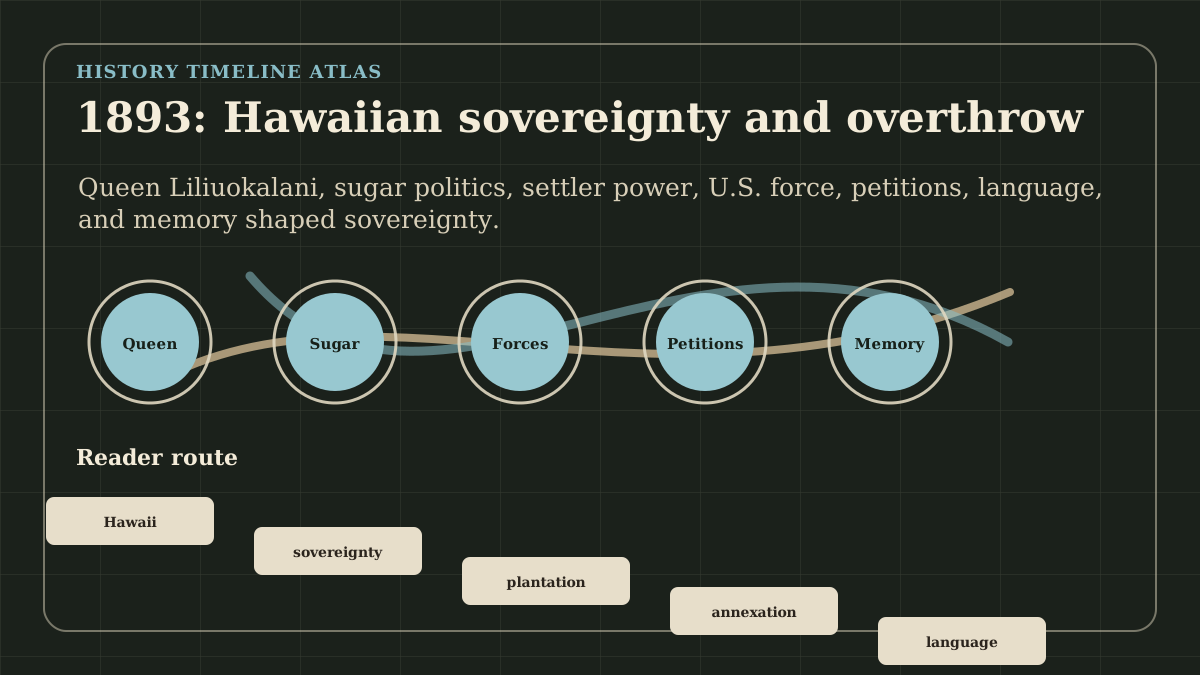
1893 is anchored by the overthrow of Queen Liliuokalani and the Hawaiian Kingdom. The year matters because local elite interests, sugar politics, U.S. strategic ambition, settler power, constitutional conflict, and the presence of U.S. forces combined to remove a sovereign monarch.
The overthrow was not an isolated island coup. Hawaii sat inside Pacific trade, missionary legacies, plantation capitalism, and U.S. expansion toward Asia. Planters and annexationists wanted security for property and political influence; Native Hawaiian resistance defended sovereignty, monarchy, and national identity.
Queen Liliuokalani's role gives the year a human center. Her attempt to restore royal authority under a new constitution threatened the political order built by earlier restrictions on the monarchy. Her restraint under pressure also shaped later memory: the loss of sovereignty became a claim carried through petitions, songs, organizations, and historical argument.
1893 should therefore be read as both event and wound. Annexation followed later, but the overthrow itself marks the point when Hawaiian self-rule was broken by a coalition that relied on U.S. support. The consequences continue in debates over apology, land, language, cultural revival, and sovereignty.
The year page should make constitutional conflict concrete. The Bayonet Constitution had already weakened the monarchy and empowered property interests before Liliuokalani tried to revise the balance. That background helps readers see why the overthrow was not a spontaneous crisis but a struggle over who could define legitimate government.
Petitions and songs matter because they turn political loss into historical evidence. Native Hawaiian opposition did not vanish after the provisional government took power. It traveled through organizing, signatures, testimony, language preservation, cultural practice, and later sovereignty movements.
The Pacific frame also matters. Hawaii's location made it strategically valuable to the United States, while plantation capitalism made sugar interests powerful. The page is richer when economy, ocean geography, and Native political claims are held together.
The reader should feel the difference between overthrow and disappearance. Hawaiian political life continued through newspapers, clubs, churches, royalist networks, petitions, and family memory. That continuity gives the year emotional force because sovereignty survived as an argument even after state power was taken.
The date should point forward to annexation without collapsing the two events. 1893 marks the overthrow; 1898 made U.S. annexation formal. Keeping that sequence clear helps readers see how provisional power, diplomacy, war, and imperial policy turned a coup into a territorial transfer.
1893 CE in History gathers events that help readers move from a single date into wider historical patterns. A useful year entry does more than answer what happened; it shows why people keep using the year as a marker for change.
The connected events show how decisions, institutions, conflicts, ideas, and consequences crossed beyond one location or one person. The event links explain the immediate story, while the topic routes and timelines show what came before and after.
The year also helps organize broad questions. It gives readers a concise answer and a direct path into deeper event pages where causes, turning points, consequences, maps, and references are easier to inspect.
Read the date in three passes. First ask what happened inside the year itself. Then ask which older pressures made the event possible. Finally ask which later pages reuse the same vocabulary, institutions, borders, technologies, or memories. That sequence keeps the page from becoming a trivia answer.
Even when only one event is currently attached, the year still has a job: it gives students and curious visitors a stable chronological doorway into the atlas. The page makes the doorway useful by pointing to the event, the topic route, the timeline, the map, and the evidence trail that can turn a date into a broader explanation.
This year matters because it connects Overthrow of the Hawaiian Kingdom to a wider sequence of causes and consequences. It gives the reader a chronological anchor while still pointing outward to people, places, institutions, and later effects. A thin year page would only name the event; a useful year page explains why this date is a handle for a larger route through history. 1893 matters because it turns Pacific history into a clear question about sovereignty, capitalism, race, and U.S. expansion. The overthrow of the Hawaiian Kingdom shows how economic interests and strategic power could dismantle an independent state while later memory kept the claim of sovereignty alive.
Reader Lenses
Look for the pressures that made change possible.
Identify who acted and what options were available.
Follow what changed after the event.
Ask why this date still appears in historical summaries.
Ask what made the Hawaiian Kingdom a state and how that status was undermined.
Track sugar, property, settlers, and constitutional pressure.
Follow petitions, songs, apology, land, and language as forms of historical claim.
How This Year Connects
1893 CE in History is anchored by Overthrow of the Hawaiian Kingdom. Read those pages together and the year stops being a date label; it becomes a crossroads where immediate choices met older pressures and opened later consequences.
The setting matters as much as the date. The year moves through Honolulu and belongs to Pacific Imperialism. That combination helps readers avoid treating the year as isolated; geography, institutions, conflict, belief, economy, and communication all shape what a date can mean.
The year also opens into people and themes. Figures such as Queen Liliuokalani and Hawaiian nationalists appear because their choices made the year visible, while themes such as Hawaii, Sovereignty, and United States explain why the consequences outlived the moment. A useful next step is usually an event page, then a topic route, then a timeline.
Evidence changes the way a date reads. A treaty, battle report, inscription, newspaper, census, court record, memoir, photograph, or archaeological trace does not answer the same question. Looking at source type helps separate what happened in the year from how later people remembered it.
A year page is most useful when it keeps two scales open at once. The first scale is immediate: what happened, where, and who was involved. The second scale is interpretive: why later readers use this date to organize a wider story. Holding both scales together makes the page a starting point for deeper reading rather than a dead-end answer.
The before-and-after frame matters too. A date rarely begins the forces it reveals. Earlier pressures made the linked event possible, while later pages show which effects were temporary, which became institutions, and which turned into memory. Reading the year this way helps students avoid the false impression that history changes only when the calendar flips.
Use this page as a junction. If the event feels too brief, follow the topic route for background; if the cause feels too abstract, open the event page for sequence; if the consequence feels larger than the date, move into the timeline. The value of a year page is that it lets readers change scale without losing their place.
Read 1893 beside Queen Liliuokalani, the overthrow of the Hawaiian Kingdom, and Pacific / Oceania sovereignty route. That path keeps monarchy, plantation power, and U.S. expansion connected.
Then compare with 1840 in New Zealand, 1898 in U.S. imperial history, and decolonization movements. The comparison shows different ways sovereignty can be lost, claimed, and remembered.
Events in This Year
- 1893Overthrow of the Hawaiian Kingdom
A group of foreign residents backed by United States power overthrew Queen Liliuokalani and the Hawaiian Kingdom.
Map Layer
1893 CE in History geography
Gold pins mark the approximate locations of published event pages. This is a schematic locator map, not a historical border map.
Coordinates are approximate and are used to help readers orient themselves before opening a full event page.
References
Where to Check the Facts
- Te Ara: Pacific migrationsReference for Pacific voyaging, settlement paths, Polynesian migration, and Aotearoa context.
- Te Ara: TupaiaPacific-based biographical reference for Tupaia's navigation, mediation, and role during Cook's voyage.
- University of Hawaii ScholarSpace: Epeli Hau'ofa, Our Sea of IslandsPacific scholar's argument for reading Oceania as a connected sea of islands rather than scattered small places.
- Waitangi Tribunal: Treaty claims and Te TiritiPacific-based institutional reference for Te Tiriti, Maori claims, Crown obligations, and treaty interpretation.