How to Read the Year
Why does 1789 CE in History deserve a focused year page?
In 1789 a hungry Parisian crowd, anxious deputies at Versailles, rural communities attacking seigneurial records, and enslaved people in French colonies all entered the same political vocabulary from different positions. The year begins with fiscal crisis, but it becomes gripping because money problems turned into arguments over bread, sovereignty, privilege, rights, fear, and who counted as the nation.
The scenes arrive quickly. In January, pamphlets such as Abbe Sieyes's argument about the Third Estate made representation sound urgent. In June, deputies swore the Tennis Court Oath after being shut out of their usual meeting space. In July, Parisians moved from bread anxiety and rumor to the Bastille. In August, rural revolt pushed privilege onto the floor of the National Assembly.
The year was French in its immediate crisis but Atlantic and global in its consequences. The new United States was testing constitutional government, Caribbean planters were watching rights language with alarm, enslaved people and free people of color in Saint-Domingue heard universal claims differently from many deputies, and states beyond Europe followed French instability through trade, diplomacy, and war planning.
Colonial stakes were present before the Haitian Revolution began. Free men of color such as Julien Raimond pressed claims in France, planters feared that rights language would unsettle slavery, and enslaved people in Saint-Domingue heard universal language inside a violent plantation order. The Declaration of Rights therefore carried a contradiction from the start: it sounded universal while colonial law still guarded racial slavery.
Historians debate whether 1789 is best explained by fiscal breakdown, Enlightenment political culture, social inequality, state failure, crowd action, imperial war costs, or a crisis of sovereignty. The safest answer does not choose one cause too quickly; it follows how those pressures met in institutions, streets, villages, and colonies.
A deeper reading of 1789 begins with fiscal crisis, but money alone does not explain revolution. The French monarchy faced debt, tax inequality, food pressure, public criticism, elite resistance, and a political culture increasingly shaped by print, salons, legal argument, and Enlightenment language. The Estates-General opened because the state needed consent and resources, but representation quickly became a struggle over sovereignty.
The Tennis Court Oath and the formation of the National Assembly changed the meaning of political authority. Deputies claimed that the nation, not only the king, could speak with legitimate power. That claim did not instantly create democracy, but it broke the older grammar of monarchy. 1789 is therefore a year about who has the right to define the public will.
The Storming of the Bastille gives the year its urban drama. Parisian crowds acted from fear, hunger, rumor, political hope, and anger at royal force. The Bastille had limited military value, but enormous symbolic value as a fortress-prison associated with arbitrary authority. Its fall showed that street politics could alter national politics.
Peasant action widened the revolution beyond Paris. The Great Fear and rural attacks on seigneurial records made clear that grievances over dues, privilege, land, and local power were not secondary. The August decrees attacked feudal privileges because revolutionary pressure came from below as well as from deputies. Social conflict turned constitutional debate into a broader restructuring of rights and obligations.
The Declaration of the Rights of Man and of the Citizen gave 1789 a language that traveled. Rights, liberty, property, sovereignty, and equality before the law became revolutionary vocabulary. Yet the exclusions were visible from the start: women, enslaved people in colonies, the poor, and many religious and political minorities faced limits. The power of the language and the reality of exclusion must be read together.
The French Revolution also sits inside an Atlantic world. The American Revolution, fiscal war costs, Caribbean slavery, Enlightenment circulation, and later Haitian Revolution all connect to 1789. France was not isolated. Its crisis belonged to a wider age of imperial competition, rights claims, and arguments over who counted as a political subject.
The global frame also includes the new United States putting its Constitution into operation, Ottoman, Qing, and other imperial worlds watching European war and trade from their own positions, and Caribbean planters trying to keep slavery stable while rights language spread. Those links do not make 1789 less French; they explain why a French crisis became a world-historical reference point.
The year is useful because it shows revolution before the later Terror and Napoleon. Readers can see possibility before the outcome is fixed: constitutional monarchy, popular sovereignty, aristocratic fear, peasant revolt, urban militancy, and rights language all existed together. The uncertainty is the point. In 1789, no one yet knew what kind of regime would survive.
Religion and property also keep the year from becoming only a story of abstract ideas. Church lands, tithes, local authority, religious identity, and state finance made reform concrete. The revolution challenged privilege through legal language, but people encountered those changes through parish life, land records, taxes, courts, markets, and rumors. That is why 1789 belongs in social history as much as intellectual history.
The international layer was present from the beginning. Neighboring monarchies watched France with alarm, reformers elsewhere watched with excitement, and enslaved people and free people of color in the Caribbean heard rights language in ways French deputies did not fully control. The year therefore opened a politics of translation: once universal claims were spoken publicly, other groups could ask why they were not included.
1789 is also a year of uncertainty rather than a finished ideology. Constitutional monarchy, aristocratic reaction, popular militancy, rural revolt, liberal reform, royal hesitation, and radical possibility all existed at once. Readers who keep that uncertainty alive can see why the revolution later moved through phases rather than unfolding from a fixed script.
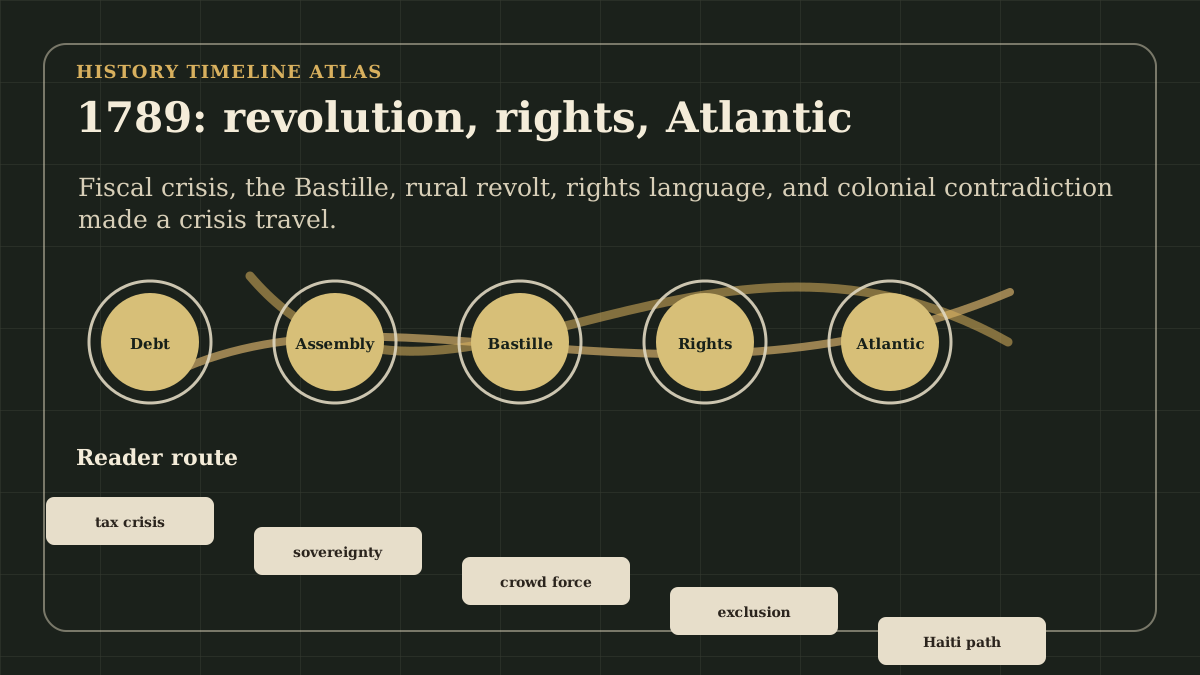
The reading path works best when readers move from institutions to streets and then to empire. The Estates-General explains representation, the Bastille explains popular force, the August decrees explain rural pressure, and the Haitian Revolution shows how rights language traveled beyond the boundaries many French reformers imagined.
The best next route moves from 1789 to the execution of Louis XVI, Haitian Revolution, Napoleon, 1848, and later rights movements. The year matters because it opened a political vocabulary that later actors would borrow, radicalize, reject, and expose.
1789 CE in History gathers events that help readers move from a single date into wider historical patterns. A useful year entry does more than answer what happened; it shows why people keep using the year as a marker for change.
The connected events show how decisions, institutions, conflicts, ideas, and consequences crossed beyond one location or one person. The event links explain the immediate story, while the topic routes and timelines show what came before and after.
The year also helps organize broad questions. It gives readers a concise answer and a direct path into deeper event pages where causes, turning points, consequences, maps, and references are easier to inspect.
Read the date in three passes. First ask what happened inside the year itself. Then ask which older pressures made the event possible. Finally ask which later pages reuse the same vocabulary, institutions, borders, technologies, or memories. That sequence keeps the page from becoming a trivia answer.
Even when only one event is currently attached, the year still has a job: it gives students and curious visitors a stable chronological doorway into the atlas. The page makes the doorway useful by pointing to the event, the topic route, the timeline, the map, and the evidence trail that can turn a date into a broader explanation.
This year matters because it connects French Revolution Begins, Storming of the Bastille to a wider sequence of causes and consequences. It gives the reader a chronological anchor while still pointing outward to people, places, institutions, and later effects. A thin year page would only name the event; a useful year page explains why this date is a handle for a larger route through history. 1789 matters because it made sovereignty, rights, representation, and privilege visible as public conflicts. The year did not complete the French Revolution, but it changed the terms of political possibility. Monarchy, aristocratic privilege, church authority, urban crowd action, peasant grievance, and written rights all entered a new relationship. That is why the date remains a gateway into modern revolutionary politics.
Reader Lenses
Look for the pressures that made change possible.
Identify who acted and what options were available.
Follow what changed after the event.
Ask why this date still appears in historical summaries.
Ask who claimed the right to speak for the nation and how that claim challenged monarchy.
Read Parisian and rural action as political force, not only background unrest.
Hold rights language beside the people it did not fully include.
How This Year Connects
1789 CE in History is anchored by French Revolution Begins and Storming of the Bastille. Read those pages together and the year stops being a date label; it becomes a crossroads where immediate choices met older pressures and opened later consequences.
The setting matters as much as the date. The year moves through Paris and belongs to Age of Revolutions. That combination helps readers avoid treating the year as isolated; geography, institutions, conflict, belief, economy, and communication all shape what a date can mean.
The year also opens into people and themes. Figures such as Louis XVI, Maximilien Robespierre, and Parisian crowds appear because their choices made the year visible, while themes such as France, Rights, Monarchy, and French Revolution explain why the consequences outlived the moment. A useful next step is usually an event page, then a topic route, then a timeline.
Evidence changes the way a date reads. A treaty, battle report, inscription, newspaper, census, court record, memoir, photograph, or archaeological trace does not answer the same question. Looking at source type helps separate what happened in the year from how later people remembered it.
A year page is most useful when it keeps two scales open at once. The first scale is immediate: what happened, where, and who was involved. The second scale is interpretive: why later readers use this date to organize a wider story. Holding both scales together makes the page a starting point for deeper reading rather than a dead-end answer.
The before-and-after frame matters too. A date rarely begins the forces it reveals. Earlier pressures made the linked event possible, while later pages show which effects were temporary, which became institutions, and which turned into memory. Reading the year this way helps students avoid the false impression that history changes only when the calendar flips.
Use this page as a junction. If the event feels too brief, follow the topic route for background; if the cause feels too abstract, open the event page for sequence; if the consequence feels larger than the date, move into the timeline. The value of a year page is that it lets readers change scale without losing their place.
Events in This Year
- 1789 CEFrench Revolution Begins
Fiscal crisis, social inequality, Enlightenment politics, and popular mobilization pushed France into revolution against the old regime.
- July 14, 1789Storming of the Bastille
Parisian crowds stormed the Bastille fortress during the French Revolution, turning political crisis into a visible attack on royal authority.
Map Layer
1789 CE in History geography
Gold pins mark the approximate locations of published event pages. This is a schematic locator map, not a historical border map.
Coordinates are approximate and are used to help readers orient themselves before opening a full event page.
References
Where to Check the Facts
- Library of Congress: Declaration of the Rights of Man and of the CitizenPrimary printed edition reference for the August 1789 declaration and rights language.
- Yale Avalon Project: Declaration of the Rights of Man, 1789Primary-source reference for the 1789 declaration's rights vocabulary.
- Fordham Modern History Sourcebook: French RevolutionPrimary-source index for Bastille, Great Fear, August decrees, rights declaration, and revolutionary documents.
- Encyclopaedia Britannica: French Revolution Events of 1789Specific reference for the 1789 CE anchor event, chronology, and historical setting.