How to Read the Year
What turns a protest against imperial policy into a claim for independent government?
The year 1776 is organized around the Declaration of Independence, but the document is best read as part of a larger political crisis. British imperial authority, colonial assemblies, taxation disputes, war, Enlightenment language, and local mobilization all shaped the moment when rebellion became a public argument for sovereignty.
A year page helps readers avoid treating independence as inevitable. In 1776, the future was still unstable: military defeat was possible, loyalist opinion mattered, slavery exposed contradictions in liberty language, and the practical design of republican government remained unresolved.
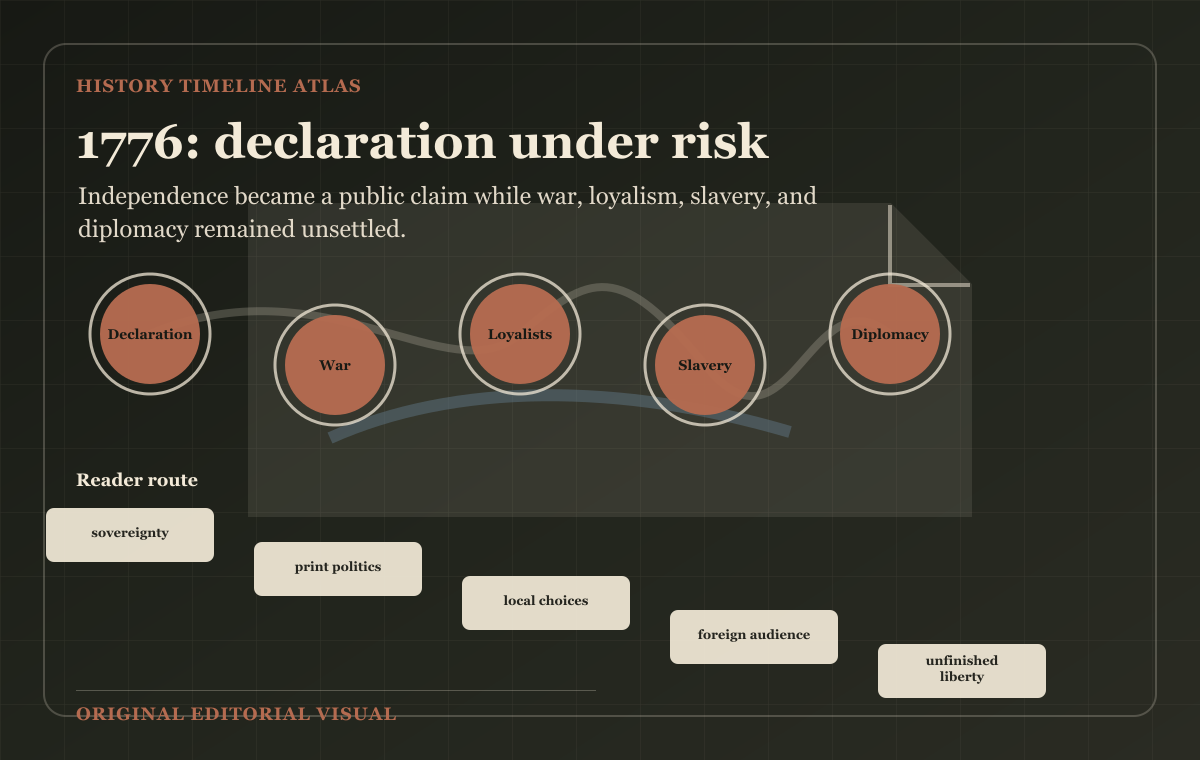
A richer 1776 page begins before the signed document. War had already started, colonial governments were improvising authority, loyalists remained a serious presence, enslaved people watched liberty language from inside bondage, and Native nations had to judge which imperial or colonial power threatened them most. Independence was a decision made in a field of unequal risks.
The Declaration worked in several registers at once. It was a legal claim, a diplomatic signal, a public explanation, a mobilizing text, and a memory document later generations would quote against the republic's own exclusions. Its famous language did not settle the meaning of equality; it made the contradiction harder to ignore.
Military uncertainty keeps the year alive. The Continental Army could still lose, British power remained formidable, and many ordinary people experienced the year through enlistment, occupation, inflation, confiscation, flight, or divided households. The document's authority depended on whether the rebellion could survive long enough to become a state.
The year also belongs to print and persuasion. Pamphlets, newspapers, broadsides, sermons, tavern debate, and local committees turned constitutional argument into public pressure. Readers should see political language moving through material channels, not floating above society.
A good 1776 route therefore moves from Declaration to war, then to constitution-making, slavery, Native sovereignty, and later rights movements. The year matters because it became an origin story that later Americans repeatedly tested against reality.
The local scale keeps the date from becoming marble. A reader should imagine town meetings, committees of safety, printers setting type, soldiers waiting for pay, women managing households during war, enslaved people weighing British and patriot promises, and Native diplomats watching settler claims expand. Those lives make the founding text a contested public event.
Diplomacy gives the year another layer. The Declaration was not only addressed inward to colonial readers; it also made independence legible to foreign powers whose recognition, loans, supplies, and alliance might determine survival. That international audience matters because sovereignty had to be claimed in public before it could be defended in war and negotiated in treaties.
The page also needs loyalists because their presence keeps choice visible. Many colonists feared disorder, valued imperial ties, distrusted local radicalism, or calculated that British victory was likely. Their property losses, exile, and family divisions show that 1776 created winners, losers, and ambiguous loyalties inside the same communities. Independence was not a unanimous national awakening.
State constitutions and local government make the year more practical. Declaring independence raised immediate questions about courts, militias, taxation, public order, religious establishment, property, and who could vote. Those decisions were made unevenly across colonies becoming states. The revolutionary year therefore belongs to institution-building as much as to founding language.
The most useful comparison path runs from 1776 to 1789, 1791, 1804, 1848, 1863, 1964, and later independence movements. The comparison lets readers ask why rights language travels so well and why it so often leaves exclusions behind. A year page should make that tension easy to follow through internal links.
That is why the 1776 entry stays argumentative. 1776 is not only a patriotic date; it is a test of how claims about freedom become institutions, borders, armies, exclusions, and later demands for a fuller republic.
That local scale also makes the year more searchable and more useful: readers asking what happened in 1776 need the famous document, but they also need war, households, allegiance, slavery, diplomacy, and public memory in one frame.
1776 matters because it became a reference date for modern arguments about rights, representation, nationhood, and revolution. The year does not answer those questions cleanly. It opens them. That makes it useful for comparing the American Revolution with later movements that borrowed, challenged, or reworked its political vocabulary. 1776 matters because it turned imperial protest into a claim of independent sovereignty while leaving the meaning of liberty unresolved. It gives readers a precise entry into revolution, war, public argument, founding memory, and exclusion. The date is powerful not because it closed debate, but because later generations kept using it to reopen questions about representation, equality, citizenship, slavery, Indigenous land, and legitimate government.
Reader Lenses
Ask who had the authority to speak for a people and break from an empire.
Read the claims of liberty beside the exclusions and contradictions of the period.
Remember that political declarations needed military survival to become durable.
Follow how later revolutions used 1776 as model, warning, or unfinished promise.
Read independence as a dangerous wartime choice, not a guaranteed founding ceremony.
Follow pamphlets, broadsides, newspapers, and sermons as engines of political persuasion.
Place equality language beside slavery, loyalism, Native sovereignty, and limited citizenship.
How This Year Connects
1776 CE in History is anchored by Declaration of Independence. Read those pages together and the year stops being a date label; it becomes a crossroads where immediate choices met older pressures and opened later consequences.
The setting matters as much as the date. The year moves through Philadelphia and belongs to Age of Revolutions. That combination helps readers avoid treating the year as isolated; geography, institutions, conflict, belief, economy, and communication all shape what a date can mean.
The year also opens into people and themes. Figures such as Thomas Jefferson, George Washington, and John Adams appear because their choices made the year visible, while themes such as American Revolution, Enlightenment, and Republicanism explain why the consequences outlived the moment. A useful next step is usually an event page, then a topic route, then a timeline.
Evidence changes the way a date reads. A treaty, battle report, inscription, newspaper, census, court record, memoir, photograph, or archaeological trace does not answer the same question. Looking at source type helps separate what happened in the year from how later people remembered it.
A year page is most useful when it keeps two scales open at once. The first scale is immediate: what happened, where, and who was involved. The second scale is interpretive: why later readers use this date to organize a wider story. Holding both scales together makes the page a starting point for deeper reading rather than a dead-end answer.
The before-and-after frame matters too. A date rarely begins the forces it reveals. Earlier pressures made the linked event possible, while later pages show which effects were temporary, which became institutions, and which turned into memory. Reading the year this way helps students avoid the false impression that history changes only when the calendar flips.
Use this page as a junction. If the event feels too brief, follow the topic route for background; if the cause feels too abstract, open the event page for sequence; if the consequence feels larger than the date, move into the timeline. The value of a year page is that it lets readers change scale without losing their place.
Events in This Year
- July 4, 1776Declaration of Independence
The Continental Congress adopted a declaration that presented the American colonies as independent states and justified separation from Britain.
Map Layer
1776 CE in History geography
Gold pins mark the approximate locations of published event pages. This is a schematic locator map, not a historical border map.
Coordinates are approximate and are used to help readers orient themselves before opening a full event page.
References
Where to Check the Facts
- Encyclopaedia Britannica: Declaration of IndependenceSpecific reference for the 1776 CE anchor event, chronology, and historical setting.
- Encyclopaedia BritannicaBackground reference for chronology, names, and historical context.
- WikidataStructured reference for dates, places, alternate names, and entity links.