How to Read the Year
Why does the fall of Malacca make 1511 a turning point in maritime Asian trade?
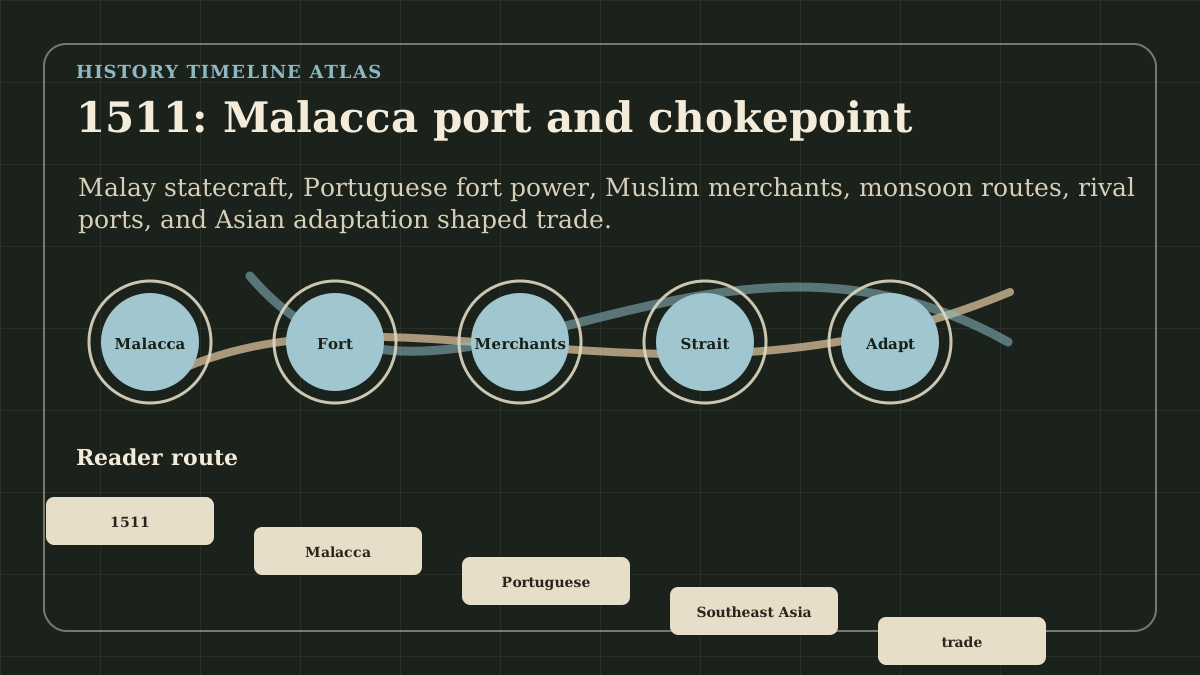
1511 is anchored by the Portuguese capture of Malacca, one of the key entrepots of Southeast Asian and Indian Ocean trade. The year matters because it placed European naval violence inside an already dense Asian commercial world. Malacca was not empty space waiting for European arrival; it was a Malay, Muslim, multilingual, merchant city linked to China, India, the Indonesian archipelago, the Bay of Bengal, and the wider Islamic world.
Portuguese victory did not create instant regional dominance. The fort and harbor mattered, but Asian merchants, Malay rulers, Muslim networks, rival ports, and local political choices continued to shape trade. Portuguese power was strategic, disruptive, and limited rather than total.
1511 also helps readers see chokepoints. The Strait of Malacca connected monsoon routes, spices, textiles, ceramics, silver, ships, pilots, and diplomatic claims. A military takeover of one port could redirect commerce, but it also provoked adaptation and resistance.
The date belongs inside both exploration and Southeast Asia routes. It links European expansion to Asian maritime history without making Europe the center of the whole story.
A fuller 1511 route keeps merchants and rulers moving after the conquest. Some trade shifted, some continued under new terms, and some actors used rival ports to avoid Portuguese pressure. That adaptation keeps Southeast Asian agency visible.
Religion also shaped the stakes. Malacca's Muslim networks connected commerce, diplomacy, law, and identity across the region. Portuguese Christian fort power therefore entered a trading world where faith, profit, and political alliance already overlapped.
The year becomes a bridge between earlier Indian Ocean commerce and later European company power. Readers can move from Malacca to Manila, Batavia, the VOC, and Omani Mombasa to see how ports were fought over, reused, and never fully controlled by one empire.
A local lens makes the conquest less abstract. Shopkeepers, pilots, ship crews, brokers, religious teachers, court officials, and displaced families had to decide whether to remain, reroute, negotiate, or resist. Their choices show why a captured port could become a strategic prize without becoming a total command over maritime Asia.
1511 CE in History gathers events that help readers move from a single date into wider historical patterns. A useful year entry does more than answer what happened; it shows why people keep using the year as a marker for change.
The connected events show how decisions, institutions, conflicts, ideas, and consequences crossed beyond one location or one person. The event links explain the immediate story, while the topic routes and timelines show what came before and after.
The year also helps organize broad questions. It gives readers a concise answer and a direct path into deeper event pages where causes, turning points, consequences, maps, and references are easier to inspect.
Read the date in three passes. First ask what happened inside the year itself. Then ask which older pressures made the event possible. Finally ask which later pages reuse the same vocabulary, institutions, borders, technologies, or memories. That sequence keeps the page from becoming a trivia answer.
Even when only one event is currently attached, the year still has a job: it gives students and curious visitors a stable chronological doorway into the atlas. The page makes the doorway useful by pointing to the event, the topic route, the timeline, the map, and the evidence trail that can turn a date into a broader explanation.
This year matters because it connects Malacca Falls to the Portuguese to a wider sequence of causes and consequences. It gives the reader a chronological anchor while still pointing outward to people, places, institutions, and later effects. A thin year page would only name the event; a useful year page explains why this date is a handle for a larger route through history. 1511 matters because Malacca shows how early modern global trade was contested at ports and straits, not only on open oceans. The year connects Malay statecraft, Portuguese fort power, Muslim merchants, Asian trade networks, spice routes, rival ports, adaptation, and the limits of European control. It also helps readers compare conquest with commercial redirection, because trade could move around power as well as submit to it, especially in a monsoon world of many ports and pilots.
Reader Lenses
Look for the pressures that made change possible.
Identify who acted and what options were available.
Follow what changed after the event.
Ask why this date still appears in historical summaries.
Read Malacca as city, market, fortress, diplomatic node, and religious crossroads.
Use the strait to connect shipping, monsoon routes, spices, textiles, pilots, and customs revenue.
Ask why conquest of a port did not equal mastery of all Asian trade.
How This Year Connects
1511 CE in History is anchored by Malacca Falls to the Portuguese. Read those pages together and the year stops being a date label; it becomes a crossroads where immediate choices met older pressures and opened later consequences.
The setting matters as much as the date. The year moves through Malacca and belongs to Early Modern Indian Ocean. That combination helps readers avoid treating the year as isolated; geography, institutions, conflict, belief, economy, and communication all shape what a date can mean.
The year also opens into people and themes. Figures such as Afonso de Albuquerque and Mahmud Shah appear because their choices made the year visible, while themes such as Malacca, Portuguese Empire, Indian Ocean, and Southeast Asia explain why the consequences outlived the moment. A useful next step is usually an event page, then a topic route, then a timeline.
Evidence changes the way a date reads. A treaty, battle report, inscription, newspaper, census, court record, memoir, photograph, or archaeological trace does not answer the same question. Looking at source type helps separate what happened in the year from how later people remembered it.
A year page is most useful when it keeps two scales open at once. The first scale is immediate: what happened, where, and who was involved. The second scale is interpretive: why later readers use this date to organize a wider story. Holding both scales together makes the page a starting point for deeper reading rather than a dead-end answer.
The before-and-after frame matters too. A date rarely begins the forces it reveals. Earlier pressures made the linked event possible, while later pages show which effects were temporary, which became institutions, and which turned into memory. Reading the year this way helps students avoid the false impression that history changes only when the calendar flips.
Use this page as a junction. If the event feels too brief, follow the topic route for background; if the cause feels too abstract, open the event page for sequence; if the consequence feels larger than the date, move into the timeline. The value of a year page is that it lets readers change scale without losing their place.
Read 1511 beside Malacca, Portuguese Indian Ocean routes, Kilwa, Mombasa, Batavia, Manila, and Southeast Asia pages. That path turns conquest into a wider maritime system.
Then compare 1511 with 1505, 1565, 1602, and 1698 where available. The comparison asks how fort power, port power, company power, and local adaptation differed across the Indian Ocean and Pacific.
Events in This Year
- 1511 CEMalacca Falls to the Portuguese
Portuguese forces captured Malacca, a major Malay entrepot, placing European military power inside one of the key choke points of Asian maritime trade.
Map Layer
1511 CE in History geography
Gold pins mark the approximate locations of published event pages. This is a schematic locator map, not a historical border map.
Coordinates are approximate and are used to help readers orient themselves before opening a full event page.
References
Where to Check the Facts
- Encyclopaedia Britannica: Southeast Asian historyReference for regional chronology, maritime exchange, colonial rule, nationalism, and modern state formation.
- Encyclopaedia Britannica: Sultanate of MalaccaReference for Malacca as a major Malay port-polity and commercial center before Portuguese conquest.
- Official UNESCO World Heritage Centre: AngkorInstitutional reference for the Angkor landscape, Khmer capitals, reservoirs, temples, and regional setting.
- Official ASEAN: About ASEANOfficial institutional reference for ASEAN's 1967 founding and regional-cooperation frame.