How to Read the Year
Why does 70,000 BCE make human migration a deep-time world history question?
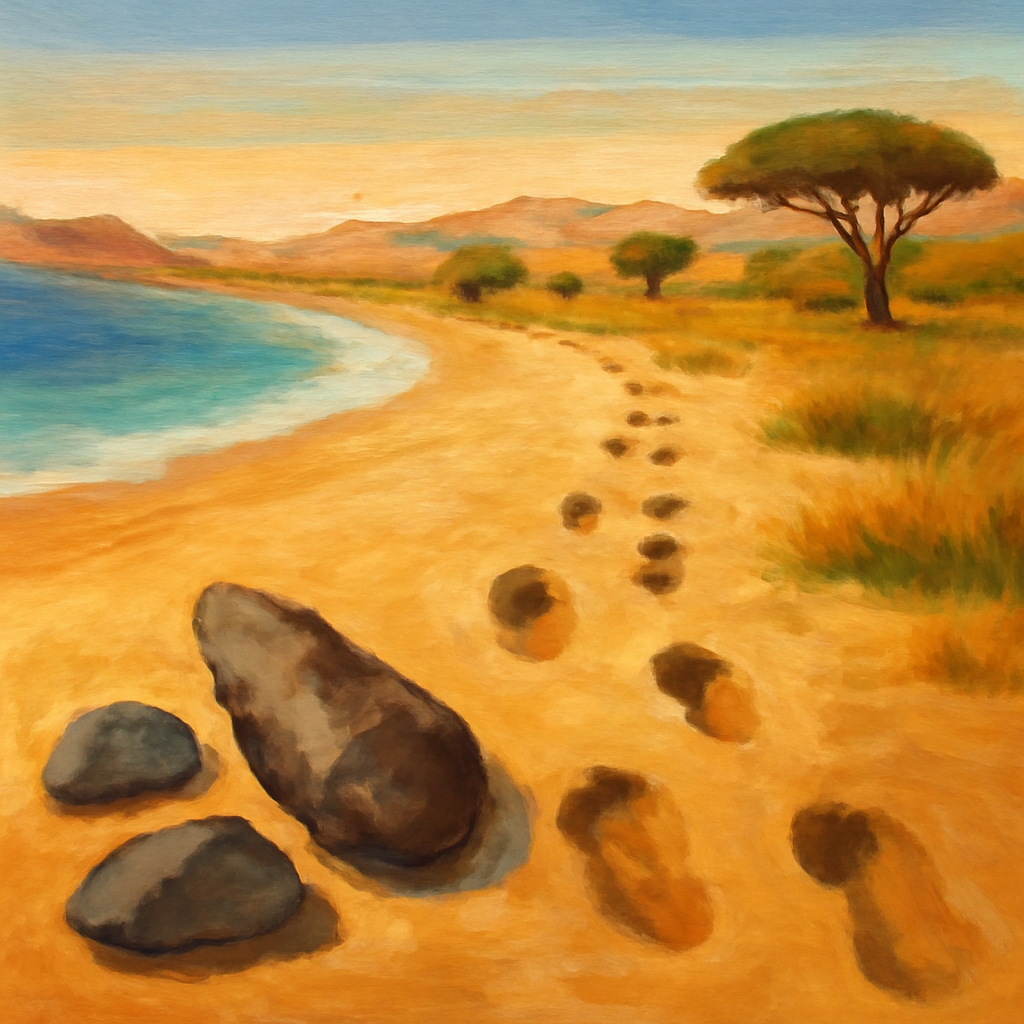
70,000 BCE is anchored by the expansion of Homo sapiens beyond Africa over many generations. The date should not read as a single march out of one place. It is a working historical doorway into archaeology, genetics, climate corridors, coastal routes, stone tools, social learning, and the long movement of human communities through Africa, Southwest Asia, and wider Eurasia.
The page matters because it makes migration a human capacity before it becomes a modern political word. Early human movement depended on groups, memory, seasonal knowledge, water, food, risk, kinship, toolmaking, and adaptation to unfamiliar landscapes. It also depended on environments that opened and closed routes across long periods.
Evidence has to stay visible. Deep-time migration is reconstructed from fragmentary traces: fossils, stone tools, genetic patterns, sediments, cave sites, sea-level change, and comparison across disciplines. A useful year page tells readers what kind of evidence is being used and why exact dates remain debated.
70,000 BCE also changes the atlas map. Later history often begins with written states, but this date asks readers to start with mobility, survival, and connection. It points forward to Sahul, Australia, Ice Age Eurasia, coastal adaptation, and the eventual peopling of many regions without pretending that all routes were simple or uniform.
The date is approximate, and that precision problem is useful. Genetic estimates, archaeological layers, fossil discoveries, and climate reconstructions can point toward overlapping time ranges rather than a single departure day. Students learn more when the page treats dates as evidence-based estimates, not as decorative certainty.
Movement also needs social imagination. People carried skills, stories, kinship ties, tools, fire knowledge, food strategies, and ways to care for children and elders. That makes migration more than an arrow on a map. It was a repeated social achievement across generations, landscapes, and changing climates.
The best next step is comparative. Put 70,000 BCE beside 65,000 BCE, 10,000 BCE, and later Pacific settlement pages, and the atlas begins to show several kinds of movement: deep dispersal, sea crossing, farming expansion, and planned voyaging. The year becomes a scale switch for the whole site.
70000 BCE in History gathers events that help readers move from a single date into wider historical patterns. A useful year entry does more than answer what happened; it shows why people keep using the year as a marker for change.
The connected events show how decisions, institutions, conflicts, ideas, and consequences crossed beyond one location or one person. The event links explain the immediate story, while the topic routes and timelines show what came before and after.
The year also helps organize broad questions. It gives readers a concise answer and a direct path into deeper event pages where causes, turning points, consequences, maps, and references are easier to inspect.
Read the date in three passes. First ask what happened inside the year itself. Then ask which older pressures made the event possible. Finally ask which later pages reuse the same vocabulary, institutions, borders, technologies, or memories. That sequence keeps the page from becoming a trivia answer.
Even when only one event is currently attached, the year still has a job: it gives students and curious visitors a stable chronological doorway into the atlas. The page makes the doorway useful by pointing to the event, the topic route, the timeline, the map, and the evidence trail that can turn a date into a broader explanation.
This year matters because it connects Out of Africa Migration Expands to a wider sequence of causes and consequences. It gives the reader a chronological anchor while still pointing outward to people, places, institutions, and later effects. A thin year page would only name the event; a useful year page explains why this date is a handle for a larger route through history. 70,000 BCE matters because it lets readers treat deep human movement as history rather than background. It connects Africa, Eurasia, climate, evidence, genetics, technology, and social adaptation while keeping uncertainty honest. The page helps students understand that world history begins long before empires and that human geography was made through many small movements across immense time.
Reader Lenses
Look for the pressures that made change possible.
Identify who acted and what options were available.
Follow what changed after the event.
Ask why this date still appears in historical summaries.
Track fossils, tools, genetics, sediments, dating, and climate models as different kinds of historical evidence.
Avoid one-line exodus language; ask how coastal, inland, and repeated movements may have worked.
Look for social learning, tools, water, food, shelter, memory, and risk in unfamiliar landscapes.
How This Year Connects
70000 BCE in History is anchored by Out of Africa Migration Expands. Read those pages together and the year stops being a date label; it becomes a crossroads where immediate choices met older pressures and opened later consequences.
The setting matters as much as the date. The year moves through Northeast Africa and Southwest Asia and belongs to Prehistory. That combination helps readers avoid treating the year as isolated; geography, institutions, conflict, belief, economy, and communication all shape what a date can mean.
The year also opens into people and themes. Figures such as early human migrant communities appear because their choices made the year visible, while themes such as Prehistory, Human Migration, Africa, and Eurasia explain why the consequences outlived the moment. A useful next step is usually an event page, then a topic route, then a timeline.
Evidence changes the way a date reads. A treaty, battle report, inscription, newspaper, census, court record, memoir, photograph, or archaeological trace does not answer the same question. Looking at source type helps separate what happened in the year from how later people remembered it.
A year page is most useful when it keeps two scales open at once. The first scale is immediate: what happened, where, and who was involved. The second scale is interpretive: why later readers use this date to organize a wider story. Holding both scales together makes the page a starting point for deeper reading rather than a dead-end answer.
The before-and-after frame matters too. A date rarely begins the forces it reveals. Earlier pressures made the linked event possible, while later pages show which effects were temporary, which became institutions, and which turned into memory. Reading the year this way helps students avoid the false impression that history changes only when the calendar flips.
Use this page as a junction. If the event feels too brief, follow the topic route for background; if the cause feels too abstract, open the event page for sequence; if the consequence feels larger than the date, move into the timeline. The value of a year page is that it lets readers change scale without losing their place.
Read 70,000 BCE beside human origins, First Peoples Australia, prehistory, Oceania, and science/discovery routes. That sequence keeps evidence, movement, and environmental change at the center of the atlas.
Then compare it with 65,000 BCE and later migration pages. The comparison asks how archaeology, genetics, oral continuity, climate, and living communities change what a timeline can responsibly claim.
Events in This Year
- c. 70,000 BCEOut of Africa Migration Expands
Groups of Homo sapiens expanded beyond Africa over many generations, carrying technologies, social practices, and genetic lineages into Southwest Asia and then wider Eurasia.
Map Layer
70000 BCE in History geography
Gold pins mark the approximate locations of published event pages. This is a schematic locator map, not a historical border map.
Coordinates are approximate and are used to help readers orient themselves before opening a full event page.
References
Where to Check the Facts
- Smithsonian Human Origins Program: Human Evolution EvidenceSpecific reference for the evidence used to study human dispersal and deep-time migration.
- Encyclopaedia BritannicaBackground reference for chronology, names, and historical context.
- WikidataStructured reference for dates, places, alternate names, and entity links.