How to Read the Year
Why does 65,000 BCE make Australia central to deep human history?
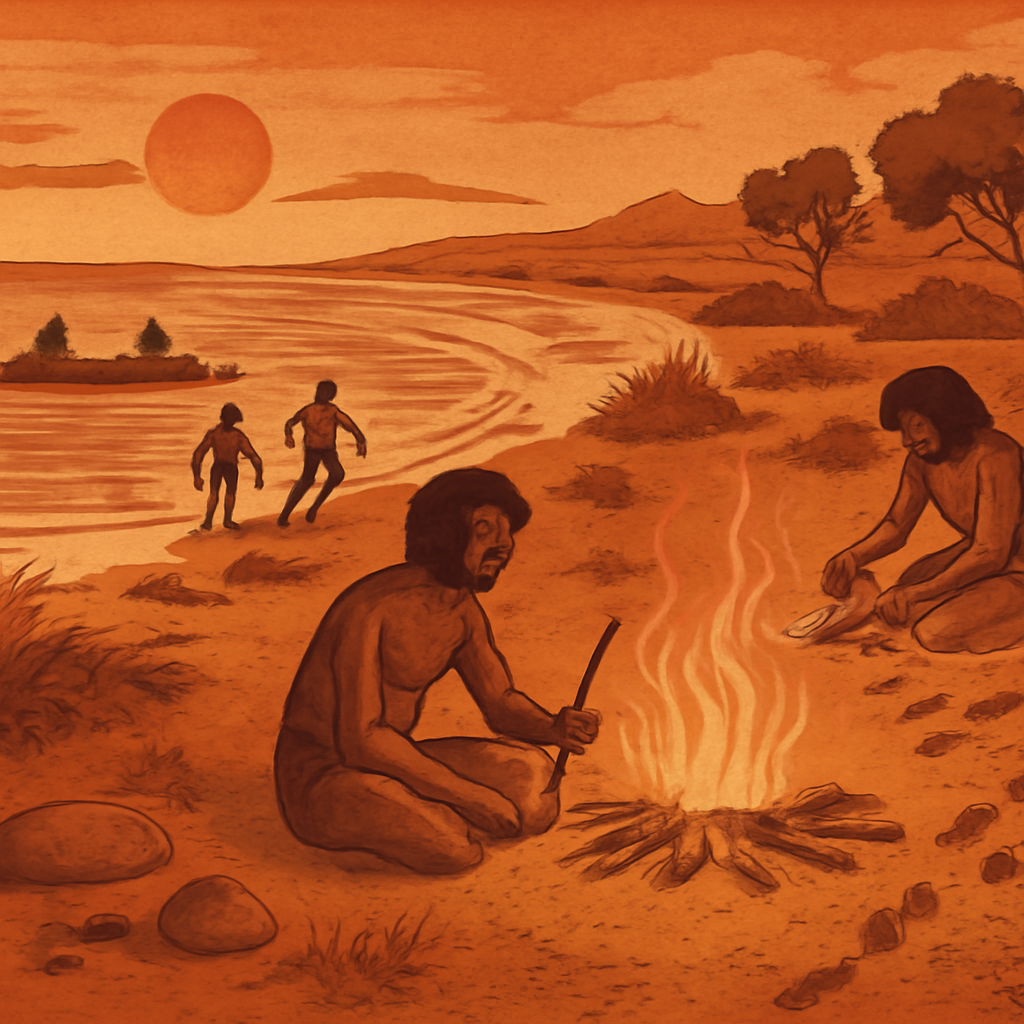
65,000 BCE is anchored by evidence for First Peoples' deep presence in Australia. The year matters because it pushes the atlas beyond written records, cities, kings, and agriculture. It asks readers to treat sea crossings, coastal adaptation, stone tools, fire, seasonal knowledge, story, and long relationships with place as history rather than as a preface to history.
The date is approximate, and that uncertainty is part of the lesson. Deep-time history depends on archaeology, dating methods, sediments, tools, environmental evidence, and careful interpretation. A useful year page does not pretend that one calendar number captures every migration. It uses the date as a doorway into evidence and continuity.
Australia also changes the world map. Human movement into Sahul required adaptation to sea gaps, shorelines, deserts, tropical environments, and changing climates. That movement shows that early human history was inventive, mobile, and ocean-facing long before empires drew routes across the map.
The page must keep First Peoples' continuity visible. The event is not only about arrival. It points toward enduring cultures, knowledge systems, law, art, language, land relationships, and survival through later colonial violence. Deep history and living Indigenous presence belong in the same frame.
A careful page also avoids turning migration into an empty arrow. Moving into Sahul required planning, shared knowledge, watercraft or crossings, food strategies, social memory, and adaptation to environments that changed over long periods. The achievement belongs to communities, not to anonymous dots on a map.
Because the date is so deep, humility is part of the method. Archaeological sites, dating ranges, environmental reconstruction, and Indigenous knowledge do not all speak in the same way. The page is strongest when it lets readers see why evidence can be powerful without pretending that every detail is settled.
Deep time also changes what counts as an event. Instead of one named ruler or battle, the historical subject is sustained presence: repeated movement, adaptation, teaching, toolmaking, ecological observation, and cultural continuity over immense time. That scale helps readers understand why Australia belongs near the beginning of any global history, not as a regional appendix.
65000 BCE in History gathers events that help readers move from a single date into wider historical patterns. A useful year entry does more than answer what happened; it shows why people keep using the year as a marker for change.
The connected events show how decisions, institutions, conflicts, ideas, and consequences crossed beyond one location or one person. The event links explain the immediate story, while the topic routes and timelines show what came before and after.
The year also helps organize broad questions. It gives readers a concise answer and a direct path into deeper event pages where causes, turning points, consequences, maps, and references are easier to inspect.
Read the date in three passes. First ask what happened inside the year itself. Then ask which older pressures made the event possible. Finally ask which later pages reuse the same vocabulary, institutions, borders, technologies, or memories. That sequence keeps the page from becoming a trivia answer.
Even when only one event is currently attached, the year still has a job: it gives students and curious visitors a stable chronological doorway into the atlas. The page makes the doorway useful by pointing to the event, the topic route, the timeline, the map, and the evidence trail that can turn a date into a broader explanation.
This year matters because it connects First Peoples Settle Australia to a wider sequence of causes and consequences. It gives the reader a chronological anchor while still pointing outward to people, places, institutions, and later effects. A thin year page would only name the event; a useful year page explains why this date is a handle for a larger route through history. 65,000 BCE matters because it gives readers a concrete entry into deep time, First Peoples' history, migration, evidence, and continuity. It prevents the atlas from beginning world history only with Eurasian agriculture or written states, and it reminds readers that archaeological evidence and living cultural memory can both shape how deep pasts are understood. The page also gives Google-facing year search a richer answer: the date is approximate, but the historical claim is large, human, and still connected to present communities.
Reader Lenses
Look for the pressures that made change possible.
Identify who acted and what options were available.
Follow what changed after the event.
Ask why this date still appears in historical summaries.
Ask how tools, sediments, dating, landscapes, and oral continuity help readers approach deep time carefully.
Treat movement across water as technology, knowledge, and social organization rather than accident.
Connect ancient settlement with living First Peoples' histories, land relationships, and survival.
How This Year Connects
65000 BCE in History is anchored by First Peoples Settle Australia. Read those pages together and the year stops being a date label; it becomes a crossroads where immediate choices met older pressures and opened later consequences.
The setting matters as much as the date. The year moves through Northern Australia and belongs to Prehistory. That combination helps readers avoid treating the year as isolated; geography, institutions, conflict, belief, economy, and communication all shape what a date can mean.
The year also opens into people and themes. Figures such as First Peoples of Australia appear because their choices made the year visible, while themes such as Prehistory, Oceania, Migration, and Indigenous History explain why the consequences outlived the moment. A useful next step is usually an event page, then a topic route, then a timeline.
Evidence changes the way a date reads. A treaty, battle report, inscription, newspaper, census, court record, memoir, photograph, or archaeological trace does not answer the same question. Looking at source type helps separate what happened in the year from how later people remembered it.
A year page is most useful when it keeps two scales open at once. The first scale is immediate: what happened, where, and who was involved. The second scale is interpretive: why later readers use this date to organize a wider story. Holding both scales together makes the page a starting point for deeper reading rather than a dead-end answer.
The before-and-after frame matters too. A date rarely begins the forces it reveals. Earlier pressures made the linked event possible, while later pages show which effects were temporary, which became institutions, and which turned into memory. Reading the year this way helps students avoid the false impression that history changes only when the calendar flips.
Use this page as a junction. If the event feels too brief, follow the topic route for background; if the cause feels too abstract, open the event page for sequence; if the consequence feels larger than the date, move into the timeline. The value of a year page is that it lets readers change scale without losing their place.
Read 65,000 BCE beside Out of Africa migration, human origins, Lapita expansion, Pacific voyaging, and Oceania routes. That path makes movement, water, climate, and evidence central to world history.
Then compare it with 70,000 BCE, 10,000 BCE, and later migration pages where available. The comparison asks how archaeology, environment, and cultural continuity change the scale of historical explanation.
Events in This Year
- c. 65,000 BCEFirst Peoples Settle Australia
The settlement of Australia by First Peoples shows that human migration crossed sea gaps, adapted to varied environments, and created some of the world's longest continuous cultural histories.
Map Layer
65000 BCE in History geography
Gold pins mark the approximate locations of published event pages. This is a schematic locator map, not a historical border map.
Coordinates are approximate and are used to help readers orient themselves before opening a full event page.
References
Where to Check the Facts
- National Museum of Australia: Evidence of First PeoplesSpecific reference for early human presence in Australia and archaeological evidence.
- Encyclopaedia BritannicaBackground reference for chronology, names, and historical context.
- WikidataStructured reference for dates, places, alternate names, and entity links.