Historical Role
Yasser Arafat's biography is an entry into Palestinian nationalism, exile politics, guerrilla strategy, diplomacy, and the difficult problem of representation. He is often remembered through the PLO, Fatah, the keffiyeh, the UN, Oslo, and the Palestinian Authority, but those symbols sit inside a much wider history of displacement, occupation, refugee camps, Arab state politics, and international diplomacy.
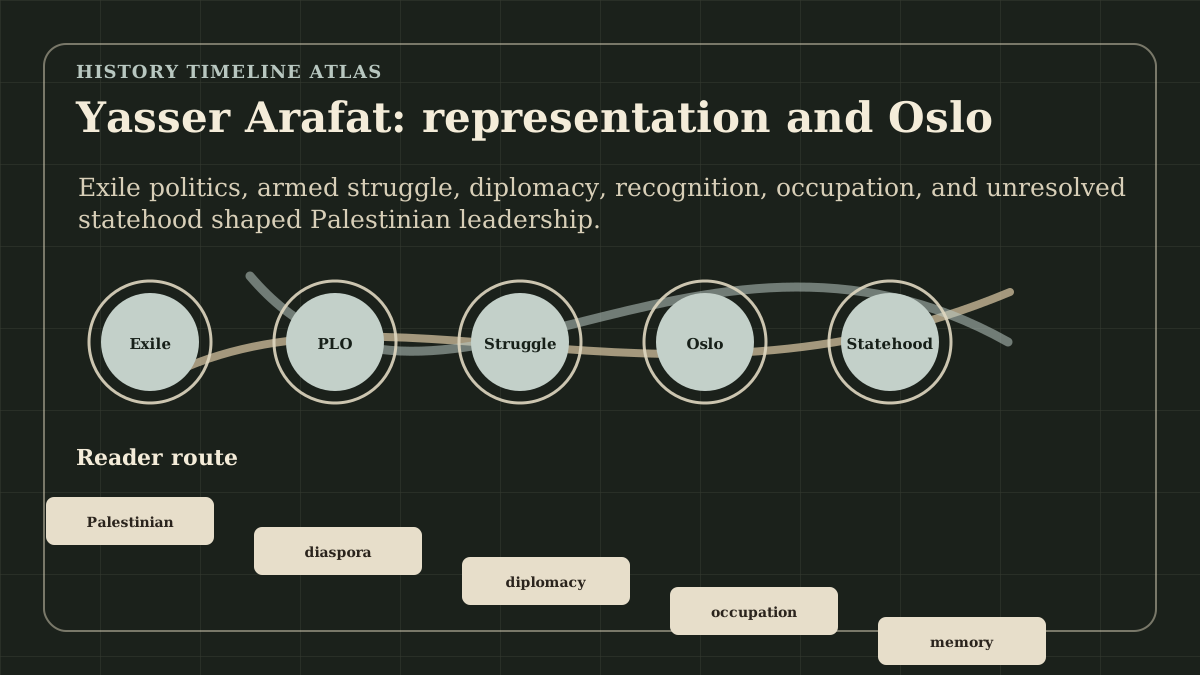
The key shift in Arafat's career was the movement from armed struggle and exile organization toward diplomatic recognition and limited self-government. That shift did not resolve the conflict. It changed its arena: from camps, raids, and regional politics into negotiations, institutions, security arrangements, elections, aid, and the unresolved question of sovereignty.
Arafat's importance depends on the PLO as much as on personal charisma. The organization claimed to speak for Palestinians scattered across territories, refugee camps, and diaspora communities. Representation was therefore not simple. Who could authorize compromise, who bore the costs, and who trusted the institutions became historical questions.
The Oslo years need balance. Supporters saw international recognition, the return of leadership to Palestinian territory, and the possibility of statehood. Critics saw ambiguous agreements, settlement expansion, corruption, security dependence, and promises that did not produce a sovereign state. Arafat's legacy remains contested because those hopes and failures are tied together.
A strong page keeps Palestinians plural. Arafat was central, but he was not the whole story. Hamas, leftist factions, civil society, refugees, Israeli governments, Arab states, U.S. diplomacy, international law, and ordinary families under occupation all shape the history around him.
The biography becomes clearer when it follows geography. Arafat's politics moved through Cairo, Kuwait, Jordan, Lebanon, Tunis, the United Nations, Gaza, Ramallah, and negotiating rooms shaped by U.S. and Israeli power. That movement shows why Palestinian leadership was often leadership without normal state territory.
The armed-struggle and diplomacy phases should not be written as a simple moral switch. They overlapped with changing regional pressures, Israeli military power, Arab state calculations, Cold War politics, and Palestinian debates over what forms of resistance could produce recognition or protection.
Arafat's later governance also belongs in the story. The Palestinian Authority created institutions, police forces, ministries, patronage networks, elections, and new disappointments under conditions of partial autonomy and continuing occupation. The page is stronger when it asks how a liberation movement changes when it must govern without full sovereignty.
The biography should make refugees visible as political actors, not only as background. Camps, family histories, UN agencies, education, militancy, diplomacy, and memory of displacement shaped the claims Arafat made and the criticism he faced. Representation meant speaking across many locations with unequal exposure to violence and compromise.
A strong page also keeps Israeli civilians and politics in view without making them the center of a Palestinian biography. Negotiations, attacks, security fears, settlement policy, elections, and leadership changes on the Israeli side affected what Arafat could promise and what Palestinians experienced.
Yasser Arafat helps connect individual action with wider historical change in Palestine. The biography works best when it keeps the surrounding world visible: authority, conflict, belief, reform, or discovery moved through decisions made under pressure.
The related events show how roles such as Palestinian nationalist leader, PLO chairman can be read through dates, places, institutions, and consequences rather than through reputation alone. The biography explains why this person matters, while the linked events explain what changed around them.
A richer reading starts with the limits around the person. Some figures acted through offices, armies, courts, laboratories, churches, parties, ships, trade networks, or protest movements; others became important because later communities turned their lives into symbols. The page therefore asks what this person could actually change, what was already moving before them, and which consequences later readers attached to the name.
Read the biography against absence as well. Many lives around Yasser Arafat are less visible in the record: opponents, collaborators, family members, workers, soldiers, students, subjects, victims, translators, scribes, or local communities. Keeping those surrounding people in view makes the page less like a name card and more like an entry point into historical systems.
Yasser Arafat also works as a navigation point. Open the linked event pages to see where the biography becomes chronology, then use the topic routes to test whether the same pattern appears beyond one life. That extra step matters because historical importance is rarely contained inside a single decision; it usually spreads through institutions, witnesses, opponents, imitators, and later arguments over memory.
Sources and Method
Source trail: the page uses Arafat biography references, Oslo Accord material, Arab-Israeli conflict route sources, and decolonization/statehood context.
Method note: the page separates personal leadership, organizational representation, armed struggle, diplomacy, and governance after Oslo.
Evidence Notes
How Sensitive Claims Are Sourced
- 1
Representation, diplomacy, and unresolved sovereignty
Arafat's page treats the PLO as an institution claiming to represent a displaced people, then follows how Oslo changed the arena without settling the underlying conflict.
Why This Person Matters
Yasser Arafat matters because the connected events make a larger historical pattern easier to follow. The page links biography to consequences so readers can move from a life story into the wider atlas, compare the person with contemporaries, and understand why later memory kept returning to this figure. Arafat matters because one biography opens a wider route through Palestinian representation, exile, occupation, diplomacy, armed struggle, governance, and disappointed sovereignty. That route keeps Oslo, refugee memory, Israeli security politics, Arab state pressure, and Palestinian institutions in one frame instead of reducing the history to one negotiator.
What does political representation mean when a people is divided among occupation, exile, camps, diaspora, and rival movements?
How to Read This Life
Yasser Arafat is easiest to understand when the biography is read beside Oslo Accords. Those events show the historical setting in motion: dates, places, institutions, conflict, and consequences give the life a structure that a short biography alone cannot provide.
The surrounding route crosses Post-Cold War and locations such as Oslo and Washington. That matters because influence rarely stays inside one person. It moves through offices, armies, movements, laws, texts, speeches, institutions, and later memory.
A useful reading path starts with the role labels, then opens the event pages to see what changed, and finally compares this person with other actors facing similar pressures.
For readers who arrive on a biography first, this page is meant to become a doorway rather than a stop. Read one paragraph for the answer, then use the turning points, topic routes, and event links to test whether the person's reputation matches the wider evidence.
Read Arafat beside the Oslo Accords and the creation of Israel / Palestine route. That path keeps diplomacy, displacement, occupation, and statehood claims connected.
Then compare with Mandela, Nkrumah, Gandhi, and Ho Chi Minh. The comparison is not equivalence; it asks how movements choose between armed struggle, negotiation, party organization, and international legitimacy.
Read Yasser Arafat through the roles of Palestinian nationalist leader, PLO chairman rather than as reputation alone.
Place the biography inside Palestine and the wider events linked below.
Ask which choices were personal and which were constrained by institutions or crisis.
Follow how later memory simplified, contested, or reused this person's role.
Track how refugee and diaspora politics shaped leadership claims.
Ask who speaks for whom, and what happens when compromise has unequal costs.
Read Oslo as a change in arena, not as a completed settlement.
Legacy, Limits, and Memory
A useful biography keeps scale in view. Yasser Arafat mattered because individual choices met a wider structure: institutions, enemies, allies, audiences, technologies, beliefs, and inherited conflicts. The related event pages help separate personal agency from conditions that no single person controlled.
Memory is part of the biography too. Later readers often simplify a figure into a hero, villain, founder, reformer, conqueror, prophet, scientist, or symbol. Those labels can be helpful, but they become misleading when they hide conflict, compromise, exclusion, uncertainty, or the experiences of people outside the main biography.
For the next step, compare this life with a topic route rather than stopping at the name. If the same pattern appears across several figures, the reader has found a historical structure; if this person breaks the pattern, the contrast is usually where the most interesting question begins.
The biography should avoid making one leader stand for all Palestinians. Representation is itself part of the history.
The Oslo process should be read as both breakthrough and unresolved structure. Recognition did not equal sovereignty.
Arafat's memory is contested because leadership, corruption claims, resistance, compromise, and disappointment remain bound together.
A useful page lets readers follow the conflict through institutions and lived geography instead of stopping at one negotiator's image, because the consequences were carried by communities as well as leaders.
Turning Points to Read Next
Oslo Accords
The Oslo Accords created a formal peace process between Israel and the Palestine Liberation Organization after mutual recognition and secret negotiations.
Related Timeline
- 1993 CEOslo Accords
The Oslo Accords created a formal peace process between Israel and the Palestine Liberation Organization after mutual recognition and secret negotiations.
References
Where to Check the Facts
- Encyclopaedia Britannica: Yasser ArafatBiographical reference for Arafat and Palestinian politics.
- Encyclopaedia Britannica: Oslo AccordsReference for Oslo diplomacy.