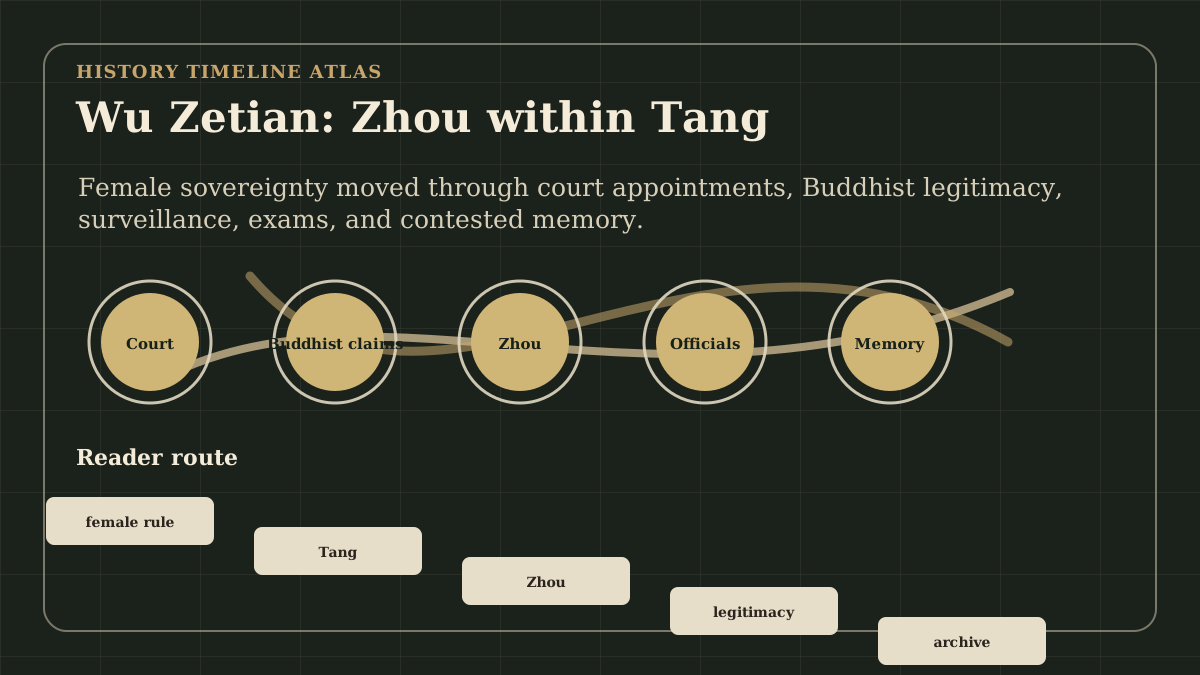
Historical Role
Wu Zetian's page begins with the difficulty of the category. She was not merely an empress beside power; she ruled in her own name and founded a Zhou dynasty within the Tang political world. That makes her a biography about gender, court legitimacy, Buddhist patronage, bureaucratic skill, factional conflict, and the language people used to explain an extraordinary female ruler.
The standard story can become too simple if it only asks whether Wu was ruthless. Court politics in Tang China were already competitive, kinship-based, textual, ritual, and dangerous. Wu Zetian learned to operate inside that world and then reshaped it, using appointments, surveillance, ritual claims, Buddhist symbolism, examinations, and court ceremony to make her authority legible.
Her reign also exposes the archive problem. Later dynastic histories were written in a political culture uncomfortable with female sovereignty, so accusation, moral judgment, and genuine political violence are often tangled together. A useful page does not excuse coercion, but it asks how much of Wu's reputation reflects her actions, how much reflects hostile memory, and how much reflects the shock of a woman claiming the throne.
Wu's change of dynastic name matters because it made legitimacy visible. Calling the regime Zhou did not remove Tang institutions from the world around her, but it gave her rule a ritual and historical language that could stand beside court appointments, examination recruitment, Buddhist patronage, surveillance, and capital politics. The page therefore reads the name change as political technology rather than as a personal flourish.
Buddhist legitimation also needs concrete treatment. Scriptures, patronage, temples, images, ceremonies, and public claims could make female sovereignty appear cosmically meaningful instead of merely irregular. That strategy did not persuade everyone, and it did not remove coercion from the court, but it shows how religious language helped solve a political problem that Confucian lineage expectations made difficult.
The administrative layer keeps Wu from becoming only a scandal story. Recruitment, memorials, officials, exams, records, informants, punishments, and palace access all shaped her authority. Some measures widened the talent pool beyond entrenched aristocratic families; others created fear and factional struggle. A good biography lets both effects remain visible.
Wu Zetian's afterlife is part of the evidence. Later writers repeatedly returned to her because she unsettled categories: ruler and woman, usurper and administrator, patron and coercive monarch, Tang insider and Zhou founder. Those contradictions explain why her page can anchor searches about female rulers, Tang politics, Chinese empire, Buddhist power, and historical reputation at the same time.
Wu Zetian helps connect individual action with wider historical change in Tang China. The biography works best when it keeps the surrounding world visible: authority, conflict, belief, reform, or discovery moved through decisions made under pressure.
The related events show how roles such as Empress, Ruler of Zhou can be read through dates, places, institutions, and consequences rather than through reputation alone. The biography explains why this person matters, while the linked events explain what changed around them.
A richer reading starts with the limits around the person. Some figures acted through offices, armies, courts, laboratories, churches, parties, ships, trade networks, or protest movements; others became important because later communities turned their lives into symbols. The page therefore asks what this person could actually change, what was already moving before them, and which consequences later readers attached to the name.
Read the biography against absence as well. Many lives around Wu Zetian are less visible in the record: opponents, collaborators, family members, workers, soldiers, students, subjects, victims, translators, scribes, or local communities. Keeping those surrounding people in view makes the page less like a name card and more like an entry point into historical systems.
Wu Zetian also works as a navigation point. Open the linked event pages to see where the biography becomes chronology, then use the topic routes to test whether the same pattern appears beyond one life. That extra step matters because historical importance is rarely contained inside a single decision; it usually spreads through institutions, witnesses, opponents, imitators, and later arguments over memory.
Sources and Method
Source method: the page uses Tang and East Asian synthesis sources while warning readers that Wu Zetian's transmitted reputation is shaped by later dynastic and gendered judgment. Claims about violence, patronage, and legitimacy need attention to who preserved the story.
Why This Person Matters
Wu Zetian matters because the connected events make a larger historical pattern easier to follow. The page links biography to consequences so readers can move from a life story into the wider atlas, compare the person with contemporaries, and understand why later memory kept returning to this figure. Wu Zetian matters because she forces readers to examine how empire explains power that breaks its own expectations. Her life connects Tang institutions, gendered memory, Buddhist legitimation, court violence, bureaucratic reform, and the politics of historical reputation.
The page also gives the atlas a sharper gender-history entry point: it asks how sources judge women who rule, how institutions adapt when legitimacy is contested, and why later memory often turns capable female power into either warning story or exception story.
What becomes clearer when this person's life is read through connected events instead of isolated biography, and where do the consequences outgrow the person?
How to Read This Life
Wu Zetian is easiest to understand when the biography is read beside Tang Dynasty Founded. Those events show the historical setting in motion: dates, places, institutions, conflict, and consequences give the life a structure that a short biography alone cannot provide.
The surrounding route crosses Tang China and locations such as Chang'an. That matters because influence rarely stays inside one person. It moves through offices, armies, movements, laws, texts, speeches, institutions, and later memory.
A useful reading path starts with the role labels, then opens the event pages to see what changed, and finally compares this person with other actors facing similar pressures.
For readers who arrive on a biography first, this page is meant to become a doorway rather than a stop. Read one paragraph for the answer, then use the turning points, topic routes, and event links to test whether the person's reputation matches the wider evidence.
Read Wu beside Tang Dynasty Founded and Emperor Taizong, then move into the East Asia dynasties timeline. That path makes her more than an exception: it shows how she worked inside Tang institutions while unsettling their assumptions.
Compare Wu with Hatshepsut, Elizabeth I, Catherine the Great, or other female rulers where available. The comparison works best around legitimacy strategies, not a shallow list of powerful women.
Read Wu Zetian through the roles of Empress, Ruler of Zhou rather than as reputation alone.
Place the biography inside Tang China and the wider events linked below.
Ask which choices were personal and which were constrained by institutions or crisis.
Follow how later memory simplified, contested, or reused this person's role.
Ask how female sovereignty changed the language of legitimacy, accusation, ritual, and memory.
Follow appointments, families, factions, rituals, and texts as the arena where power was made.
Separate later moralized reputation from the political work her regime actually performed.
Legacy, Limits, and Memory
A useful biography keeps scale in view. Wu Zetian mattered because individual choices met a wider structure: institutions, enemies, allies, audiences, technologies, beliefs, and inherited conflicts. The related event pages help separate personal agency from conditions that no single person controlled.
Memory is part of the biography too. Later readers often simplify a figure into a hero, villain, founder, reformer, conqueror, prophet, scientist, or symbol. Those labels can be helpful, but they become misleading when they hide conflict, compromise, exclusion, uncertainty, or the experiences of people outside the main biography.
For the next step, compare this life with a topic route rather than stopping at the name. If the same pattern appears across several figures, the reader has found a historical structure; if this person breaks the pattern, the contrast is usually where the most interesting question begins.
Wu's biography is strongest when gender is treated as a structure, not an aside. The question is not only that she was a woman ruler; it is how court ritual, kinship, textual memory, Buddhist symbolism, and official history responded to female sovereignty.
The page keeps two truths together: Wu Zetian was a highly capable political operator who changed Tang governance, and her career involved coercion, fear, and contested memory. Reducing her to either villain or feminist icon makes the history thinner.
Turning Points to Read Next
Tang Dynasty Founded
The Tang dynasty replaced the Sui and built one of imperial China's most influential political and cultural orders.
Related Timeline
- 618Tang Dynasty Founded
The Tang dynasty replaced the Sui and built one of imperial China's most influential political and cultural orders.
References
Where to Check the Facts
- Encyclopaedia Britannica: Tang dynastyReference for Tang state formation, government, culture, and regional influence.
- Encyclopaedia Britannica: Song dynastyReference for Song political chronology, economy, technology, and culture.
- Official UNESCO World Heritage Centre: Historic Monuments of Ancient NaraInstitutional reference for Nara's capital landscape, Buddhist monuments, and East Asian cultural exchange.