Historical Role
Lenin's page becomes deeper when it begins with war, exile, party discipline, and state collapse. The Russian Revolution was not simply the arrival of one thinker. It was a crisis in which military defeat, food shortages, land hunger, worker militancy, peasant expectations, imperial weakness, and socialist organization met in a collapsing monarchy.
Lenin mattered because he gave the Bolsheviks a hard strategic line at moments when many other actors hesitated. The April Theses, the demand for soviet power, the refusal to support the Provisional Government, and the push toward insurrection made his role more than symbolic. He helped turn a revolutionary opening into a party seizure of power.
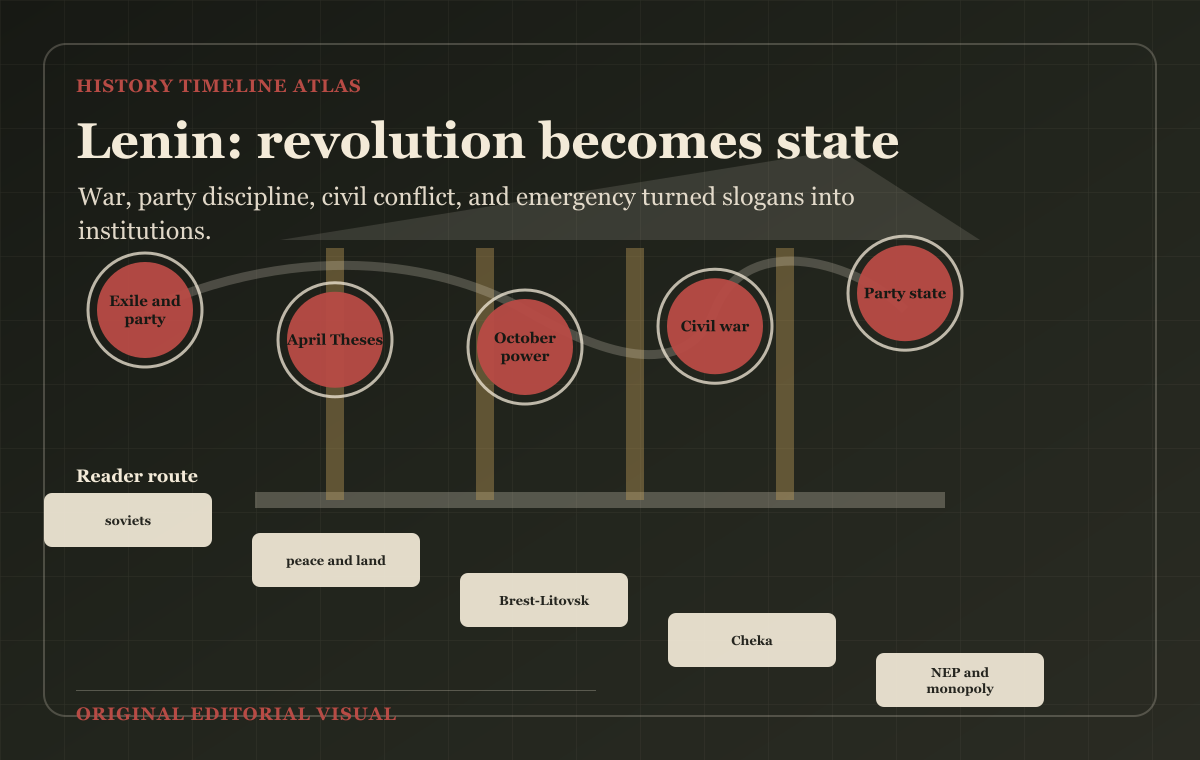
The biography must also follow what came after October. Civil war, the Cheka, Red Terror, war communism, famine, the New Economic Policy, party centralization, and suppression of rival socialist voices show how revolutionary government became coercive state power. That transition is the core historical problem.
Lenin's legacy is inseparable from later Soviet history, but it should not be collapsed into Stalin alone. Some institutions and habits of party rule were already present under Lenin; other later developments changed scale and character. Readers need both continuity and distinction.
The page is strongest when it asks what kind of authority a revolution creates when it claims to speak for workers and peasants while narrowing political competition. Lenin forces that question because ideology, organization, emergency, violence, and state-building all meet in his career.
Lenin's writing should be treated as political action, not only theory. Pamphlets, party newspapers, polemics, slogans, and directives helped create a disciplined audience before the Bolsheviks held state power. Once in government, the same habit of sharp line-drawing shaped debates over peace, land, party discipline, and economic retreat. Words organized people, and people then built institutions.
His return from exile in 1917 also gives readers a concrete scene for the page. A revolutionary leader entered a capital already crowded with soldiers, workers, party committees, soviets, ministers, newspapers, rumors, and hunger. Lenin did not invent that crisis, but he changed the Bolshevik response to it by rejecting compromise with the Provisional Government and making power itself the question.
The Brest-Litovsk debate adds another layer because it shows Lenin governing through defeat as well as victory. Accepting a harsh peace with Germany split socialists and angered many supporters, yet Lenin judged that survival of the new regime mattered more than revolutionary honor in the short term. That choice helps readers see revolutionary politics as tradeoff, not only slogan.
A fuller biography also follows the social cost of the state Lenin helped build. Political policing, censorship, requisitioning, party monopoly, and civil-war emergency changed the meaning of liberation for opponents and ordinary communities. The point is not to make one person explain the entire Soviet system, but to show how institutions created under pressure could survive beyond the pressure.
The Constituent Assembly makes that cost especially clear. When an elected body did not produce Bolshevik dominance, Lenin accepted its closure in the name of soviet power and revolutionary necessity. That episode helps readers understand how democratic language and party monopoly could coexist in Bolshevik practice. It also connects Lenin to later twentieth-century arguments about whether emergency rule can ever return power to the people it claims to defend.
Vladimir Lenin helps connect individual action with wider historical change in Russia. The biography works best when it keeps the surrounding world visible: authority, conflict, belief, reform, or discovery moved through decisions made under pressure.
The related events show how roles such as Revolutionary leader can be read through dates, places, institutions, and consequences rather than through reputation alone. The biography explains why this person matters, while the linked events explain what changed around them.
A richer reading starts with the limits around the person. Some figures acted through offices, armies, courts, laboratories, churches, parties, ships, trade networks, or protest movements; others became important because later communities turned their lives into symbols. The page therefore asks what this person could actually change, what was already moving before them, and which consequences later readers attached to the name.
Read the biography against absence as well. Many lives around Vladimir Lenin are less visible in the record: opponents, collaborators, family members, workers, soldiers, students, subjects, victims, translators, scribes, or local communities. Keeping those surrounding people in view makes the page less like a name card and more like an entry point into historical systems.
Vladimir Lenin also works as a navigation point. Open the linked event pages to see where the biography becomes chronology, then use the topic routes to test whether the same pattern appears beyond one life. That extra step matters because historical importance is rarely contained inside a single decision; it usually spreads through institutions, witnesses, opponents, imitators, and later arguments over memory.
Sources and Method
Source trail: the page checks Lenin through Britannica, the Russian Revolution event, and the revolutions route. It treats 1917 strategy, civil war government, party centralization, and later Soviet memory as linked but distinct claims.
Evidence Notes
How Sensitive Claims Are Sourced
- 1
From revolutionary slogan to governing state
Lenin is read through the movement from antiwar and soviet slogans into civil-war rule, coercion, party discipline, and the New Economic Policy. That arc keeps the page from stopping at October 1917.
Why This Person Matters
Vladimir Lenin matters because the connected events make a larger historical pattern easier to follow. The page links biography to consequences so readers can move from a life story into the wider atlas, compare the person with contemporaries, and understand why later memory kept returning to this figure. Lenin matters because he joins revolutionary theory to the practical creation of a one-party state under conditions of war, scarcity, and social hope. His life helps readers ask how ideology becomes organization, how emergency becomes institution, and why a revolution made in the name of popular power narrowed political choice so quickly.
When did Bolshevik strategy stop being a method for winning a revolution and become a structure for governing a state?
How to Read This Life
Vladimir Lenin is easiest to understand when the biography is read beside Russian Revolution. Those events show the historical setting in motion: dates, places, institutions, conflict, and consequences give the life a structure that a short biography alone cannot provide.
The surrounding route crosses Twentieth Century and locations such as Petrograd. That matters because influence rarely stays inside one person. It moves through offices, armies, movements, laws, texts, speeches, institutions, and later memory.
A useful reading path starts with the role labels, then opens the event pages to see what changed, and finally compares this person with other actors facing similar pressures.
For readers who arrive on a biography first, this page is meant to become a doorway rather than a stop. Read one paragraph for the answer, then use the turning points, topic routes, and event links to test whether the person's reputation matches the wider evidence.
Read Lenin beside the Russian Revolution, World War I, the Treaty of Brest-Litovsk, civil war, Stalin, Mao, and Cold War routes. That path keeps his biography attached to war, state collapse, party organization, and later ideological afterlives.
Then compare him with Cromwell, Napoleon, and Nasser where available. Each figure raises a different version of the same problem: how a movement that promises political transformation creates institutions able to command, exclude, and endure.
Read Vladimir Lenin through the roles of Revolutionary leader rather than as reputation alone.
Place the biography inside Russia and the wider events linked below.
Ask which choices were personal and which were constrained by institutions or crisis.
Follow how later memory simplified, contested, or reused this person's role.
Watch how party discipline changed what revolutionary opportunity could become.
Ask when civil-war necessity became a lasting structure of rule.
Separate Lenin's own period from later Soviet uses of his image.
Legacy, Limits, and Memory
A useful biography keeps scale in view. Vladimir Lenin mattered because individual choices met a wider structure: institutions, enemies, allies, audiences, technologies, beliefs, and inherited conflicts. The related event pages help separate personal agency from conditions that no single person controlled.
Memory is part of the biography too. Later readers often simplify a figure into a hero, villain, founder, reformer, conqueror, prophet, scientist, or symbol. Those labels can be helpful, but they become misleading when they hide conflict, compromise, exclusion, uncertainty, or the experiences of people outside the main biography.
For the next step, compare this life with a topic route rather than stopping at the name. If the same pattern appears across several figures, the reader has found a historical structure; if this person breaks the pattern, the contrast is usually where the most interesting question begins.
A Lenin page has to separate explanation from endorsement. Understanding why Bolshevik strategy worked in 1917 does not require softening the violence and exclusions that followed.
Compare Lenin with Napoleon and Mao. All three converted crisis into centralized authority, but their institutions, ideologies, armies, and social coalitions were different.
Lenin also belongs in a route about modern political language. Terms such as party, class, soviet, dictatorship, peace, land, and counterrevolution did practical work: they sorted allies from enemies and made certain actions appear necessary.
Turning Points to Read Next
Russian Revolution
War, hunger, strikes, and political collapse brought down the Romanov monarchy and opened the way for Bolshevik seizure of power.
Related Timeline
- 1917 CERussian Revolution
War, hunger, strikes, and political collapse brought down the Romanov monarchy and opened the way for Bolshevik seizure of power.
References
Where to Check the Facts
- Encyclopaedia Britannica: Vladimir LeninBiographical reference for Vladimir Lenin's life dates, roles, institutions, and historical setting.
- Encyclopaedia BritannicaBackground reference for chronology, names, and historical context.
- WikidataStructured reference for dates, places, alternate names, and entity links.