Historical Role
Desmond Tutu gives the atlas a biography about moral authority under and after apartheid. His importance did not come from state office or command of an army. It came from church leadership, public speech, international attention, nonviolent pressure, sanctions advocacy, pastoral care, and a willingness to name apartheid as a moral and political system.
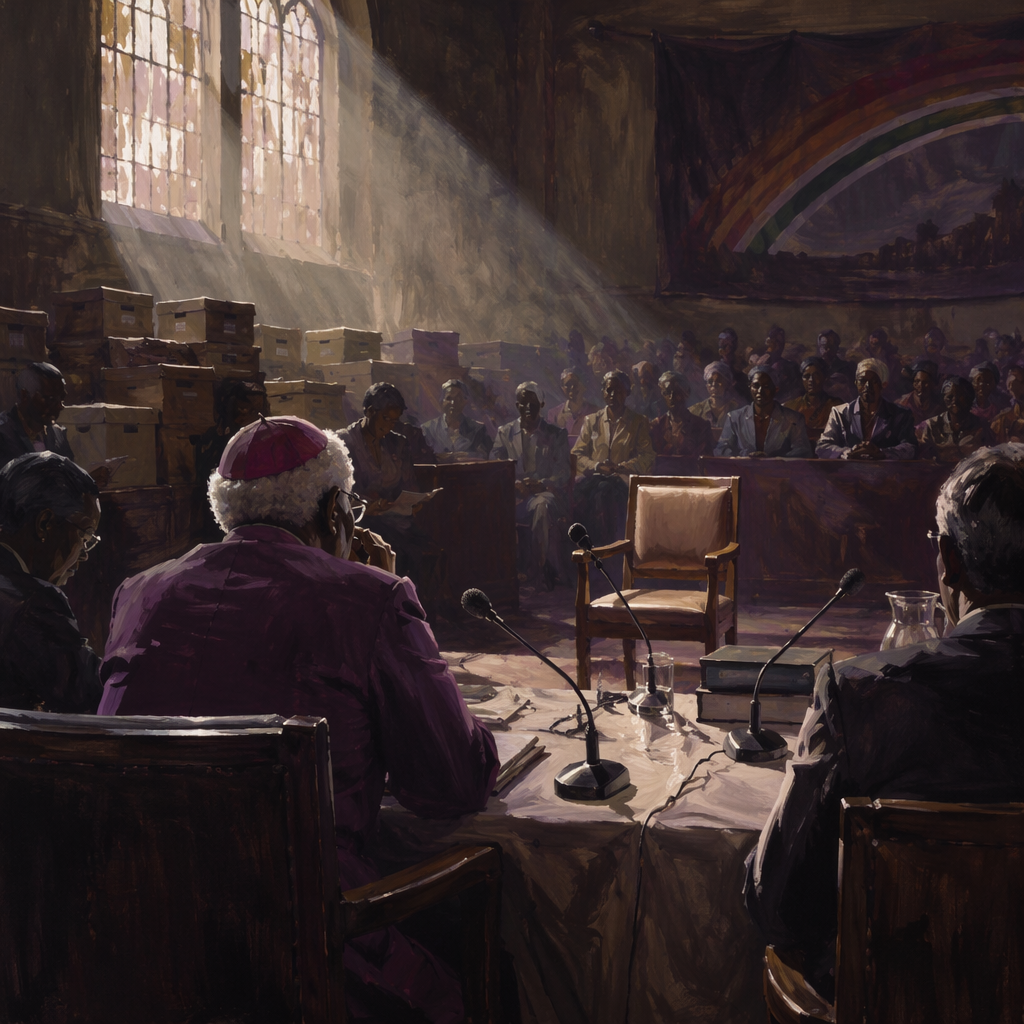
The Truth and Reconciliation Commission is the hinge. Tutu's role as chair linked testimony, amnesty hearings, public grief, confession, archive-making, and national transition. The commission did not heal South Africa by itself, and it did not deliver full justice or economic repair. But it made violence, memory, and accountability public in a way that shaped how the post-apartheid transition was narrated.
A deeper reading begins before the commission. Tutu used sermons, letters, marches, funerals, media interviews, and international church networks to make apartheid visible as sin, law, policing, forced removal, school inequality, labor control, and everyday fear. Moral language mattered because it translated political violence into terms that congregations, foreign governments, and ordinary listeners could not easily dismiss.
Victims and limits stay visible throughout the biography. Tutu's charisma and language mattered, but survivors, families, activists, lawyers, churches, journalists, township communities, and former detainees carried the burden of testimony and memory. A biography that only praises reconciliation can hide the hard questions of land, inequality, punishment, and unfinished repair.
The afterlife of Tutu's work belongs to global transitional-justice history. Truth commissions in other places borrowed, debated, or resisted South African language, while critics asked whether public truth without fuller redistribution could become a moral substitute for structural change. That tension makes the page useful beyond one life: it asks what societies expect from truth after state violence.
Tutu's public voice also shows how biography can connect institutions to emotion. Courts, commissions, churches, schools, newspapers, and memorial ceremonies all shaped how South Africans heard testimony. The result was neither private forgiveness nor simple legal judgment, but a difficult public argument over what a democratic society owed to victims.
Desmond Tutu helps connect individual action with wider historical change in South Africa. The biography works best when it keeps the surrounding world visible: authority, conflict, belief, reform, or discovery moved through decisions made under pressure.
The related events show how roles such as Archbishop, Anti-apartheid activist, Truth commission chair can be read through dates, places, institutions, and consequences rather than through reputation alone. The biography explains why this person matters, while the linked events explain what changed around them.
A richer reading starts with the limits around the person. Some figures acted through offices, armies, courts, laboratories, churches, parties, ships, trade networks, or protest movements; others became important because later communities turned their lives into symbols. The page therefore asks what this person could actually change, what was already moving before them, and which consequences later readers attached to the name.
Read the biography against absence as well. Many lives around Desmond Tutu are less visible in the record: opponents, collaborators, family members, workers, soldiers, students, subjects, victims, translators, scribes, or local communities. Keeping those surrounding people in view makes the page less like a name card and more like an entry point into historical systems.
Desmond Tutu also works as a navigation point. Open the linked event pages to see where the biography becomes chronology, then use the topic routes to test whether the same pattern appears beyond one life. That extra step matters because historical importance is rarely contained inside a single decision; it usually spreads through institutions, witnesses, opponents, imitators, and later arguments over memory.
Sources and Method
Source method: read Tutu through anti-apartheid struggle, Soweto, the Truth and Reconciliation Commission, and human-rights routes. The page treats reconciliation as a contested public process, not a soft slogan.
Evidence Notes
How Sensitive Claims Are Sourced
- 1
Moral authority against apartheid
The biography links Tutu's church role to public protest, sanctions advocacy, international attention, and South African movement pressure.
- 2
Truth commission and unfinished repair
The TRC frame keeps testimony and accountability visible while naming the limits of reconciliation without full material justice.
Why This Person Matters
Desmond Tutu matters because the connected events make a larger historical pattern easier to follow. The page links biography to consequences so readers can move from a life story into the wider atlas, compare the person with contemporaries, and understand why later memory kept returning to this figure. Desmond Tutu matters because his life helps readers study apartheid, moral protest, public testimony, transitional justice, and the limits of reconciliation. The biography turns a familiar moral voice into a route through institutions, victims, memory, and unfinished democratic repair.
What can public truth-telling repair after state violence, and what remains unresolved when reconciliation is asked to carry too much?
How to Read This Life
Desmond Tutu is easiest to understand when the biography is read beside South African Truth and Reconciliation Commission Hearings, Soweto Uprising. Those events show the historical setting in motion: dates, places, institutions, conflict, and consequences give the life a structure that a short biography alone cannot provide.
The surrounding route crosses Post-Apartheid South Africa, Apartheid South Africa and locations such as South Africa, Soweto. That matters because influence rarely stays inside one person. It moves through offices, armies, movements, laws, texts, speeches, institutions, and later memory.
A useful reading path starts with the role labels, then opens the event pages to see what changed, and finally compares this person with other actors facing similar pressures.
For readers who arrive on a biography first, this page is meant to become a doorway rather than a stop. Read one paragraph for the answer, then use the turning points, topic routes, and event links to test whether the person's reputation matches the wider evidence.
Read Tutu beside Mandela, Soweto, the end of apartheid, the Truth and Reconciliation Commission, rights movements, and human-rights explainers. That path keeps liberation and aftermath together.
Then compare him with Martin Luther King Jr., Gandhi, Wilberforce, Mandela, and Du Bois where available. The comparison asks how moral language works differently through church, movement, law, boycott, and state transition.
Read Desmond Tutu through the roles of Archbishop, Anti-apartheid activist, Truth commission chair rather than as reputation alone.
Place the biography inside South Africa and the wider events linked below.
Ask which choices were personal and which were constrained by institutions or crisis.
Follow how later memory simplified, contested, or reused this person's role.
Ask how church authority, public speech, and international attention became political pressure.
Read the TRC through survivors, families, records, amnesty, grief, and public archive.
Track what reconciliation did not solve: inequality, land, punishment, trauma, and material repair.
Legacy, Limits, and Memory
A useful biography keeps scale in view. Desmond Tutu mattered because individual choices met a wider structure: institutions, enemies, allies, audiences, technologies, beliefs, and inherited conflicts. The related event pages help separate personal agency from conditions that no single person controlled.
Memory is part of the biography too. Later readers often simplify a figure into a hero, villain, founder, reformer, conqueror, prophet, scientist, or symbol. Those labels can be helpful, but they become misleading when they hide conflict, compromise, exclusion, uncertainty, or the experiences of people outside the main biography.
For the next step, compare this life with a topic route rather than stopping at the name. If the same pattern appears across several figures, the reader has found a historical structure; if this person breaks the pattern, the contrast is usually where the most interesting question begins.
The main risk is making reconciliation sound easy. The TRC created a public record and moral vocabulary, but it did not erase trauma, inequality, land questions, or arguments over justice.
A second risk is leader-centered memory. Tutu's role mattered because communities, survivors, churches, activists, and institutions made testimony and public pressure possible.
Turning Points to Read Next
South African Truth and Reconciliation Commission Hearings
South Africa's Truth and Reconciliation Commission held public hearings on apartheid-era abuses, linking testimony, amnesty, public memory, and democratic transition.
Soweto Uprising
Students in Soweto protested apartheid education policy and the use of Afrikaans in schools, triggering state violence and a wider crisis of legitimacy.
Related Timeline
- 1996 CESouth African Truth and Reconciliation Commission Hearings
South Africa's Truth and Reconciliation Commission held public hearings on apartheid-era abuses, linking testimony, amnesty, public memory, and democratic transition.
- June 16, 1976Soweto Uprising
Students in Soweto protested apartheid education policy and the use of Afrikaans in schools, triggering state violence and a wider crisis of legitimacy.
References
Where to Check the Facts
- Encyclopaedia Britannica: Desmond TutuBiographical reference for Tutu's religious, political, and TRC roles.
- Encyclopaedia Britannica: Truth and Reconciliation Commission, South AfricaReference for the TRC.