Historical Role
Charlemagne stands at the meeting point of conquest, Christian kingship, education, and imperial memory in medieval Europe. His coronation in 800 did not recreate the Roman Empire in any simple sense, but it gave western rulers a powerful language for connecting military rule with sacred legitimacy and Roman inheritance.
The event linked on this page is small in time and large in meaning. A ceremony in Rome became a reference point for later debates over empire, papal authority, kingship, and the political imagination of western Europe.
A fuller Charlemagne page begins with movement: royal courts on the road, envoys carrying instructions, bishops and abbots preserving written orders, aristocrats negotiating loyalty, and frontier armies pushing Frankish power into Saxony, Italy, Bavaria, and beyond. The famous imperial coronation in Rome in 800 makes sense only after that mobile system of command is visible.
His reign is useful because it lets readers see medieval rule as a practical problem. A ruler could not simply announce empire and have it function. Charlemagne needed assemblies, capitularies, royal agents, church partners, military followings, tribute, marriage politics, monastic literacy, and punishments that could reach local communities. The empire was built from conquest, but it had to be held by communication.
The Saxon wars keep the biography morally harder than a schoolbook founder story. Frankish expansion involved forced conversion, deportation, execution, and decades of resistance. Christian kingship and violence were not separate themes in his rule; they were often fused. A stronger reading keeps learning, law, and reform beside coercion rather than letting one half decorate the other.
The coronation by Pope Leo III did not restore Rome in a literal administrative sense. It created a new western claim: a Frankish ruler could be framed as emperor through Christian ritual, Roman memory, military success, and papal politics. That claim mattered because later rulers, popes, and historians reused it when arguing about empire, church authority, and the political geography of Europe.
Charlemagne also belongs to the history of education. The Carolingian Renaissance was not a modern school system, but it did sponsor correction of texts, copying of manuscripts, clerical training, liturgical reform, and a more regular written culture of government. Those changes make the page more than biography; they show how power can depend on books, scripts, teachers, and memory.
The family and succession problem keeps the ending grounded. Charlemagne's authority looked strongest when he could hold conquest, church alliance, aristocratic politics, and personal prestige together. After his death, inheritance customs and regional interests made that unity difficult to preserve. A reader who follows the empire beyond 814 sees why medieval state-building often depended on relationships that one powerful ruler could coordinate but not permanently solve.
A richer page should also make ordinary mechanisms visible. The empire depended on local counts, oath-taking, military summonses, seasonal assemblies, monastery schools, estate production, and the ability of written orders to travel farther than the ruler. That does not make Carolingian government modern or smooth. It shows why medieval authority was a relationship repeatedly renewed through presence, command, ritual, reward, and fear.
Aachen gives the biography a physical center without turning it into a capital in the modern sense. Palace, chapel, court scholars, envoys, and aristocratic visitors helped stage a claim that Frankish power could inherit Rome and reform Christian life. Readers should see Aachen, Rome, Saxony, and the frontier together: the ruler's image was made from buildings and books, but also from campaigns and compulsion.
The page becomes more useful for search readers when it separates three questions that are often blended together: what Charlemagne actually governed, what the coronation of 800 claimed, and what later Europe wanted him to mean. Those layers explain why a biography page belongs beside a medieval timeline, a church-state route, and later arguments over empire.
One final layer is scale. Charlemagne's reign can look orderly from a dynastic chart, but from the ground it was uneven: some regions were integrated through old aristocratic bargains, some through conquest, some through church networks, and some through repeated punishment. The biography is richer when it lets readers feel that difference instead of using one word, empire, as if it explained every relationship.
The manuscript world makes that uneven rule visible. Corrected texts, copied sermons, calendars, school exercises, and administrative orders moved through monasteries and bishoprics, turning learning into infrastructure. Carolingian reform was not only an intellectual revival; it was a way to standardize memory, worship, and command across a realm that still depended on local cooperation.
Charlemagne also works as a navigation point. Open the linked event pages to see where the biography becomes chronology, then use the topic routes to test whether the same pattern appears beyond one life. That extra step matters because historical importance is rarely contained inside a single decision; it usually spreads through institutions, witnesses, opponents, imitators, and later arguments over memory.
Sources and Method
Source trail: the page reads Charlemagne through the linked coronation event, Britannica's biographical frame, and the atlas's medieval route. Claims about conquest, coronation, learning, and church partnership are kept separate so the biography does not turn one dramatic ceremony into the whole reign.
Evidence Notes
How Sensitive Claims Are Sourced
- 1
Command before coronation
Charlemagne's imperial title is explained after the machinery of Frankish rule: assemblies, capitularies, royal agents, bishops, armies, and monasteries. That order prevents the page from making 800 look like a sudden invention.
Why This Person Matters
Charlemagne matters because his reign shows how medieval rulers built authority from several materials at once: armies, aristocratic loyalty, church partnership, law, learning, and memory. His importance is not only what he controlled, but how later generations used his image to argue about rightful rule. Charlemagne matters because his life shows how medieval empire was assembled from conquest, Christian kingship, written administration, church reform, aristocratic negotiation, and later memory. The biography works when it refuses to make him only a founder or only a conqueror; its value is that it shows both the constructive and coercive work needed to make a large realm feel governable.
Why do rulers borrow older imperial symbols when they are building something historically new?
How to Read This Life
Charlemagne is easiest to understand when the biography is read beside Coronation of Charlemagne. Those events show the historical setting in motion: dates, places, institutions, conflict, and consequences give the life a structure that a short biography alone cannot provide.
The surrounding route crosses Medieval World and locations such as Rome. That matters because influence rarely stays inside one person. It moves through offices, armies, movements, laws, texts, speeches, institutions, and later memory.
A useful reading path starts with the role labels, then opens the event pages to see what changed, and finally compares this person with other actors facing similar pressures.
For readers who arrive on a biography first, this page is meant to become a doorway rather than a stop. Read one paragraph for the answer, then use the turning points, topic routes, and event links to test whether the person's reputation matches the wider evidence.
Read Charlemagne through the roles of King of the Franks, Emperor rather than as reputation alone.
Place the biography inside Carolingian Empire and the wider events linked below.
Ask which choices were personal and which were constrained by institutions or crisis.
Follow how later memory simplified, contested, or reused this person's role.
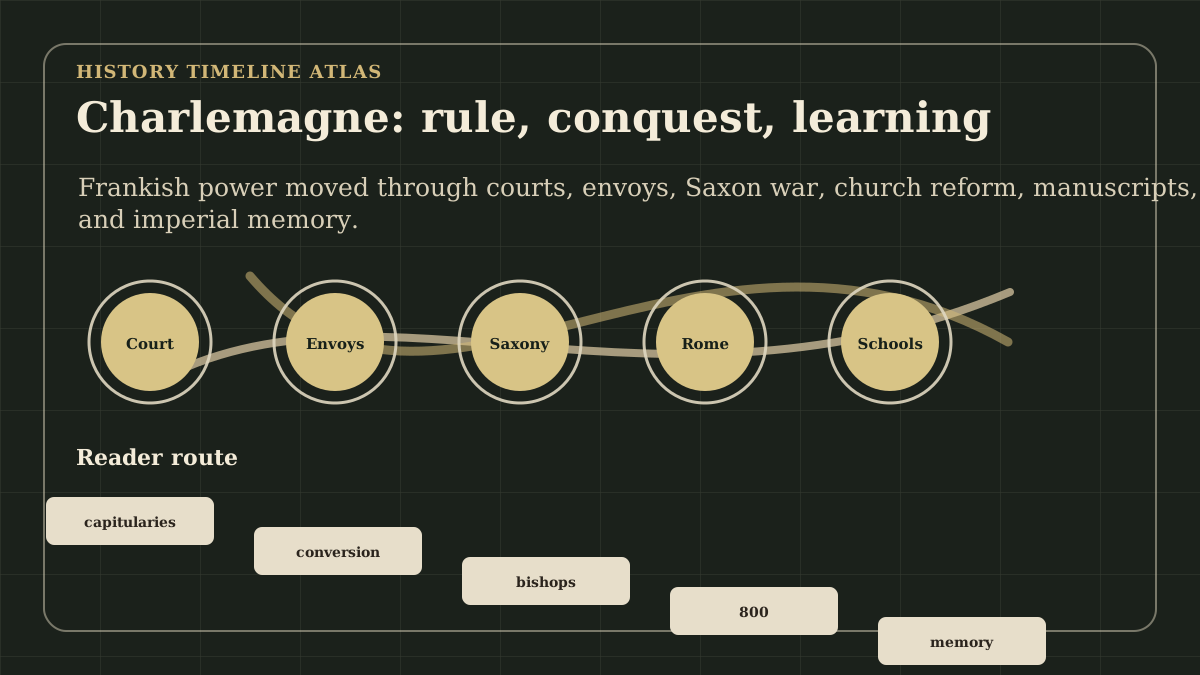
Track courts, envoys, assemblies, bishops, and written orders as the practical machinery of a large medieval realm.
Read conversion, frontier war, and punishment beside learning and reform.
Ask why later Europe kept returning to Charlemagne when arguing about empire and legitimacy.
Legacy, Limits, and Memory
A useful biography keeps scale in view. Charlemagne mattered because individual choices met a wider structure: institutions, enemies, allies, audiences, technologies, beliefs, and inherited conflicts. The related event pages help separate personal agency from conditions that no single person controlled.
Memory is part of the biography too. Later readers often simplify a figure into a hero, villain, founder, reformer, conqueror, prophet, scientist, or symbol. Those labels can be helpful, but they become misleading when they hide conflict, compromise, exclusion, uncertainty, or the experiences of people outside the main biography.
For the next step, compare this life with a topic route rather than stopping at the name. If the same pattern appears across several figures, the reader has found a historical structure; if this person breaks the pattern, the contrast is usually where the most interesting question begins.
Charlemagne is often used as a founder of Europe, but founder language can hide the violence of conquest and the instability of succession. The page is stronger when it asks what was built, who paid for it, and why the structure fractured after his death.
His memory is also political. Later rulers used Charlemagne to imagine Christian empire, European unity, German and French inheritance, and papal-imperial legitimacy. The historical Charlemagne and the remembered Charlemagne are related, but not identical.
Turning Points to Read Next
Coronation of Charlemagne
Pope Leo III crowned Charlemagne emperor in Rome, joining Frankish military power with papal authority in a ceremony loaded with Roman memory.
Related Timeline
- December 25, 800Coronation of Charlemagne
Pope Leo III crowned Charlemagne emperor in Rome, joining Frankish military power with papal authority in a ceremony loaded with Roman memory.
References
Where to Check the Facts
- Encyclopaedia Britannica: CharlemagneBiographical reference for Charlemagne's life dates, roles, institutions, and historical setting.
- Encyclopaedia BritannicaBackground reference for chronology, names, and historical context.
- WikidataStructured reference for dates, places, alternate names, and entity links.