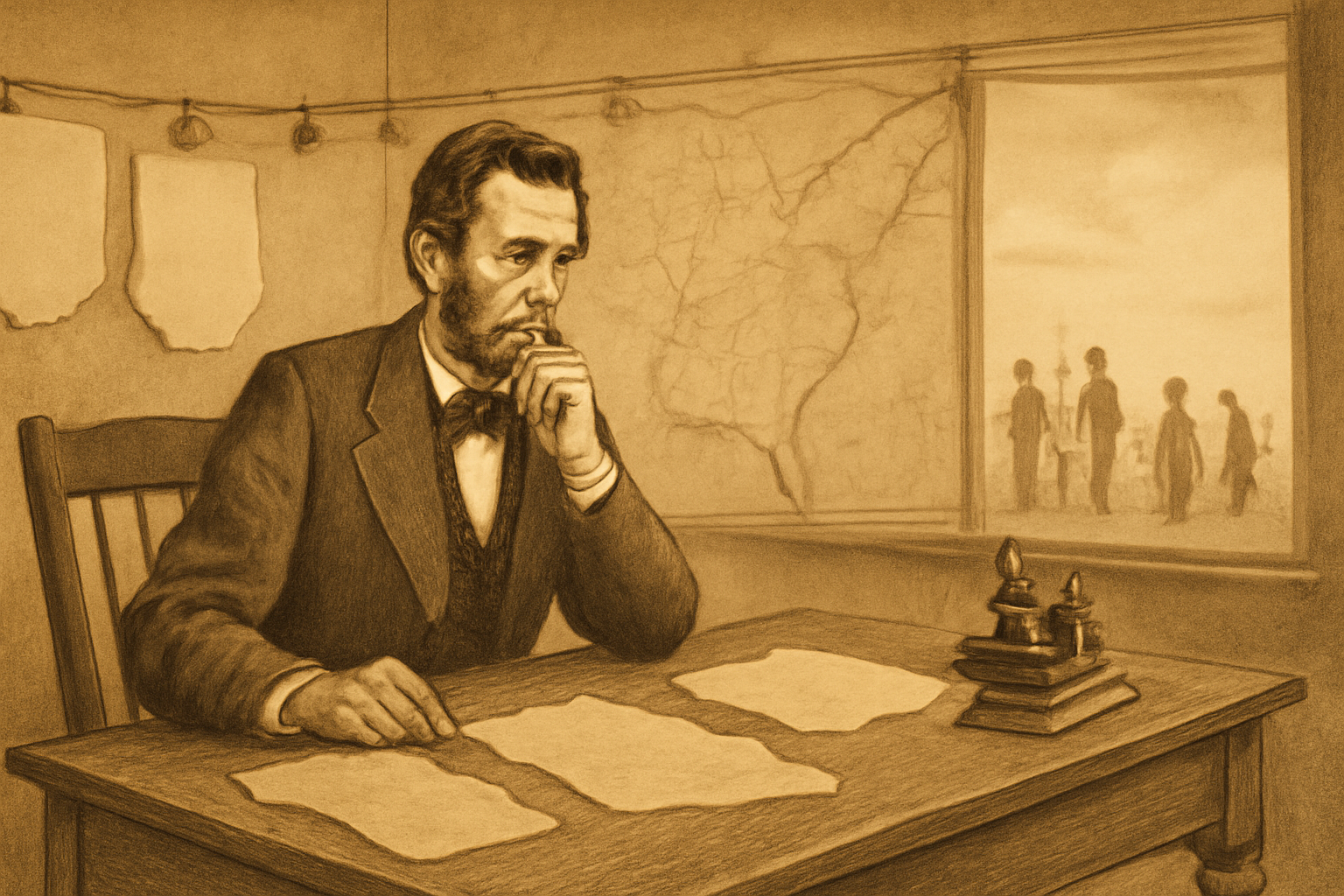
Historical Role
Abraham Lincoln is best read through the collision of Union, slavery, war, law, and democratic legitimacy. His presidency did not begin with a settled blueprint for emancipation. It began with secession, constitutional crisis, border-state caution, military emergency, enslaved people's own movement toward Union lines, and a political world in which every decision about slavery also affected armies, elections, diplomacy, and federal authority.
The Civil War gives the biography its institutional pressure. Lincoln had to make presidential power work under conditions that could have broken it: volunteers, conscription, battlefield disaster, cabinet rivalry, newspaper opposition, habeas corpus controversy, party politics, and the need to keep the Union cause morally and militarily coherent. The office mattered because the war forced old constitutional language to answer new questions.
The Emancipation Proclamation is the central hinge, but it should not be flattened into a single heroic signature. It was a war measure, a moral turn, a diplomatic signal, a recruitment tool, and a public recognition that slavery sat at the center of the conflict. Its limits mattered too: it applied to areas in rebellion, depended on Union military reach, and pointed toward the harder constitutional work of the Thirteenth Amendment.
Black military service and enslaved people's self-emancipation make the page fuller. The United States Colored Troops, refugee camps, labor behind Union lines, family searches, and testimony from formerly enslaved people changed what Union victory could mean. Lincoln responded to that changing reality, but he did not create it alone.
The 1864 election is another crucial test. A wartime democracy asked voters to judge casualties, conscription, emancipation, party conflict, and the future of the Union while the war was still unresolved. Lincoln's reelection made emancipation harder to reverse and gave the Thirteenth Amendment a stronger political path, but it also showed how contingent the outcome had been.
The Gettysburg Address and Second Inaugural gave the war a language of sacrifice, unfinished work, and judgment without erasing conflict over race and citizenship. Lincoln's assassination then turned him into national memory before Reconstruction could settle what freedom would mean in law, land, labor, voting, and protection from white violence.
Abraham Lincoln helps connect individual action with wider historical change in United States. The biography works best when it keeps the surrounding world visible: authority, conflict, belief, reform, or discovery moved through decisions made under pressure.
The related events show how roles such as U.S. president can be read through dates, places, institutions, and consequences rather than through reputation alone. The biography explains why this person matters, while the linked events explain what changed around them.
A richer reading starts with the limits around the person. Some figures acted through offices, armies, courts, laboratories, churches, parties, ships, trade networks, or protest movements; others became important because later communities turned their lives into symbols. The page therefore asks what this person could actually change, what was already moving before them, and which consequences later readers attached to the name.
Read the biography against absence as well. Many lives around Abraham Lincoln are less visible in the record: opponents, collaborators, family members, workers, soldiers, students, subjects, victims, translators, scribes, or local communities. Keeping those surrounding people in view makes the page less like a name card and more like an entry point into historical systems.
Abraham Lincoln also works as a navigation point. Open the linked event pages to see where the biography becomes chronology, then use the topic routes to test whether the same pattern appears beyond one life. That extra step matters because historical importance is rarely contained inside a single decision; it usually spreads through institutions, witnesses, opponents, imitators, and later arguments over memory.
Sources and Method
Source method: read Lincoln through the Civil War and Emancipation Proclamation pages, then separate five layers of evidence: constitutional argument, military necessity, enslaved agency, party politics, and later public memory.
Evidence Notes
How Sensitive Claims Are Sourced
- 1
Union crisis and presidential power
The biography treats Lincoln's choices as wartime statecraft under constitutional strain rather than as speeches detached from armies, elections, border states, and federal authority.
- 2
Emancipation as military and moral turning point
The Emancipation Proclamation anchors the page because it links slavery, Union war aims, Black military service, international diplomacy, and the path toward abolition.
Why This Person Matters
Abraham Lincoln matters because the connected events make a larger historical pattern easier to follow. The page links biography to consequences so readers can move from a life story into the wider atlas, compare the person with contemporaries, and understand why later memory kept returning to this figure. Abraham Lincoln matters because his presidency shows how a constitutional republic can be remade under war pressure. The page helps readers connect leadership with institutions: Union survival, slavery's destruction, presidential authority, public persuasion, military crisis, and democratic memory all meet in one biography.
How did Lincoln turn a war for Union into a war that also destroyed slavery, and which parts of that transformation came from pressures beyond Lincoln himself?
How to Read This Life
Abraham Lincoln is easiest to understand when the biography is read beside American Civil War Begins, Emancipation Proclamation. Those events show the historical setting in motion: dates, places, institutions, conflict, and consequences give the life a structure that a short biography alone cannot provide.
The surrounding route crosses Modern World, Nineteenth Century and locations such as Fort Sumter, Washington, D.C.. That matters because influence rarely stays inside one person. It moves through offices, armies, movements, laws, texts, speeches, institutions, and later memory.
A useful reading path starts with the role labels, then opens the event pages to see what changed, and finally compares this person with other actors facing similar pressures.
For readers who arrive on a biography first, this page is meant to become a doorway rather than a stop. Read one paragraph for the answer, then use the turning points, topic routes, and event links to test whether the person's reputation matches the wider evidence.
Read Lincoln beside the American Civil War, Emancipation Proclamation, abolition, civil rights, and constitutional crisis routes. That path keeps biography tied to state survival and slavery rather than turning him into a detached moral icon.
Then compare him with Washington, Toussaint Louverture, Martin Luther King Jr., and later rights figures where available. The comparison asks how leaders use law, war, moral language, and public office when legitimacy is under pressure.
Read Abraham Lincoln through the roles of U.S. president rather than as reputation alone.
Place the biography inside United States and the wider events linked below.
Ask which choices were personal and which were constrained by institutions or crisis.
Follow how later memory simplified, contested, or reused this person's role.
Track how secession, border states, elections, armies, and federal authority shaped presidential choice.
Read the proclamation as moral claim, war measure, diplomatic signal, and route toward constitutional abolition.
Keep enslaved people, Black soldiers, abolitionists, Congress, and Union military pressure visible beside Lincoln.
Legacy, Limits, and Memory
A useful biography keeps scale in view. Abraham Lincoln mattered because individual choices met a wider structure: institutions, enemies, allies, audiences, technologies, beliefs, and inherited conflicts. The related event pages help separate personal agency from conditions that no single person controlled.
Memory is part of the biography too. Later readers often simplify a figure into a hero, villain, founder, reformer, conqueror, prophet, scientist, or symbol. Those labels can be helpful, but they become misleading when they hide conflict, compromise, exclusion, uncertainty, or the experiences of people outside the main biography.
For the next step, compare this life with a topic route rather than stopping at the name. If the same pattern appears across several figures, the reader has found a historical structure; if this person breaks the pattern, the contrast is usually where the most interesting question begins.
The main risk is monument language. Lincoln mattered enormously, but emancipation was not made by one president alone. Enslaved people, Black soldiers, abolitionists, Congress, Union armies, local communities, and wartime pressure all shaped what became possible.
A second risk is separating Union from slavery too cleanly. The biography becomes richer when readers see how preserving the Union and destroying slavery became connected through war, law, politics, and military necessity.
Turning Points to Read Next
American Civil War Begins
Confederate forces fired on Fort Sumter after secession, turning disputes over slavery, federal authority, and union into open war.
Emancipation Proclamation
Abraham Lincoln issued the Emancipation Proclamation, declaring enslaved people in Confederate-held territory to be free as a war measure.
Related Timeline
- April 12, 1861American Civil War Begins
Confederate forces fired on Fort Sumter after secession, turning disputes over slavery, federal authority, and union into open war.
- January 1, 1863Emancipation Proclamation
Abraham Lincoln issued the Emancipation Proclamation, declaring enslaved people in Confederate-held territory to be free as a war measure.
References
Where to Check the Facts
- Encyclopaedia Britannica: Abraham LincolnBiographical reference for Abraham Lincoln's life dates, roles, institutions, and historical setting.
- Encyclopaedia BritannicaBackground reference for chronology, names, and historical context.
- WikidataStructured reference for dates, places, alternate names, and entity links.