How to Read the Year
Why did 1968 become a shorthand for reform, revolt, repression, and global protest?
Tanks entered Prague, students filled streets in Paris and Mexico City, American cities mourned Martin Luther King Jr., and antiwar protest moved through campuses, churches, and television screens. The year is not memorable because every protest had the same cause. It is memorable because so many governments had to answer people who no longer accepted official promises at face value.
Mexico City needs a place in the first frame. Before the Olympics, students challenged authoritarian rule and public order politics; the Tlatelolco massacre made modernization, media image, and state violence part of the year's global meaning. Dakar, Warsaw, Tokyo, Rio de Janeiro, and other protest settings also remind readers that 1968 was not only Paris, Prague, and the United States.
Interpretive claims about 1968 stay modest. Historians debate whether the year marks a global generational revolt, a media-synchronized cluster of local crises, a turning point in culture, or a memory later movements reshaped. Those interpretations overlap, but none replaces the need to read each place on its own terms.
The year 1968 is remembered because protest and state power seemed to collide in many places at once. In the atlas inventory, Prague Spring anchors the year through socialist reform and Soviet-bloc repression. The wider historical meaning reaches beyond Czechoslovakia: students, workers, civil-rights activists, antiwar movements, anti-colonial politics, feminist organizing, and governments all tested the limits of authority.
Prague Spring gives 1968 a clear Cold War turning point. Reformers in Czechoslovakia tried to create socialism with more openness, press freedom, and public debate. The Warsaw Pact invasion showed that Moscow would not allow a member state to move beyond limits the Soviet leadership considered dangerous. Reform became a question of sovereignty as well as ideology.
The United States gives the year another layer through the Vietnam War, civil-rights conflict, and the assassination of Martin Luther King Jr. These events exposed the strain between democratic language and violence at home and abroad. Even when a specific event page is not yet present for every 1968 crisis, the year helps readers connect war, race, protest, media, and state legitimacy.
France and other student movements show that 1968 cannot be reduced to one country. Protests challenged universities, workplaces, family authority, consumer society, party politics, and the meaning of participation. Some movements wanted reform, some revolution, some cultural freedom, and some more direct democracy. Their differences matter because 1968 was a cluster of pressures, not one ideology.
Mexico City keeps the story from becoming Euro-American. Student protest before the Olympics, state violence at Tlatelolco, and official concern over national image show another pattern: modernization and public order language could be used to silence dissent in the Global South as well as in Europe or the United States. Anti-colonial and postcolonial movements elsewhere faced similar questions about youth, authority, development, and repression.
Media changed the scale of the year. Television, photography, radio, student newspapers, and international reporting made protest and repression visible across borders. Images of tanks, marches, police violence, funerals, and crowds helped movements learn from one another while governments worried about legitimacy in front of wider audiences.
The year also shows the limits of protest. Prague Spring was crushed. Many student movements fragmented. Civil-rights gains faced backlash. Antiwar activism did not immediately end war. Yet failure in the short term did not mean disappearance. The memory of 1968 reshaped later dissident politics, cultural life, human-rights language, and debates over democracy.
For students, 1968 is useful because it separates reform, revolution, and repression. Reform asks whether institutions can change from within. Revolution asks whether the existing order must be replaced. Repression reveals what authorities fear losing. The year becomes clearer when each event is sorted into those categories instead of treated as generic unrest.
1968 also helps readers understand generational politics. Many protesters had grown up after World War II, inside expanding universities, mass media, consumer culture, and states that promised planning, welfare, modernization, or liberation. They often judged those promises against racism, bureaucracy, war, censorship, patriarchy, and colonial violence. The anger of the year came partly from that gap between official futures and lived contradiction.
The conservative and governmental reactions are part of the story too. Calls for order, national unity, moral discipline, anti-communism, party control, and police authority gained force because many people feared that protest would become chaos. The year therefore did not move politics in only one direction. It energized radicals, reformers, dissidents, state hard-liners, and later conservative movements that defined themselves against the upheavals.
The afterlife of 1968 is uneven because different places remember different defeats and openings. In Prague, the date can evoke crushed reform and later dissident patience. In the United States, it can evoke grief, backlash, Vietnam, civil rights, and political realignment. In France, it can evoke student revolt, labor action, and cultural change. The year works best when those memories sit beside one another rather than being forced into a single legend.
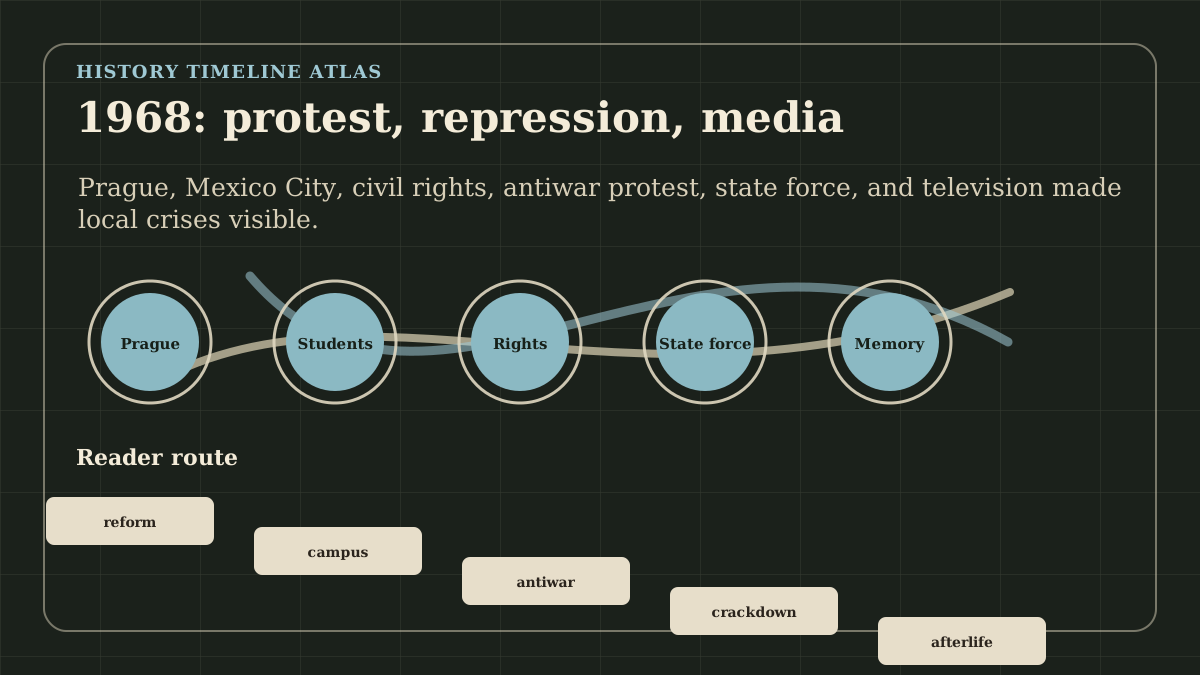
The route also gives readers a practical way to sort the year. Prague Spring belongs to reform inside a socialist state. Antiwar and civil-rights protest belong to democratic crisis and public legitimacy. Student movements belong to education, culture, and generational authority. Reading the year through those lanes turns a noisy global moment into a navigable map.
The best next route moves from Prague Spring to civil rights, Vietnam, Cold War detente, decolonization, feminism, and human-rights activism. 1968 matters because it shows how many societies entered the late twentieth century arguing over authority, participation, identity, violence, and the public right to dissent.
1968 CE in History gathers events that help readers move from a single date into wider historical patterns. A useful year entry does more than answer what happened; it shows why people keep using the year as a marker for change.
The connected events show how decisions, institutions, conflicts, ideas, and consequences crossed beyond one location or one person. The event links explain the immediate story, while the topic routes and timelines show what came before and after.
The year also helps organize broad questions. It gives readers a concise answer and a direct path into deeper event pages where causes, turning points, consequences, maps, and references are easier to inspect.
Read the date in three passes. First ask what happened inside the year itself. Then ask which older pressures made the event possible. Finally ask which later pages reuse the same vocabulary, institutions, borders, technologies, or memories. That sequence keeps the page from becoming a trivia answer.
Even when only one event is currently attached, the year still has a job: it gives students and curious visitors a stable chronological doorway into the atlas. The page makes the doorway useful by pointing to the event, the topic route, the timeline, the map, and the evidence trail that can turn a date into a broader explanation.
This year matters because it connects Prague Spring to a wider sequence of causes and consequences. It gives the reader a chronological anchor while still pointing outward to people, places, institutions, and later effects. A thin year page would only name the event; a useful year page explains why this date is a handle for a larger route through history. 1968 matters because it concentrated a global argument over who could speak, organize, reform, dissent, and define freedom. The year did not produce one outcome. It produced a memory of possibility and repression that later activists, governments, and historians kept revisiting. Its value as a year page is that it connects Cold War reform, civil-rights struggle, antiwar protest, student movements, media politics, and the limits of state tolerance.
Reader Lenses
Look for the pressures that made change possible.
Identify who acted and what options were available.
Follow what changed after the event.
Ask why this date still appears in historical summaries.
Use Prague Spring to ask how far reform could move inside a Soviet-bloc system.
Compare students, workers, civil-rights activists, and antiwar movements without forcing them into one ideology.
Watch how governments used police, armies, party discipline, and public order language to contain dissent.
Ask how images and reporting made local crises legible to global audiences.
Follow how 1968 became a memory used by later dissidents, conservatives, reformers, and cultural movements.
How This Year Connects
1968 CE in History is anchored by Prague Spring. Read those pages together and the year stops being a date label; it becomes a crossroads where immediate choices met older pressures and opened later consequences.
The setting matters as much as the date. The year moves through Prague and belongs to Cold War. That combination helps readers avoid treating the year as isolated; geography, institutions, conflict, belief, economy, and communication all shape what a date can mean.
The year also opens into people and themes. Figures such as Alexander Dubcek appear because their choices made the year visible, while themes such as Cold War, Soviet Bloc, and Reform explain why the consequences outlived the moment. A useful next step is usually an event page, then a topic route, then a timeline.
Evidence changes the way a date reads. A treaty, battle report, inscription, newspaper, census, court record, memoir, photograph, or archaeological trace does not answer the same question. Looking at source type helps separate what happened in the year from how later people remembered it.
A year page is most useful when it keeps two scales open at once. The first scale is immediate: what happened, where, and who was involved. The second scale is interpretive: why later readers use this date to organize a wider story. Holding both scales together makes the page a starting point for deeper reading rather than a dead-end answer.
The before-and-after frame matters too. A date rarely begins the forces it reveals. Earlier pressures made the linked event possible, while later pages show which effects were temporary, which became institutions, and which turned into memory. Reading the year this way helps students avoid the false impression that history changes only when the calendar flips.
Use this page as a junction. If the event feels too brief, follow the topic route for background; if the cause feels too abstract, open the event page for sequence; if the consequence feels larger than the date, move into the timeline. The value of a year page is that it lets readers change scale without losing their place.
Events in This Year
- 1968Prague Spring
Czechoslovak reformers attempted to liberalize socialism during the Prague Spring before Warsaw Pact forces invaded to stop the movement.
Map Layer
1968 CE in History geography
Gold pins mark the approximate locations of published event pages. This is a schematic locator map, not a historical border map.
Coordinates are approximate and are used to help readers orient themselves before opening a full event page.
References
Where to Check the Facts
- U.S. National Archives: Martin Luther King Jr. Federal RecordsArchive reference for Martin Luther King Jr. records connected to the 1968 assassination and civil-rights memory.
- Library of Congress: The Civil Rights MovementArchive and teaching collection reference for the civil-rights movement context around 1968.
- Encyclopaedia Britannica: Prague SpringSpecific reference for the 1968 CE anchor event, chronology, and historical setting.
- Encyclopaedia Britannica: Martin Luther King, Jr.Specific reference for the 1968 CE anchor event, chronology, and historical setting.