How to Read the Year
How did a regional assassination become the opening of a world war?
The year 1914 is a lesson in escalation. The assassination of Archduke Franz Ferdinand did not mechanically cause the First World War on its own, but it triggered decisions inside a Europe already shaped by alliances, militarized planning, imperial rivalry, nationalism, and fear that delay would weaken strategic position.
Reading 1914 as a year page is useful because it keeps attention on sequence. A violent act in Sarajevo became an international crisis because governments interpreted risk through earlier commitments and worst-case expectations. The year shows how speed, pride, mobilization schedules, and diplomatic mistrust can reduce room for retreat.
Read 1914 first as a human calendar. In Sarajevo, witnesses saw a royal visit become a murder investigation; in railway stations, reservists said goodbye before they understood the war's scale; in colonies, soldiers and laborers were pulled into a European crisis by empires they did not control; in border towns, civilians learned that mobilization could turn geography into danger overnight.
Names keep the year from becoming a diagram. Gavrilo Princip, Count Leopold Berchtold, Nikola Pasic, Kaiser Wilhelm II, Tsar Nicholas II, Raymond Poincare, and Sir Edward Grey stood in different rooms of the crisis, while West African porters, Indian soldiers, Belgian civilians, and French and German reservists felt decisions made far above them. The first year of war was already a world system touching bodies, not only a diplomatic chain.
Historians disagree over emphasis. Christopher Clark stresses how leaders and institutions moved through the crisis like sleepwalkers inside a dangerous system. Margaret MacMillan gives more room to choices, personalities, militarism, and political culture before the war. The page uses those tensions as guide rails: structure mattered, but responsibility does not disappear inside structure.
A deeper reading of 1914 begins with the July Crisis, but it cannot end there. Austria-Hungary saw the Sarajevo assassination as a challenge to imperial authority in the Balkans. Serbia faced demands that touched sovereignty. Russia watched Slavic politics and great-power prestige. Germany feared encirclement and gave support to Vienna. France was bound to Russia. Britain worried about Belgium, naval security, and the European balance. The crisis became dangerous because each government read delay as a possible loss.
Some points are widely shared: Sarajevo triggered the July Crisis, alliances widened the danger, mobilization narrowed time, and the Marne helped end hopes of a short western war. Other points are interpretive: historians argue over how much fear, domestic politics, military planning, imperial rivalry, or deliberate risk-taking mattered most in the choices of individual governments.
Mobilization gave the year its deadly tempo. Military plans were not neutral paperwork. They shaped what leaders thought was still possible once orders began to move. Rail schedules, reserve call-ups, frontier assumptions, and fear of being second made diplomacy more brittle. 1914 is therefore a year about time pressure: when institutions reward speed, political choice can shrink even while leaders still believe they are choosing.
The First Battle of the Marne shows that the war's first phase already contained the failure of a short-war expectation. German hopes for rapid victory in the west broke against French and British resistance, logistical strain, exhaustion, and battlefield adaptation. The outcome did not end the war; it helped create the conditions for trench systems, attrition, and a longer conflict that none of the major powers had fully prepared to absorb.
The human scale of 1914 is often hidden by diplomatic diagrams. Soldiers moved by train, civilians watched mobilization as spectacle and dread, border communities became exposed, families faced separation, and governments used censorship and patriotic language to hold public commitment together. The war became industrial and global later, but the social transformation began immediately as states demanded bodies, money, obedience, and belief.
Empire made the year global from the start. European states carried colonial troops, resources, sea lanes, cables, and imperial rivalries into the conflict. Fighting and mobilization touched Africa, Asia, the Middle East, and the world's oceans even when the famous trigger sat in Sarajevo. A world-history reading of 1914 treats the Western Front as central but not complete.
The year also changed political imagination. Before the war, many elites believed crisis could be managed by deterrence, alliance signaling, or limited conflict. By the end of 1914, the scale of casualties, stalemate, invasion, occupation, and economic mobilization had made older assumptions look dangerously thin. The system had not only produced war; it had revealed how little control leaders had once escalation became collective.
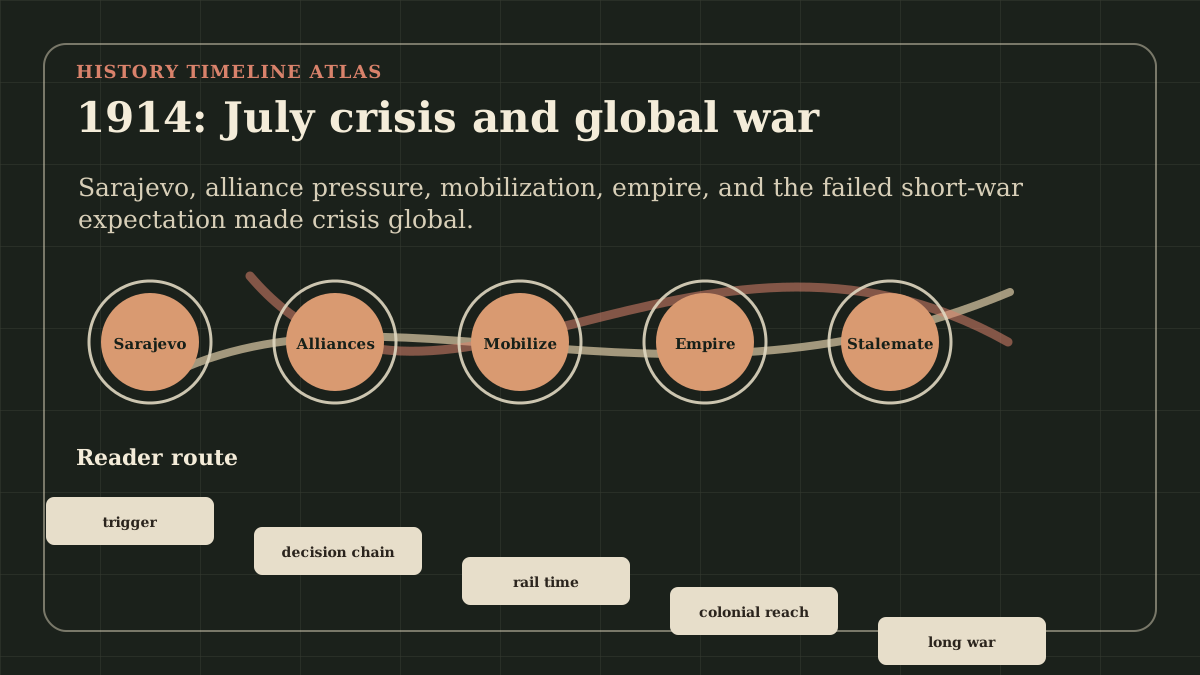
For students, 1914 is useful because it separates levels of causation. Background pressures include militarism, alliances, nationalism, imperial rivalry, and domestic politics. The trigger is Sarajevo. The decision chain is the July Crisis. The early turning point is the failure of quick victory. The consequence is a war system that became harder to exit than to enter.
The year also belongs in the history of information. Newspapers, telegrams, military intelligence, rumors, censorship, and diplomatic messages shaped what governments and publics thought was happening. Leaders did not act with perfect knowledge. They acted through reports, assumptions, partial signals, and inherited fears. That makes 1914 useful for readers interested in how modern states can become powerful at mobilizing people while still poor at understanding one another.
1914 also changed the meaning of home front. War finance, food prices, patriotic associations, censorship offices, refugee movement, and the first casualties made civilians part of the crisis from the beginning. This matters because total war did not arrive only after trenches hardened. The first year already pulled households, newspapers, schools, banks, railways, and factories into the state's demand for endurance.
The reading path becomes stronger when 1914 is treated as an opening chapter rather than a complete explanation. Sarajevo explains ignition, the July Crisis explains decision, the Marne explains failed expectation, and later battles explain how industrial war hardened. That sequence gives readers a structure they can reuse when comparing other crises.
The best next route moves from 1914 to Verdun, the Somme, the Zimmermann Telegram, the armistice, Versailles, and then World War II. That sequence prevents 1914 from becoming a trivia date. It becomes the opening of a crisis whose consequences reshaped revolution, borders, colonial politics, economic life, and collective memory.
1914 matters because it marks the point where a nineteenth-century balance of power broke into industrial war. It leads forward to trench warfare, revolution, empire collapse, new borders, mass death, and the unsettled peace that shaped the next global conflict. The year is an entry point into how systems fail under pressure. The lasting importance of 1914 is that it turns causation into a sequence readers can test. The year shows how older structures made crisis likely, how specific decisions made war actual, and how early battlefield outcomes made the war harder to end. It also teaches humility about systems. No single state controlled the whole chain once fear, alliance logic, mobilization, and public commitment began reinforcing one another.
Reader Lenses
Trace how one crisis widened through alliances, ultimatums, mobilization, and fear.
Look for the pressures of imperial rule, ethnic politics, and state honor.
Ask how military timetables and assumptions narrowed political choice.
Read 1914 as the opening of a chain that reaches Versailles and World War II.
Watch how deadlines, rail plans, mobilization orders, and fear of delay narrowed diplomatic exits.
Follow colonial troops, sea lanes, cables, and imperial rivalry to keep the year global.
Use the Marne to see how the failure of a short war created the conditions for a long one.
How This Year Connects
1914 CE in History is anchored by Assassination of Archduke Franz Ferdinand and First Battle of the Marne. Read those pages together and the year stops being a date label; it becomes a crossroads where immediate choices met older pressures and opened later consequences.
The setting matters as much as the date. The year moves through Sarajevo and Marne River and belongs to Twentieth Century and World War I. That combination helps readers avoid treating the year as isolated; geography, institutions, conflict, belief, economy, and communication all shape what a date can mean.
The year also opens into people and themes. Figures such as Franz Ferdinand, Gavrilo Princip, Joseph Joffre, and Helmuth von Moltke appear because their choices made the year visible, while themes such as World War I, Nationalism, Balkans, Western Front, and Warfare explain why the consequences outlived the moment. A useful next step is usually an event page, then a topic route, then a timeline.
Evidence changes the way a date reads. A treaty, battle report, inscription, newspaper, census, court record, memoir, photograph, or archaeological trace does not answer the same question. Looking at source type helps separate what happened in the year from how later people remembered it.
A year page is most useful when it keeps two scales open at once. The first scale is immediate: what happened, where, and who was involved. The second scale is interpretive: why later readers use this date to organize a wider story. Holding both scales together makes the page a starting point for deeper reading rather than a dead-end answer.
The before-and-after frame matters too. A date rarely begins the forces it reveals. Earlier pressures made the linked event possible, while later pages show which effects were temporary, which became institutions, and which turned into memory. Reading the year this way helps students avoid the false impression that history changes only when the calendar flips.
Use this page as a junction. If the event feels too brief, follow the topic route for background; if the cause feels too abstract, open the event page for sequence; if the consequence feels larger than the date, move into the timeline. The value of a year page is that it lets readers change scale without losing their place.
Events in This Year
- June 28, 1914Assassination of Archduke Franz Ferdinand
Gavrilo Princip assassinated Archduke Franz Ferdinand in Sarajevo, setting off a diplomatic crisis among Europe's alliance systems.
- September 1914First Battle of the Marne
French and British forces stopped the German advance near the Marne, preventing a quick German victory and helping turn the Western Front into a long war of attrition.
Map Layer
1914 CE in History geography
Gold pins mark the approximate locations of published event pages. This is a schematic locator map, not a historical border map.
Coordinates are approximate and are used to help readers orient themselves before opening a full event page.
References
Where to Check the Facts
- The National Archives: First World WarArchive reference for 1914 as the opening year of the First World War and its document record.
- Imperial War Museums: First World WarMuseum reference for the outbreak, global scale, and human setting of the First World War.
- Encyclopaedia Britannica: World War ISpecific reference for the 1914 CE anchor event, chronology, and historical setting.