How to Read the Year
Why does the Second Siege of Vienna make 1683 a turning point without ending Ottoman history?
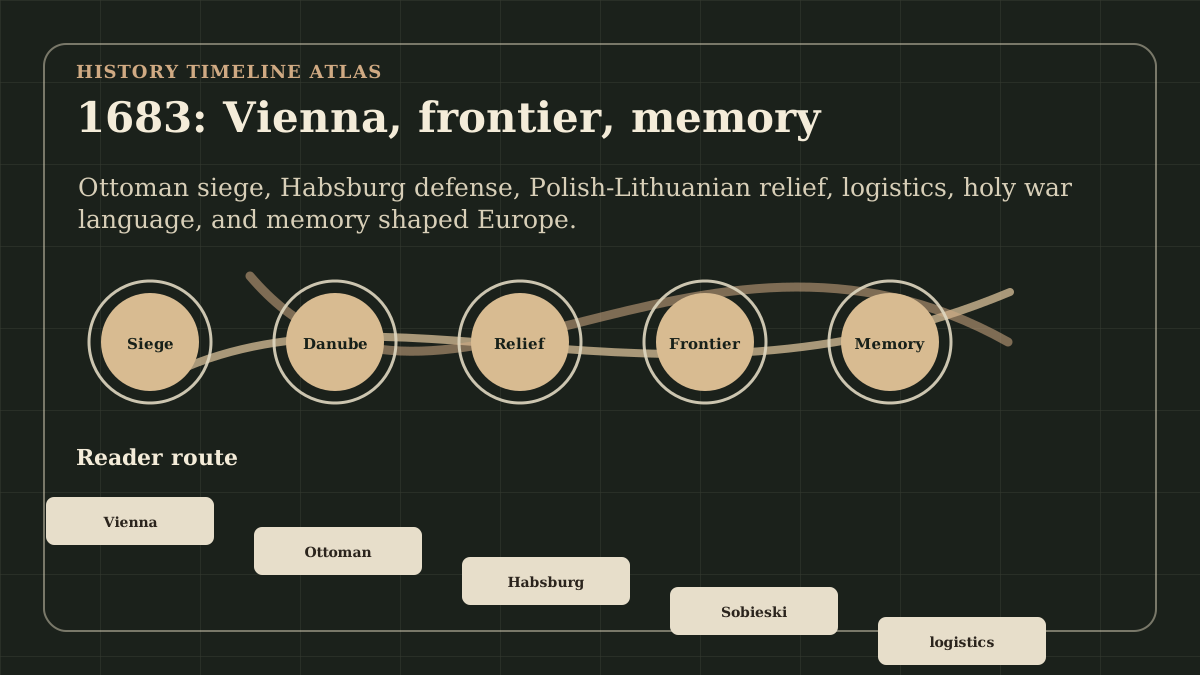
1683 is anchored by the failed Ottoman siege of Vienna and the relief force that broke it. The year matters because it concentrated Ottoman-Habsburg rivalry, Central European coalition politics, siege warfare, logistics, fortifications, cavalry, and later memory into one dramatic campaign.
A careful reading avoids the old shortcut that 1683 ended Ottoman power. It was a major strategic defeat and opened a Habsburg counteroffensive, but the Ottoman Empire remained a major state. The turning point matters without becoming civilizational myth.
Vienna also makes geography visible. The Danube, Central Europe, Ottoman supply lines, Habsburg defense, Polish-Lithuanian intervention, fortifications, and the Great Turkish War all shaped the outcome. The battle was not only a charge; it was months of planning, attrition, alliance, fear, and relief.
The memory afterlife matters too. 1683 became part of Austrian, Polish, Ottoman, European, and religious narratives, often simplified for later politics. Readers need to separate the event from the uses made of it.
The coalition frame is essential. Relief depended on Habsburg defenders, Polish-Lithuanian forces under John III Sobieski, German princes, papal diplomacy, local logistics, and the ability to coordinate armies under pressure. A single heroic image cannot explain that machinery.
The Ottoman side also needs more than a failed-siege label. Command decisions, supply distance, weather, disease, morale, artillery, cavalry, and the politics of grand vizier authority shaped the campaign. The year becomes more useful when readers see failure as a system problem, not only a battlefield moment.
A strong search answer should tell readers what changed next. The defeat helped open a Habsburg counteroffensive and shifted the frontier, but Ottoman power continued. That balance prevents both triumphalist mythology and a flat statement that nothing changed.
The civilian layer keeps the siege from becoming only a military diagram. Vienna's residents, refugees, suppliers, clergy, and neighboring communities lived through fear, scarcity, rumor, and relief while armies made decisions outside the walls. That scale helps readers understand why the year became emotionally powerful before it became a later symbol.
The event also asks how memory turns war into identity. Later stories used 1683 to define Europe, Christianity, Poland, Austria, or Ottoman decline in simplified ways. A better page keeps memory visible without letting memory replace the complicated campaign.
1683 CE in History gathers events that help readers move from a single date into wider historical patterns. A useful year entry does more than answer what happened; it shows why people keep using the year as a marker for change.
The connected events show how decisions, institutions, conflicts, ideas, and consequences crossed beyond one location or one person. The event links explain the immediate story, while the topic routes and timelines show what came before and after.
The year also helps organize broad questions. It gives readers a concise answer and a direct path into deeper event pages where causes, turning points, consequences, maps, and references are easier to inspect.
Read the date in three passes. First ask what happened inside the year itself. Then ask which older pressures made the event possible. Finally ask which later pages reuse the same vocabulary, institutions, borders, technologies, or memories. That sequence keeps the page from becoming a trivia answer.
Even when only one event is currently attached, the year still has a job: it gives students and curious visitors a stable chronological doorway into the atlas. The page makes the doorway useful by pointing to the event, the topic route, the timeline, the map, and the evidence trail that can turn a date into a broader explanation.
This year matters because it connects Second Siege of Vienna to a wider sequence of causes and consequences. It gives the reader a chronological anchor while still pointing outward to people, places, institutions, and later effects. A thin year page would only name the event; a useful year page explains why this date is a handle for a larger route through history. 1683 matters because it shows how one siege can become a strategic turning point, a coalition story, and a memory symbol at once. The year connects Ottoman-Habsburg rivalry, Central European defense, Polish intervention, fortification warfare, imperial logistics, and the danger of later mythmaking.
Reader Lenses
Look for the pressures that made change possible.
Identify who acted and what options were available.
Follow what changed after the event.
Ask why this date still appears in historical summaries.
Track Habsburg, Polish-Lithuanian, German, papal, and local defense interests rather than one single actor.
Read walls, supply, artillery, weather, command, cavalry, and relief timing as part of the outcome.
Ask how later stories turned a siege into a symbol and what those stories leave out.
How This Year Connects
1683 CE in History is anchored by Second Siege of Vienna. Read those pages together and the year stops being a date label; it becomes a crossroads where immediate choices met older pressures and opened later consequences.
The setting matters as much as the date. The year moves through Vienna and belongs to Early Modern Europe and Ottoman World. That combination helps readers avoid treating the year as isolated; geography, institutions, conflict, belief, economy, and communication all shape what a date can mean.
The year also opens into people and themes. Figures such as Kara Mustafa Pasha and John III Sobieski appear because their choices made the year visible, while themes such as Ottoman Empire, Habsburg Monarchy, Central Europe, and Coalition Warfare explain why the consequences outlived the moment. A useful next step is usually an event page, then a topic route, then a timeline.
Evidence changes the way a date reads. A treaty, battle report, inscription, newspaper, census, court record, memoir, photograph, or archaeological trace does not answer the same question. Looking at source type helps separate what happened in the year from how later people remembered it.
A year page is most useful when it keeps two scales open at once. The first scale is immediate: what happened, where, and who was involved. The second scale is interpretive: why later readers use this date to organize a wider story. Holding both scales together makes the page a starting point for deeper reading rather than a dead-end answer.
The before-and-after frame matters too. A date rarely begins the forces it reveals. Earlier pressures made the linked event possible, while later pages show which effects were temporary, which became institutions, and which turned into memory. Reading the year this way helps students avoid the false impression that history changes only when the calendar flips.
Use this page as a junction. If the event feels too brief, follow the topic route for background; if the cause feels too abstract, open the event page for sequence; if the consequence feels larger than the date, move into the timeline. The value of a year page is that it lets readers change scale without losing their place.
Read 1683 beside Suleiman's Vienna, Chaldiran, Ottoman-Safavid routes, Kucuk Kaynarca, Tanzimat, and late Ottoman pages. That path turns one siege into a long Ottoman and European sequence.
Then compare 1683 with 1453, 1529, 1774, and 1908 where available. The comparison asks how Ottoman power shifted across conquest, frontier limits, treaty pressure, and constitutional crisis.
Events in This Year
- 1683 CESecond Siege of Vienna
The Ottoman siege of Vienna in 1683 failed after a relief force broke the siege, opening a period of Habsburg counteroffensive in Central Europe.
Map Layer
1683 CE in History geography
Gold pins mark the approximate locations of published event pages. This is a schematic locator map, not a historical border map.
Coordinates are approximate and are used to help readers orient themselves before opening a full event page.
References
Where to Check the Facts
- Encyclopaedia Britannica: Siege of Vienna 1683Reference for the 1683 siege, relief force, and Ottoman defeat.
- Encyclopaedia Britannica: Ottoman EmpireReference for Ottoman imperial chronology, institutions, reform, war, and decline.
- Encyclopaedia Britannica: TanzimatReference for the nineteenth-century Ottoman reform program and its administrative setting.