How to Read the Year
Why does 1398 make Timur's sack of Delhi more than a single invasion date?
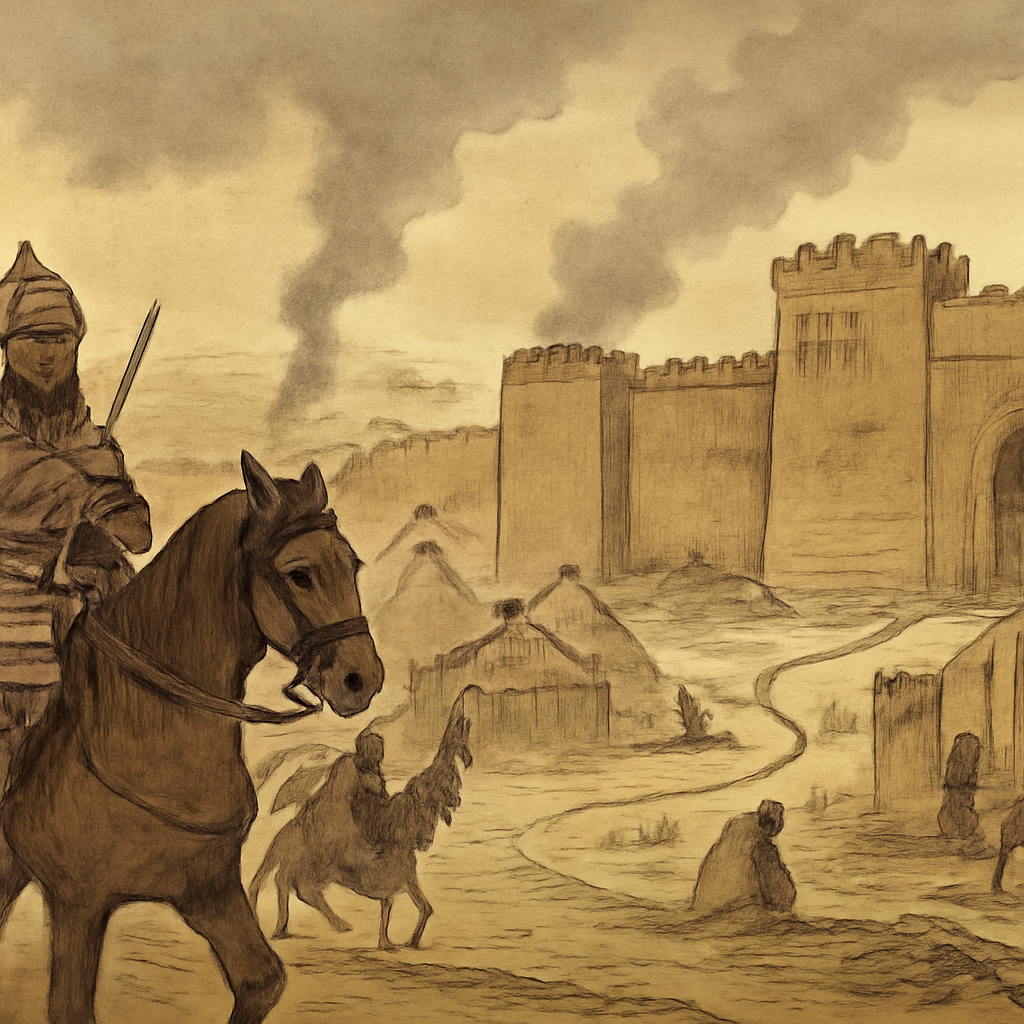
1398 is anchored by Timur's sack of Delhi, a catastrophe that links Central Asian conquest, Delhi Sultanate weakness, urban violence, and the fragility of political authority in late medieval South Asia. A thin reading says that Timur invaded and looted the city. A stronger reading asks why Delhi was vulnerable, how campaign mobility and terror worked as political tools, and why a raid could produce consequences beyond the months of fighting.
The year belongs to two worlds at once. From Central Asia, Timur's campaigns projected power through cavalry, alliance, plunder, fear, and claims to universal sovereignty. From Delhi, the same event exposed the Sultanate's internal strain, factional weakness, military limits, and the vulnerability of urban populations who bore the shock of imperial competition.
The moral center of the year cannot disappear behind strategy. Sack, enslavement, massacre, flight, and economic disruption shaped how people experienced the event. A careful reading keeps civilians, markets, religious sites, and local memory visible beside the ruler-centered military narrative.
1398 also points forward. Timur did not settle permanently in Delhi, but the damage deepened instability and became part of a longer story of regional powers, successor states, and later imperial formations in South Asia. The year helps readers see how a violent campaign could be temporary in occupation but lasting in political memory.
The evidence layer matters because conquest narratives often magnify rulers while compressing victims. Chronicles, later histories, urban memory, economic traces, and regional political change each preserve different parts of the event. A useful 1398 page teaches readers to ask who is speaking, whose losses are counted, and how memory of destruction can serve later claims about legitimacy, warning, or divine judgment.
The date also belongs in a wider Eurasian comparison. Delhi was not the only city whose fate revealed the connection between mobile conquest and urban vulnerability. Comparing 1398 with Baghdad in 1258 or Constantinople in 1453 helps readers see why capital cities concentrate wealth, archives, sacred sites, people, and symbolic authority, making their fall both material and psychological.
The South Asian aftermath was not one simple collapse. Regional rulers, revenue networks, soldiers, artisans, scholars, and merchants still had to rebuild lives and authority after the shock. That recovery frame keeps the year from ending with destruction alone.
1398 CE in History gathers events that help readers move from a single date into wider historical patterns. A useful year entry does more than answer what happened; it shows why people keep using the year as a marker for change.
The connected events show how decisions, institutions, conflicts, ideas, and consequences crossed beyond one location or one person. The event links explain the immediate story, while the topic routes and timelines show what came before and after.
The year also helps organize broad questions. It gives readers a concise answer and a direct path into deeper event pages where causes, turning points, consequences, maps, and references are easier to inspect.
Read the date in three passes. First ask what happened inside the year itself. Then ask which older pressures made the event possible. Finally ask which later pages reuse the same vocabulary, institutions, borders, technologies, or memories. That sequence keeps the page from becoming a trivia answer.
Even when only one event is currently attached, the year still has a job: it gives students and curious visitors a stable chronological doorway into the atlas. The page makes the doorway useful by pointing to the event, the topic route, the timeline, the map, and the evidence trail that can turn a date into a broader explanation.
This year matters because it connects Timur Sacks Delhi to a wider sequence of causes and consequences. It gives the reader a chronological anchor while still pointing outward to people, places, institutions, and later effects. A thin year page would only name the event; a useful year page explains why this date is a handle for a larger route through history. 1398 matters because it turns Timur's Delhi campaign into a lesson about conquest, urban trauma, state weakness, and memory. The date helps readers connect Central Asian imperial ambition with South Asian political fragmentation while asking how historians write about violence without making destruction feel like spectacle.
Reader Lenses
Look for the pressures that made change possible.
Identify who acted and what options were available.
Follow what changed after the event.
Ask why this date still appears in historical summaries.
Track cavalry mobility, plunder, terror, alliance, and strategic timing without turning violence into spectacle.
Ask what Delhi's civilians, markets, rulers, soldiers, and religious spaces experienced when imperial war entered the city.
Follow how temporary occupation could still leave long political, economic, and memory effects.
How This Year Connects
1398 CE in History is anchored by Timur Sacks Delhi. Read those pages together and the year stops being a date label; it becomes a crossroads where immediate choices met older pressures and opened later consequences.
The setting matters as much as the date. The year moves through Delhi and belongs to Late Medieval South Asia. That combination helps readers avoid treating the year as isolated; geography, institutions, conflict, belief, economy, and communication all shape what a date can mean.
The year also opens into people and themes. Figures such as Timur and Delhi Sultanate rulers appear because their choices made the year visible, while themes such as Timurid Empire, Delhi Sultanate, South Asia, and Central Asia explain why the consequences outlived the moment. A useful next step is usually an event page, then a topic route, then a timeline.
Evidence changes the way a date reads. A treaty, battle report, inscription, newspaper, census, court record, memoir, photograph, or archaeological trace does not answer the same question. Looking at source type helps separate what happened in the year from how later people remembered it.
A year page is most useful when it keeps two scales open at once. The first scale is immediate: what happened, where, and who was involved. The second scale is interpretive: why later readers use this date to organize a wider story. Holding both scales together makes the page a starting point for deeper reading rather than a dead-end answer.
The before-and-after frame matters too. A date rarely begins the forces it reveals. Earlier pressures made the linked event possible, while later pages show which effects were temporary, which became institutions, and which turned into memory. Reading the year this way helps students avoid the false impression that history changes only when the calendar flips.
Use this page as a junction. If the event feels too brief, follow the topic route for background; if the cause feels too abstract, open the event page for sequence; if the consequence feels larger than the date, move into the timeline. The value of a year page is that it lets readers change scale without losing their place.
Read 1398 beside Timur Sacks Delhi, the Delhi Sultanate, the Timurid world, and later Mughal and South Asian routes. That sequence shows how invasion, memory, and state rebuilding sit inside one regional history.
Then compare 1398 with 1206, 1258, 1453, and 1526 where available. The comparison asks how sack, conquest, capital cities, and successor rule differ across Eurasian empires.
Events in This Year
- 1398 CETimur Sacks Delhi
Timur invaded north India and sacked Delhi, exposing the vulnerability of the late Delhi Sultanate and linking South Asian politics to Central Asian imperial violence.
Map Layer
1398 CE in History geography
Gold pins mark the approximate locations of published event pages. This is a schematic locator map, not a historical border map.
Coordinates are approximate and are used to help readers orient themselves before opening a full event page.
References
Where to Check the Facts
- Encyclopaedia Britannica: Delhi sultanateReference for Delhi Sultanate decline, Timurid invasion context, and later Mughal transition.
- Encyclopaedia Britannica: TimurBiographical reference for Timur's campaigns, Central Asian imperial power, and military reputation.