Historical Role
William Wilberforce should be read through Parliament, organized abolitionism, religious conviction, evidence campaigns, petition culture, and the voices of Black abolitionists and enslaved people whose experiences made the system visible. He was an important parliamentary advocate, but he was not the whole movement.
The 1807 Abolition of the Slave Trade Act is the central turning point for his atlas page. It did not abolish slavery across the British Empire, and it did not end illegal trafficking or coerced labor. It did mark a major legal attack on Britain's participation in the trade and showed how moral pressure, economic argument, witness testimony, print campaigns, and parliamentary strategy could converge.
Abolitionist politics worked by making distant violence legible. Diagrams of slave ships, testimony from sailors, accounts by formerly enslaved people, boycotts, sermons, pamphlets, petitions, and parliamentary speeches turned the Atlantic trade into a public scandal. Wilberforce's role was powerful because he carried that campaign into legislative procedure year after year.
The page must also prevent a comfortable savior story. Enslaved resistance, maroon communities, the Haitian Revolution, Black writers such as Olaudah Equiano, women organizers, Quaker networks, working-class petitioners, sailors, missionaries, and economic change all shaped abolition. Wilberforce matters most when he is placed inside that coalition rather than above it.
The 1833 Slavery Abolition Act adds another layer. Wilberforce died shortly after hearing that the bill had passed. The act abolished slavery in much of the British Empire, but compensation went to slaveholders rather than to the enslaved, apprenticeship extended coercion, and colonial inequality survived legal abolition. The victory was real and incomplete.
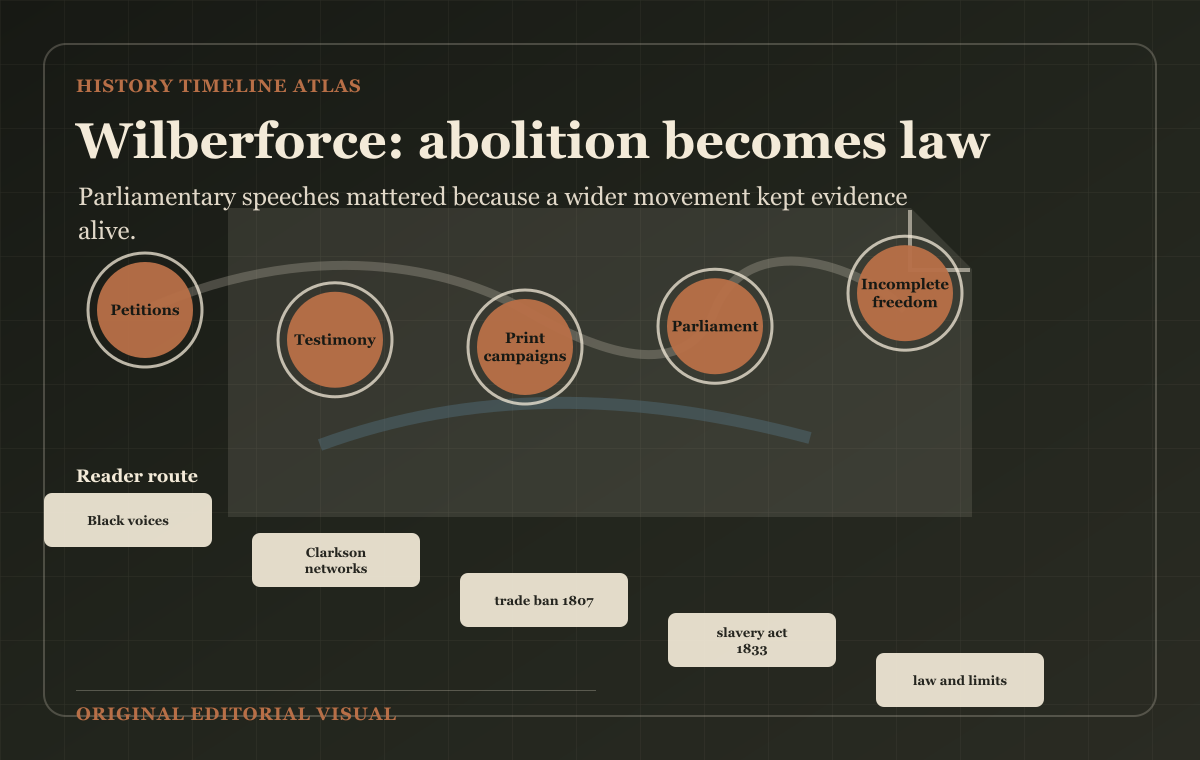
The parliamentary grind is part of the drama. Motions failed, interests defended the trade, war with revolutionary France changed political timing, and abolitionists had to keep evidence alive across years when success looked unlikely. Thomas Clarkson's organizing, local committees, consumer boycotts, petitions signed far from London, and repeated bills made the campaign durable enough for Wilberforce's speeches to matter inside Parliament.
The biography also asks what kind of empathy became politically persuasive. British audiences were moved by testimony, print, images, religious argument, and stories of suffering, but they often heard those stories through filters controlled by reformers, publishers, and legislators. A richer reading notices both the power of public moral pressure and the unequal terms on which enslaved people's experiences entered metropolitan debate.
Wilberforce's reform politics also extended beyond abolition, and that wider moral project should be handled carefully. His evangelical commitments shaped campaigns around manners, vice, charity, and public life, sometimes in ways modern readers may find paternalistic. That tension helps the biography avoid a statue-like tone: he could be courageous against the slave trade while still belonging to a conservative world of hierarchy, empire, and moral discipline.
For readers, Wilberforce opens a larger route into how law changes moral economies. Abolition did not happen because polite opinion suddenly improved. It required repeated organizing, evidence, spiritual argument, political timing, slave resistance, empire-wide pressure, and a willingness to keep partial victories under scrutiny.
William Wilberforce helps connect individual action with wider historical change in British Empire. The biography works best when it keeps the surrounding world visible: authority, conflict, belief, reform, or discovery moved through decisions made under pressure.
The related events show how roles such as Abolitionist politician, Parliamentary campaigner can be read through dates, places, institutions, and consequences rather than through reputation alone. The biography explains why this person matters, while the linked events explain what changed around them.
A richer reading starts with the limits around the person. Some figures acted through offices, armies, courts, laboratories, churches, parties, ships, trade networks, or protest movements; others became important because later communities turned their lives into symbols. The page therefore asks what this person could actually change, what was already moving before them, and which consequences later readers attached to the name.
Read the biography against absence as well. Many lives around William Wilberforce are less visible in the record: opponents, collaborators, family members, workers, soldiers, students, subjects, victims, translators, scribes, or local communities. Keeping those surrounding people in view makes the page less like a name card and more like an entry point into historical systems.
William Wilberforce also works as a navigation point. Open the linked event pages to see where the biography becomes chronology, then use the topic routes to test whether the same pattern appears beyond one life. That extra step matters because historical importance is rarely contained inside a single decision; it usually spreads through institutions, witnesses, opponents, imitators, and later arguments over memory.
Sources and Method
Source trail: the page now uses a Wilberforce biography reference, the National Archives guide to British slave-trade legislation, and abolition sources connected to later emancipation and Atlantic slavery.
Method note: the page separates the 1807 abolition of the trade from 1833 abolition of slavery, and it treats Wilberforce as one actor inside a wider abolitionist movement.
Evidence Notes
How Sensitive Claims Are Sourced
- 1
Parliamentary abolition and movement pressure
Wilberforce is presented as a parliamentary advocate whose work depended on petitions, testimony, print, religious networks, Black abolitionists, and enslaved resistance.
- 2
1807 was not the same as 1833
The page distinguishes abolition of Britain's slave trade from the later abolition of slavery in much of the British Empire, while keeping incomplete freedom and compensation politics visible.
Why This Person Matters
William Wilberforce matters because the connected events make a larger historical pattern easier to follow. The page links biography to consequences so readers can move from a life story into the wider atlas, compare the person with contemporaries, and understand why later memory kept returning to this figure. Wilberforce matters because he makes abolition visible as a political process: evidence gathering, petitions, religious reform, parliamentary procedure, Black testimony, slave resistance, economic pressure, law, and the long gap between ending a trade and ending coerced life.
How does a moral campaign become law, and what remains unresolved after law changes?
How to Read This Life
William Wilberforce is easiest to understand when the biography is read beside Britain Abolishes the Slave Trade, British Slavery Abolition Act. Those events show the historical setting in motion: dates, places, institutions, conflict, and consequences give the life a structure that a short biography alone cannot provide.
The surrounding route crosses Abolition and locations such as London, British Empire. That matters because influence rarely stays inside one person. It moves through offices, armies, movements, laws, texts, speeches, institutions, and later memory.
A useful reading path starts with the role labels, then opens the event pages to see what changed, and finally compares this person with other actors facing similar pressures.
For readers who arrive on a biography first, this page is meant to become a doorway rather than a stop. Read one paragraph for the answer, then use the turning points, topic routes, and event links to test whether the person's reputation matches the wider evidence.
Read Wilberforce beside Britain Abolishes the Slave Trade, then move to Zong, Haiti, Amistad, and the Slavery Abolition Act. That path keeps law, violence, resistance, and public evidence in one sequence.
Compare Wilberforce with Equiano, Douglass, and Atlantic slavery routes where available. The comparison prevents the story from becoming only a parliamentary biography.
Read William Wilberforce through the roles of Abolitionist politician, Parliamentary campaigner rather than as reputation alone.
Place the biography inside British Empire and the wider events linked below.
Ask which choices were personal and which were constrained by institutions or crisis.
Follow how later memory simplified, contested, or reused this person's role.
Look beyond Parliament to petitions, testimony, print, churches, Black abolitionists, women organizers, and enslaved resistance.
Separate the 1807 trade ban from the 1833 abolition of slavery and later labor coercion.
Ask how images, testimony, ship records, speeches, and pamphlets changed public imagination.
Legacy, Limits, and Memory
A useful biography keeps scale in view. William Wilberforce mattered because individual choices met a wider structure: institutions, enemies, allies, audiences, technologies, beliefs, and inherited conflicts. The related event pages help separate personal agency from conditions that no single person controlled.
Memory is part of the biography too. Later readers often simplify a figure into a hero, villain, founder, reformer, conqueror, prophet, scientist, or symbol. Those labels can be helpful, but they become misleading when they hide conflict, compromise, exclusion, uncertainty, or the experiences of people outside the main biography.
For the next step, compare this life with a topic route rather than stopping at the name. If the same pattern appears across several figures, the reader has found a historical structure; if this person breaks the pattern, the contrast is usually where the most interesting question begins.
The main interpretive danger is moral simplification. Wilberforce's commitment was real, but abolition was made by a broad, transatlantic field of actors and by enslaved people resisting the system directly.
Legal abolition should not be confused with full justice. Compensation, apprenticeship, racial hierarchy, colonial labor systems, and later imperial coercion all show why the end of law was not the end of consequences.
Turning Points to Read Next
Britain Abolishes the Slave Trade
Parliament abolished British participation in the transatlantic slave trade after decades of Black resistance, abolitionist campaigning, and political pressure.
British Slavery Abolition Act
The Slavery Abolition Act ended slavery in most British colonies, though apprenticeship and compensation structures limited immediate freedom.
Related Timeline
- 1807Britain Abolishes the Slave Trade
Parliament abolished British participation in the transatlantic slave trade after decades of Black resistance, abolitionist campaigning, and political pressure.
- 1833British Slavery Abolition Act
The Slavery Abolition Act ended slavery in most British colonies, though apprenticeship and compensation structures limited immediate freedom.
References
Where to Check the Facts
- The National Archives: British transatlantic slave trade recordsOfficial research guide reference for British slave-trade records and digitised legislation including the Abolition of the Slave Trade Act 1807 and Slavery Abolition Act 1833.
- Official archive: Emancipation ProclamationReference for the United States Emancipation Proclamation and its legal setting.
- Legifrance: French abolition decree, 1848Official legal reference for the 1848 abolition of slavery in French colonies and possessions.
- Gilder Lehrman Institute: Frederick Douglass, 1852Primary-source teaching reference for Douglass's abolitionist Fourth of July address.
- Yale Archives: Cuban slavery collectionArchival reference for Cuban slavery and the 1886 abolition date.
- Encyclopaedia Britannica: William WilberforceBiographical reference for Wilberforce, parliamentary abolitionism, the 1807 slave-trade abolition, and the 1833 slavery abolition act.
- Encyclopaedia Britannica: Slavery Abolition ActReference for British abolition of slavery in much of the empire.