Historical Role
Sheikh Mujibur Rahman gives the atlas a biography about language, elections, mass politics, war, and the hard beginning of a postcolonial state. His importance begins before 1971, in the tensions between East and West Pakistan over representation, language, resources, military power, and federal authority. Bengali nationalism grew because constitutional promises and lived inequality kept colliding.
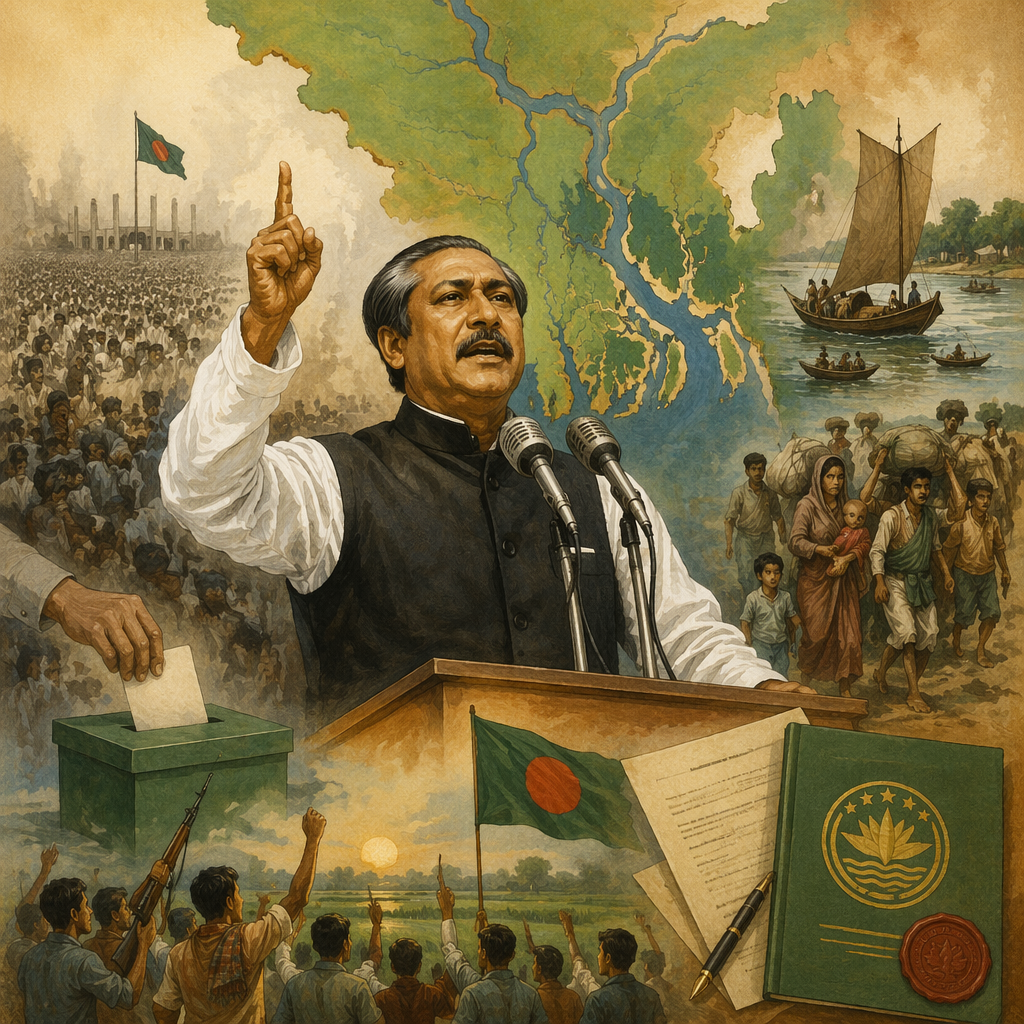
The 1970 election and the 1971 crisis are the hinge. Mujib's Awami League won a mandate, but the transfer of power failed. Military crackdown, mass violence, refugee flight, guerrilla resistance, Indian intervention, and Pakistani surrender turned a constitutional crisis into the Bangladesh Liberation War. Civilians, students, workers, women, refugees, soldiers, and survivors belong beside the leader because they carried the war's human reality.
The early Bangladesh years add necessary complexity. Mujib became founding leader in a country facing famine, displacement, destroyed infrastructure, political polarization, and the difficulty of turning liberation legitimacy into institutions. His later one-party turn and assassination show that founding authority did not automatically produce stable democratic rule.
The language movement gives the biography a deeper beginning. Bengali claims were not only cultural pride; they asked whether a state created in the name of Muslim unity could deny political equality to its eastern majority. Students, writers, families, newspapers, and public commemorations turned language into a claim about dignity, representation, and the right to be heard inside Pakistan.
Mujib's Six Point program also matters because it translated grievance into a constitutional design. Autonomy, revenue control, militia questions, and federal power were not abstract slogans in East Pakistan. They addressed uneven development, military dominance, cyclone response, resource extraction, and the feeling that votes from the east did not carry equal weight when national decisions were made.
The liberation war requires careful scale. Pakistani military violence, local collaboration and resistance, sexual violence, refugee camps in India, guerrilla organization, international diplomacy, and the experience of people who crossed borders under terror all shaped the meaning of independence. Mujib's imprisonment made him a symbol, but the war's reality was carried by millions who did not appear at negotiating tables.
After independence, the promise of a new republic ran into scarcity, trauma, party rivalry, administrative weakness, and competing visions of nationalism, socialism, secularism, and democracy. The 1974 famine, emergency politics, BAKSAL, military discontent, and the assassination of Mujib and much of his family show how quickly founding consensus can fracture when institutions are fragile.
Sheikh Mujibur Rahman helps connect individual action with wider historical change in Bangladesh. The biography works best when it keeps the surrounding world visible: authority, conflict, belief, reform, or discovery moved through decisions made under pressure.
The related events show how roles such as Bengali nationalist leader, Founding leader of Bangladesh can be read through dates, places, institutions, and consequences rather than through reputation alone. The biography explains why this person matters, while the linked events explain what changed around them.
A richer reading starts with the limits around the person. Some figures acted through offices, armies, courts, laboratories, churches, parties, ships, trade networks, or protest movements; others became important because later communities turned their lives into symbols. The page therefore asks what this person could actually change, what was already moving before them, and which consequences later readers attached to the name.
Read the biography against absence as well. Many lives around Sheikh Mujibur Rahman are less visible in the record: opponents, collaborators, family members, workers, soldiers, students, subjects, victims, translators, scribes, or local communities. Keeping those surrounding people in view makes the page less like a name card and more like an entry point into historical systems.
Sheikh Mujibur Rahman also works as a navigation point. Open the linked event pages to see where the biography becomes chronology, then use the topic routes to test whether the same pattern appears beyond one life. That extra step matters because historical importance is rarely contained inside a single decision; it usually spreads through institutions, witnesses, opponents, imitators, and later arguments over memory.
Sources and Method
Source method: read Mujib through the Bangladesh Liberation War, Pakistan's eastern wing, electoral crisis, refugee history, and early state-building. The page separates national founder memory from the wider social experience of war and postwar governance.
Evidence Notes
How Sensitive Claims Are Sourced
- 1
Mandate denied and crisis escalated
The biography links Mujib's leadership to the 1970 electoral mandate, Bengali autonomy demands, military refusal, and the escalation from constitutional conflict into war.
- 2
Liberation memory and state-building strain
The post-1971 frame keeps reconstruction, famine, party power, institutional fragility, and contested memory beside founder status.
Why This Person Matters
Sheikh Mujibur Rahman matters because the connected events make a larger historical pattern easier to follow. The page links biography to consequences so readers can move from a life story into the wider atlas, compare the person with contemporaries, and understand why later memory kept returning to this figure. Sheikh Mujibur Rahman matters because his life connects Bengali language politics, electoral mandate, liberation war, postcolonial sovereignty, and the difficulty of founding a state after mass violence. The biography helps readers see Bangladesh as more than a date of independence; it is a struggle over representation, memory, and government.
How did Mujib's leadership turn Bengali autonomy into statehood, and why did liberation legitimacy become so difficult to convert into stable government?
How to Read This Life
Sheikh Mujibur Rahman is easiest to understand when the biography is read beside Bangladesh Liberation War. Those events show the historical setting in motion: dates, places, institutions, conflict, and consequences give the life a structure that a short biography alone cannot provide.
The surrounding route crosses Postcolonial South Asia and locations such as East Pakistan. That matters because influence rarely stays inside one person. It moves through offices, armies, movements, laws, texts, speeches, institutions, and later memory.
A useful reading path starts with the role labels, then opens the event pages to see what changed, and finally compares this person with other actors facing similar pressures.
For readers who arrive on a biography first, this page is meant to become a doorway rather than a stop. Read one paragraph for the answer, then use the turning points, topic routes, and event links to test whether the person's reputation matches the wider evidence.
Read Mujib beside the Bangladesh Liberation War, Indian independence, decolonization, Cold War, and South Asia routes. That path shows how partition's afterlife produced new claims over language, representation, and sovereignty.
Then compare him with Gandhi, Nehru, Jinnah, Ho Chi Minh, Sukarno, and Nkrumah where available. The comparison asks how anti-colonial and postcolonial leaders moved from popular legitimacy into the harder work of governing.
Read Sheikh Mujibur Rahman through the roles of Bengali nationalist leader, Founding leader of Bangladesh rather than as reputation alone.
Place the biography inside Bangladesh and the wider events linked below.
Ask which choices were personal and which were constrained by institutions or crisis.
Follow how later memory simplified, contested, or reused this person's role.
Track Bengali identity, political representation, and the long afterlife of partition.
Keep civilians, refugees, students, women, soldiers, and survivors visible beside leaders.
Ask how a liberation movement becomes a state under famine, trauma, and institutional strain.
Legacy, Limits, and Memory
A useful biography keeps scale in view. Sheikh Mujibur Rahman mattered because individual choices met a wider structure: institutions, enemies, allies, audiences, technologies, beliefs, and inherited conflicts. The related event pages help separate personal agency from conditions that no single person controlled.
Memory is part of the biography too. Later readers often simplify a figure into a hero, villain, founder, reformer, conqueror, prophet, scientist, or symbol. Those labels can be helpful, but they become misleading when they hide conflict, compromise, exclusion, uncertainty, or the experiences of people outside the main biography.
For the next step, compare this life with a topic route rather than stopping at the name. If the same pattern appears across several figures, the reader has found a historical structure; if this person breaks the pattern, the contrast is usually where the most interesting question begins.
The main risk is letting founder reverence flatten the war. Mujib mattered deeply, but Bangladesh's independence was also made by voters, protesters, soldiers, refugees, women, students, diplomats, and civilians facing mass violence.
A second risk is ending the biography in victory. The new state inherited trauma, poverty, famine, institutional weakness, and political conflict that shaped Mujib's contested later rule.
Turning Points to Read Next
Bangladesh Liberation War
Bengali nationalists fought for independence after political crisis and military repression in East Pakistan, leading to the creation of Bangladesh.
Related Timeline
- 1971 CEBangladesh Liberation War
Bengali nationalists fought for independence after political crisis and military repression in East Pakistan, leading to the creation of Bangladesh.
References
Where to Check the Facts
- Encyclopaedia Britannica: Sheikh Mujibur RahmanBiographical reference for Mujibur Rahman's leadership and Bangladesh's independence movement.
- Encyclopaedia Britannica: Bangladesh Liberation WarReference for the 1971 war and creation of Bangladesh.