Historical Role
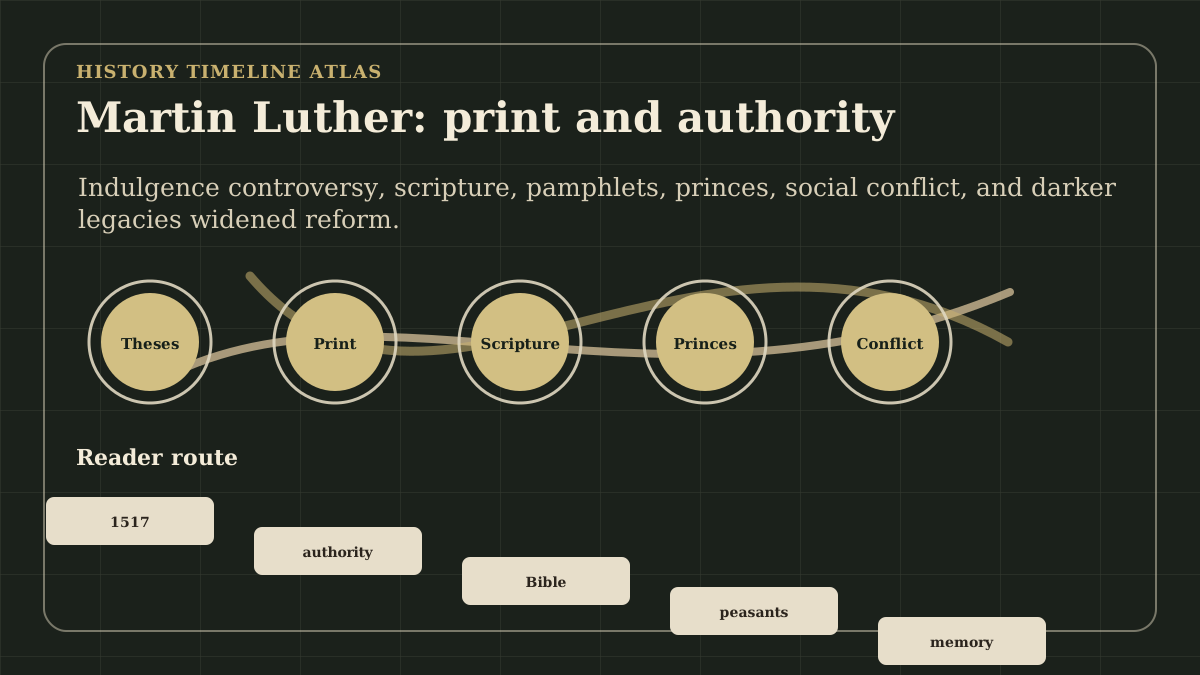
Martin Luther's biography begins with a crisis over authority: Who could define Christian truth, forgive sin, interpret scripture, discipline clergy, and decide whether a practice such as indulgence preaching was legitimate? The Ninety-Five Theses matter because they turned a theological dispute into a public controversy that print, universities, princes, and imperial politics could amplify.
Luther did not create dissatisfaction with the late medieval church out of nothing. Reform criticism, clerical abuses, humanist learning, local politics, and financial tensions were already present. His importance lay in giving those pressures a forceful theological and textual form, then refusing to back down when church and imperial authorities demanded recantation.
Printing changed the scale of the conflict. Pamphlets, translations, sermons, woodcuts, and vernacular argument let ideas move faster than older institutions could contain. Luther's German Bible translation became part of religious devotion and language formation, but the Reformation was never only a book project. It reshaped worship, education, marriage, political allegiance, and conflict.
The biography also needs the darker consequences. Reformation dispute contributed to polarization, iconoclasm, persecution, peasant revolt, princely consolidation, and long religious wars. Luther's writings against Jews and his response to the Peasants' War remain serious parts of the record, not side notes that can be hidden behind reform language.
A strong page keeps Luther central without making him the whole Reformation. Zwingli, Calvin, radical reformers, Catholic reformers, printers, princes, city councils, peasants, nuns, teachers, and ordinary worshipers all shaped the movement's outcomes. Luther opened a door, but the world that walked through it was larger than one monk.
The Diet of Worms gives the biography a concrete public scene. Luther's refusal to recant mattered because it placed conscience, scripture, imperial authority, church hierarchy, and political protection in direct conflict. The drama is famous, but the machinery around it is just as important: summons, examination, safe conduct, printing, and princely shelter.
The German Bible translation belongs to language and education as much as doctrine. Vernacular scripture helped readers encounter Christian teaching outside Latin clerical mediation, but it also required schools, printers, pastors, and households able to use the text. Reform was therefore textual and social at the same time.
A mature Luther page should keep consequences open. Some readers use him as a founder of religious freedom, but early Protestant worlds still disciplined belief, punished dissent, and tied religion to rulers. The question is not whether authority vanished; it is how authority moved.
Luther's conflicts also show how ideas need protection. Without sympathetic princes, urban allies, printers, and networks of readers, his theological challenge could have been silenced more quickly. The Reformation became durable because doctrine, politics, media, and local institutions reinforced one another.
Later Protestant memory needs to be kept distinct from Luther's own world. Modern readers may connect him to individual conscience or modernity, but Luther also lived inside a society of hierarchy, confessional discipline, apocalyptic fear, and harsh polemic. That tension makes the biography historically useful.
The biography becomes strongest when it follows institutions after controversy begins. Universities examined arguments, printers multiplied them, rulers protected or condemned them, households learned new devotional habits, and opponents forced sharper statements. Luther's importance rests in that chain from text to audience to institution, not in a private act of belief alone.
Martin Luther helps connect individual action with wider historical change in Early modern Europe. The biography works best when it keeps the surrounding world visible: authority, conflict, belief, reform, or discovery moved through decisions made under pressure.
The related events show how roles such as Reformer, Theologian can be read through dates, places, institutions, and consequences rather than through reputation alone. The biography explains why this person matters, while the linked events explain what changed around them.
A richer reading starts with the limits around the person. Some figures acted through offices, armies, courts, laboratories, churches, parties, ships, trade networks, or protest movements; others became important because later communities turned their lives into symbols. The page therefore asks what this person could actually change, what was already moving before them, and which consequences later readers attached to the name.
Read the biography against absence as well. Many lives around Martin Luther are less visible in the record: opponents, collaborators, family members, workers, soldiers, students, subjects, victims, translators, scribes, or local communities. Keeping those surrounding people in view makes the page less like a name card and more like an entry point into historical systems.
Martin Luther also works as a navigation point. Open the linked event pages to see where the biography becomes chronology, then use the topic routes to test whether the same pattern appears beyond one life. That extra step matters because historical importance is rarely contained inside a single decision; it usually spreads through institutions, witnesses, opponents, imitators, and later arguments over memory.
Sources and Method
Source trail: the page uses Luther biography references, Reformation event sources, and Religion / Reform / Ideas route material.
Method note: the biography separates theological argument, print culture, political protection, social consequences, and later Protestant memory.
Evidence Notes
How Sensitive Claims Are Sourced
Why This Person Matters
Martin Luther matters because the connected events make a larger historical pattern easier to follow. The page links biography to consequences so readers can move from a life story into the wider atlas, compare the person with contemporaries, and understand why later memory kept returning to this figure.
What happens when a dispute over salvation becomes a dispute over media, law, language, and political authority?
How to Read This Life
Martin Luther is easiest to understand when the biography is read beside Protestant Reformation Begins. Those events show the historical setting in motion: dates, places, institutions, conflict, and consequences give the life a structure that a short biography alone cannot provide.
The surrounding route crosses Early Modern World and locations such as Wittenberg. That matters because influence rarely stays inside one person. It moves through offices, armies, movements, laws, texts, speeches, institutions, and later memory.
A useful reading path starts with the role labels, then opens the event pages to see what changed, and finally compares this person with other actors facing similar pressures.
For readers who arrive on a biography first, this page is meant to become a doorway rather than a stop. Read one paragraph for the answer, then use the turning points, topic routes, and event links to test whether the person's reputation matches the wider evidence.
Read Luther beside the Reformation, the printing press, and the Thirty Years' War. That path keeps ideas, media, and violence in one frame.
Then compare with Galileo, Muhammad, Confucius, and Enlightenment figures. The comparison asks how texts, institutions, and authority disputes reshape public life.
Read Martin Luther through the roles of Reformer, Theologian rather than as reputation alone.
Place the biography inside Early modern Europe and the wider events linked below.
Ask which choices were personal and which were constrained by institutions or crisis.
Follow how later memory simplified, contested, or reused this person's role.
Track pamphlets, translations, sermons, and woodcuts as engines of controversy.
Ask who could define doctrine, discipline, and legitimate reform.
Keep reform, coercion, social conflict, and religious violence in the same story.
Legacy, Limits, and Memory
A useful biography keeps scale in view. Martin Luther mattered because individual choices met a wider structure: institutions, enemies, allies, audiences, technologies, beliefs, and inherited conflicts. The related event pages help separate personal agency from conditions that no single person controlled.
Memory is part of the biography too. Later readers often simplify a figure into a hero, villain, founder, reformer, conqueror, prophet, scientist, or symbol. Those labels can be helpful, but they become misleading when they hide conflict, compromise, exclusion, uncertainty, or the experiences of people outside the main biography.
For the next step, compare this life with a topic route rather than stopping at the name. If the same pattern appears across several figures, the reader has found a historical structure; if this person breaks the pattern, the contrast is usually where the most interesting question begins.
The Reformation should not read like a straight march toward modern freedom. It produced new authorities as well as challenges to old ones.
Luther's anti-Jewish writings and stance during the Peasants' War are historically important and morally serious. They should remain visible in any fuller treatment.
Print mattered because it connected doctrine to audience. Without readers, printers, patrons, and opponents, a thesis list would not have become a European crisis.
That is why Luther belongs on media, religion, education, social conflict, and political-authority routes at once, not only on a church-history shelf.
Turning Points to Read Next
Protestant Reformation Begins
Martin Luther's challenge to indulgences became a wider dispute over authority, salvation, scripture, and church power in western Christianity.
Related Timeline
- 1517 CEProtestant Reformation Begins
Martin Luther's challenge to indulgences became a wider dispute over authority, salvation, scripture, and church power in western Christianity.
References
Where to Check the Facts
- Encyclopaedia Britannica: Martin LutherBiographical reference for Martin Luther's life dates, roles, institutions, and historical setting.
- Encyclopaedia BritannicaBackground reference for chronology, names, and historical context.
- WikidataStructured reference for dates, places, alternate names, and entity links.